

Ghunnah is the nasal sound you hear when reciting certain forms of noon and meem in the Quran. The sound seems simple, yet beginners often hold it where they should read clearly or rush through a place that needs a measured pause. This guide explains what ghunnah means in English and Arabic, where the sound forms, which Tajweed rules call for a clear nasal hold, and how four teaching levels compare. You will also see Quran examples that you can check while you practice.
What Ghunnah Means in Tajweed
Ghunnah is the nasal resonance naturally associated with Arabic noon and meem. Tajweed teaches a clear, measured hold for that sound in specific recitation conditions.
If you hear a reciter briefly sustain a gentle hum, you hear ghunnah. The sound travels through the nasal passage without adding a letter or vowel.
Ghunnah names both a natural quality of noon and meem and an audible hold in particular rules. Every noon and meem carries some nasal resonance, but not every one needs two counts.
Ghunnah Meaning in English and Arabic
The Arabic term غُنَّة (ghunnah) is commonly explained in English as a nasal sound or nasal resonance. In Tajweed, the rules for correct Quranic pronunciation and recitation, the term refers to the sound associated with ن (noon) and م (meem). Some teachers describe the sound as a gentle hum. That comparison helps you locate the resonance, but you still need to pronounce the Arabic letter accurately.
Ghunnah is a sound quality, not a third letter. The letter’s mark and its neighbor decide when the nasal sound needs a hold.
If you are new to Tajweed terms, start with our guide to beginner Tajweed rules with examples. Ghunnah becomes easier to recognize when you see how silent noon, doubled letters, and other rules fit together.
Nasal Quality Versus a Two-Count Hold
A count is a steady recitation beat, not a fixed number of seconds. Teachers often introduce a clear ghunnah as a two-count sound. The count gives you a practical rhythm for doubled noon or meem and for several concealment and merging rules. Your recitation pace should remain even, so the hold does not suddenly become much longer than the surrounding sounds.
The natural nasal quality of an ordinary, voweled noon or meem is different. For example, a noon with a short vowel should sound like a proper noon, not like a prolonged hum. A clear noon before a throat letter also keeps the letter distinct. For both cases, adding an obvious two-count nasal hold would change the reading.
The rule changes how prominent ghunnah sounds. Written counts guide practice; listening and reciting aloud establish the distinction.
Ghunnah Letters in Arabic and Where the Sound Forms
The two ghunnah letters are noon (ن) and meem (م). Their nasal resonance comes through the nasal passage while the mouth forms each letter.
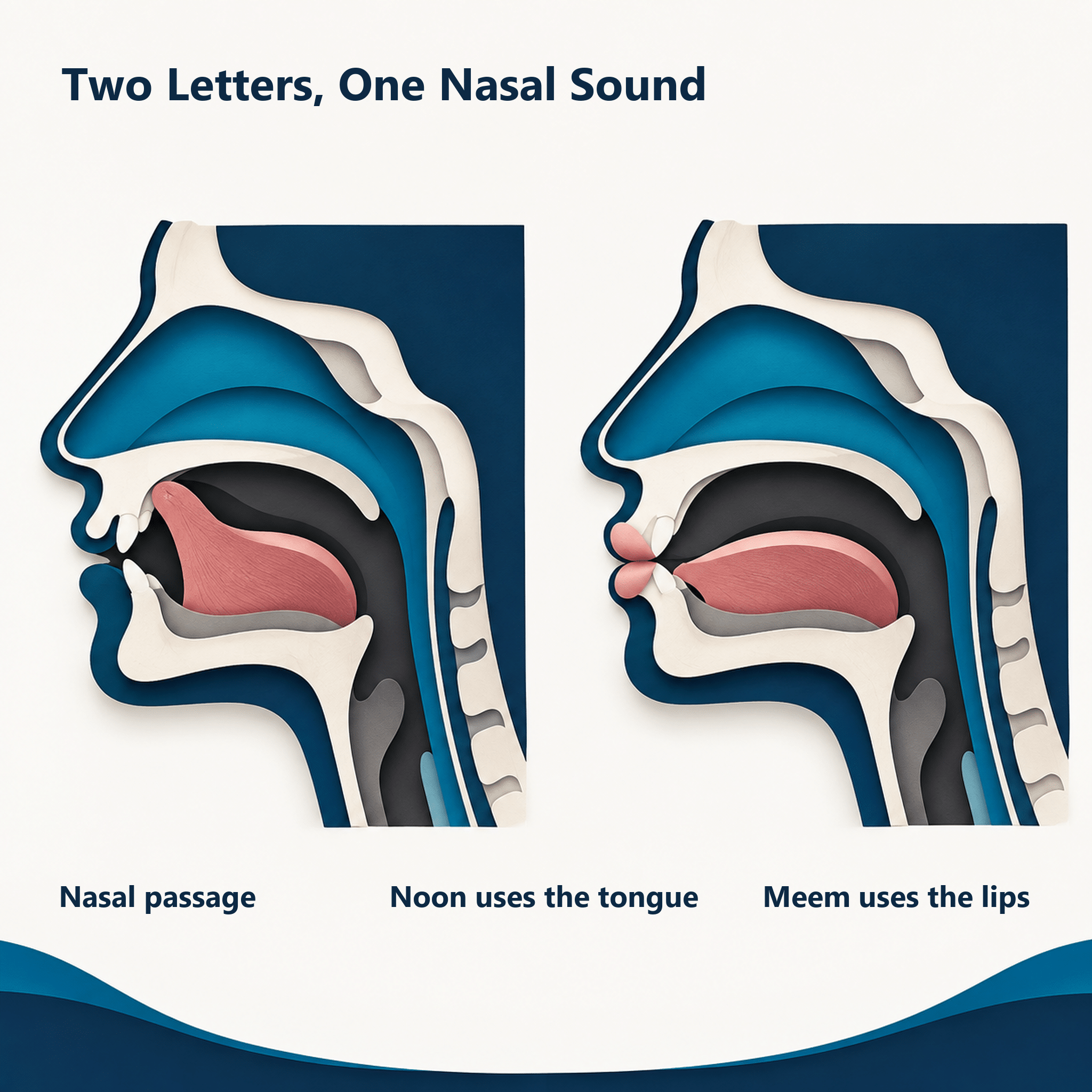
The nasal passage is called al-khayshum (الخَيْشُوم) in Tajweed. Air passing through that passage creates the resonant part of the sound. Meanwhile, the tongue or lips shape the consonant that you are reciting. A beginner should notice both parts: the letter itself and its nasal quality.
Noon ن and Meem م
For noon, the tongue tip meets the area behind the upper front teeth. The nasal passage carries part of the sound. For meem, the lips meet and the nasal passage carries the sound while the mouth is closed. These are two different letters, even though both have ghunnah.
A doubled noon still needs a recognizable noon; a doubled meem needs a recognizable meem. Avoid turning both into the same vague hum.
The Arabic spelling helps. نّ (noon with shaddah) and مّ (meem with shaddah) show a doubled letter. A shaddah (ّ) is the mark that indicates doubling. نْ (noon sakinah) and مْ (meem sakinah) carry sukoon (ْ), the mark for no short vowel. A silent noon or meem needs the following letter to identify the next Tajweed rule.
The Nasal Passage and the Mouth
Hum gently, then say a clear noon and a clear meem. Notice the nasal resonance and the different tongue and lip positions. The exercise locates the sound, not its timing.
Avoid squeezing the nose or forcing air through it. Ghunnah is a controlled part of the voice, not a strained noise. Pressing your lips too hard on a concealed meem can also make the letter too obvious. The exact mouth action depends on whether meem is clear, merged into another meem, or hidden before baa.
Our guide to the articulation points of Arabic letters shows where noon, meem, and the nasal passage fit. A teacher can then check your timing.
When Ghunnah Appears in Tajweed Rules
The rule family decides when nasal quality becomes an audible hold. Spot a shaddah, silent noon, tanween ending, or silent meem. Then check the next letter.
Tanween is a doubled vowel ending that produces an n sound when connected. Idgham means merging; ikhfa means concealment with retained nasal quality. Iqlab changes a silent noon or tanween into a concealed meem sound before ب (baa).
| Trigger | Rule or reading | What you do | Quran example |
|---|---|---|---|
| Noon or meem with shaddah | Doubled noon or meem | Sustain the nasal sound for a measured two counts | عَمَّ in 78:1 |
| Noon sakinah or tanween before ي، ن، م، و across words | Idgham with ghunnah | Merge into the following letter while retaining ghunnah | مَن يَقُولُ in 2:8 |
| Noon sakinah or tanween before an ikhfa letter | Ikhfa haqiqi | Conceal the noon sound and retain ghunnah | مِن شَرِّ in 114:4 |
| Noon sakinah or tanween before ب | Iqlab | Change the noon sound to a concealed meem with ghunnah | مِنۢ بَعْدِ in 2:27 |
| Meem sakinah before م | Idgham shafawi | Merge the two meems with ghunnah | أَطْعَمَهُم مِّن in 106:4 |
| Meem sakinah before ب | Ikhfa shafawi | Conceal the meem and retain ghunnah | تَرْمِيهِم بِحِجَارَةٍ in 105:4 |
The table helps you recognize triggers. The next letter affects how the sound joins or remains concealed, so practice with a recitation.
Doubled Noon and Meem
A shaddah on noon or meem gives beginners the clearest starting point. In إِنَّ (inna), the noon is doubled. In عَمَّ (amma), the meem is doubled. Hold the nasal part with a steady rhythm, then release into the next sound without adding an extra vowel.
The shaddah is a dependable clue. Rushing loses the measured sound; stretching too long disrupts the phrase. An ordinary noon or meem does not take the same hold.
Noon Sakinah and Tanween
A silent noon, written نْ, or a tanween ending takes different readings depending on the next letter. Before ي، ن، م، و, the relevant rule is idgham with ghunnah. Those four letters trigger the merging pattern, although ن and م remain the two letters that inherently carry ghunnah. Do not call ي and و additional ghunnah letters.
Before an ikhfa letter, the noon is concealed rather than pronounced with a firm tongue contact. The nasal sound remains audible as the reciter prepares the following letter. Before ب, iqlab changes the noon or tanween sound into a concealed meem. Our separate guide explains the iqlab rule in more detail.
Idgham is not always nasal. When a silent noon or tanween meets ل (lam) or ر (raa) across words, the rule is idgham without a prolonged ghunnah. The noon merges into the following letter, but you should not insert a two-count hum. The contrast is useful: two situations may both be called idgham, yet their sound treatment differs.
Meem Sakinah
A silent meem, مْ, also changes with the next letter. Before another م, the two meems merge in idgham shafawi, with a measured ghunnah. Before ب, ikhfa shafawi conceals the meem while retaining nasal resonance. Shafawi means “of the lips,” reminding you that the underlying meem is a lip letter.
Before most other letters, meem sakinah is clear, without a prolonged hold. In ikhfa shafawi, avoid pressing the lips fully closed throughout the nasal interval.
When a Long Ghunnah Is Not Added
The two most useful contrasts are izhar and idgham without ghunnah. Izhar means clear pronunciation. A silent noon or tanween before one of the six throat letters ء، ه، ع، ح، غ، خ is pronounced clearly. The normal nasal quality of noon remains, but the beginner should not manufacture a long humming interval.
Likewise, a clear silent meem remains distinct. “No ghunnah” in a beginner chart usually means “no deliberate, prolonged ghunnah.” The letter’s inherent nasal quality remains.
The Four Levels of Ghunnah
One common Tajweed chart ranks ghunnah from most complete to most incomplete across doubled, concealed, clear, and voweled noon or meem. These ranks describe audible strength and duration.
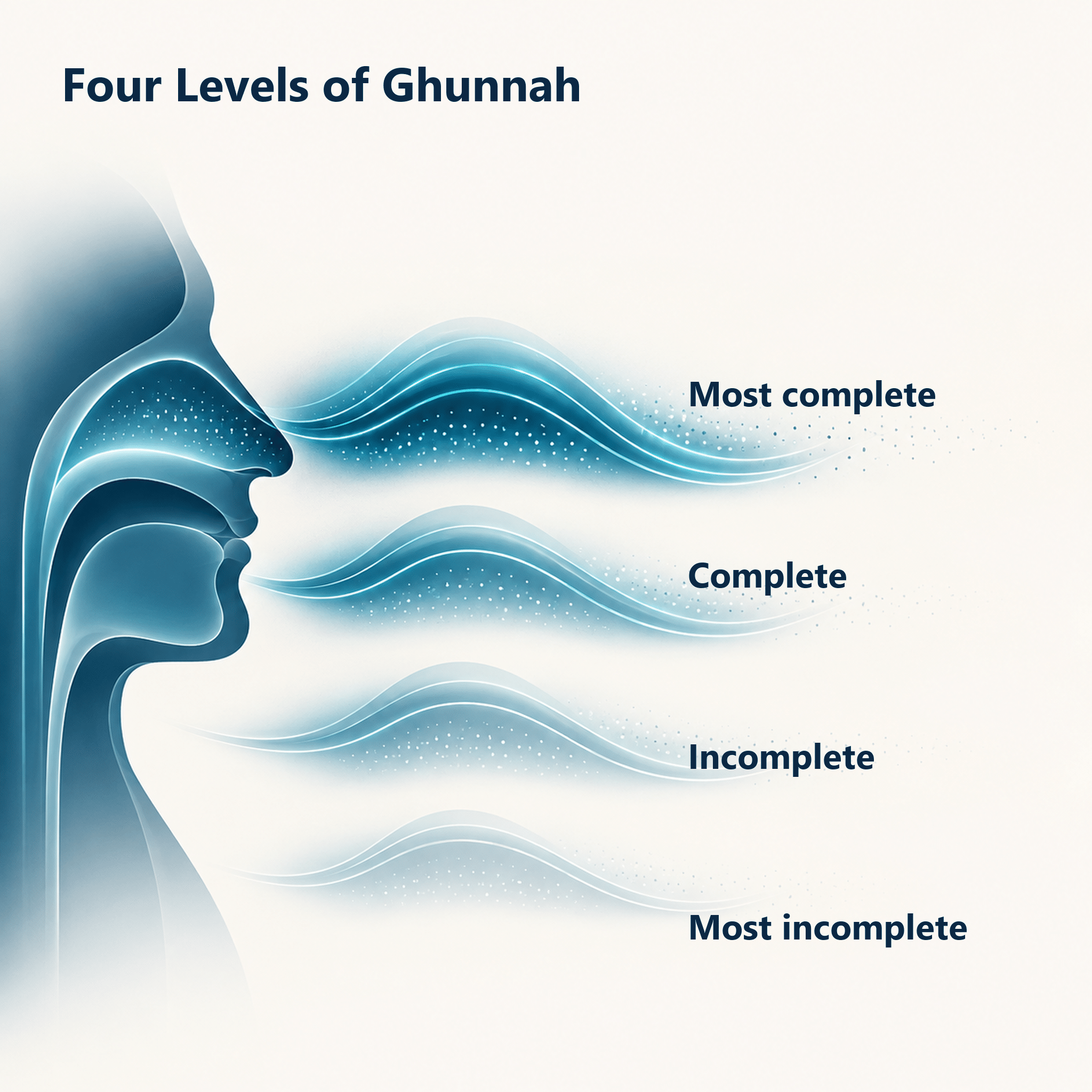
The levels help explain why one rule sounds more prominent than another. They are not a request to assign four different stopwatch times. In ordinary beginner practice, pay closest attention to where the sound is clearly held and where the letter is simply pronounced without an added hold.
| Level | Typical condition | What you hear | Beginner caution |
|---|---|---|---|
| Most complete | Doubled noon or meem; merging with ghunnah | Strongest, clearest sustained nasal quality | Do not add a vowel after the hold |
| Complete | Concealed noon or meem in ikhfa | Clear nasal quality while the letter is hidden | Do not pronounce a full, separate noon first |
| Incomplete | Clear silent noon or meem | Natural nasal quality within a distinct consonant | Do not hold for two counts |
| Most incomplete | Voweled noon or meem | Brief, inherent nasal quality | Do not turn an ordinary syllable into a hum |
The order is a learning aid. The difference between neighboring ranks can be subtle, particularly at a natural recitation pace. Listen for the broad contrast between a deliberate hold and an ordinary consonant before trying to fine-tune the smallest differences.
Why Some Teachers Describe Five Levels
You may see a five-level chart in another Tajweed lesson. One scholarly commentary explains that its base text names four levels, while later teachers add a separate fifth level for voweled noon and meem. Other four-level lessons group the conditions differently. The number therefore reflects how a teacher divides the same pronunciation situations.
The practical rule does not change: identify the letter and the surrounding marks, then apply the proper reading. A five-level diagram should not persuade you to prolong every noon and meem. Likewise, the four-level diagram above does not erase the natural nasal quality from clear or voweled forms.
If you study with a teacher, follow the teacher’s terminology for the chart. Ask the teacher to demonstrate one example from each rank. Hearing the contrast is more useful than memorizing a label without a sound attached to it.
Ghunnah Examples From the Quran
Short passages show how ghunnah changes across rules. Read each phrase in context and listen to the verse, because a written example shows the trigger but cannot reproduce the sound. The Arabic below follows the cited Quran verses; transliteration is only a rough reading aid.
A Doubled Meem in Surah An-Naba
In عَمَّ يَتَسَاءَلُونَ (amma yatasā’alūn), An-Naba 78:1, the first word contains مّ, a meem with shaddah. Let the lips form meem and sustain the nasal sound for a measured two counts. Then move into the next vowel without adding another syllable between the doubled meem and the rest of the word.
Follow the printed مّ while listening. Keep the sound smooth rather than repeating separate m sounds.
Merging and Concealment Across Words
In مَن يَقُولُ (man yaqūlu), Al-Baqarah 2:8, the silent noon at the end of مَن meets ي at the start of the next word. That meeting calls for idgham with ghunnah. Rather than finishing a hard, fully released n and starting a separate y, let the sound merge while the nasal resonance remains for the taught count.
In مِن شَرِّ (min sharri), An-Nas 114:4, the silent noon meets ش (sheen). This is ikhfa: the noon is concealed, but the ghunnah is heard before sheen. The sound should not become a fully pronounced n followed by a pause. Prepare the mouth for sheen while allowing the nasal resonance to carry the transition.
Both phrases begin with a silent noon. The next letter changes the rule. Compare their recordings; English transliteration cannot show the difference.
Iqlab Before Baa
In مِنۢ بَعْدِ (min baʿdi), Al-Baqarah 2:27, a silent noon meets ب (baa). Iqlab changes the noon sound into a concealed meem with ghunnah before baa. Some Quran printings show a small meem mark as an additional reading cue. You should hear a nasal transition, not a sharply released n before the b.
Surah Quraysh gives a compact comparison. In أَطْعَمَهُم مِّن جُوعٍ (aṭʿamahum min jūʿin), Quraysh 106:4, the meem at the end of أَطْعَمَهُم meets the next meem. That is meem-to-meem idgham with ghunnah. Later, the noon of مِنْ meets ج, giving ikhfa. The two nasal passages occur for different reasons within one short verse.
Read beyond each isolated pair so the phrase keeps its natural flow. Stopping after the first word changes a cross-word rule. A teacher can demonstrate where to connect or pause.
How to Practice Ghunnah and Check Common Mistakes
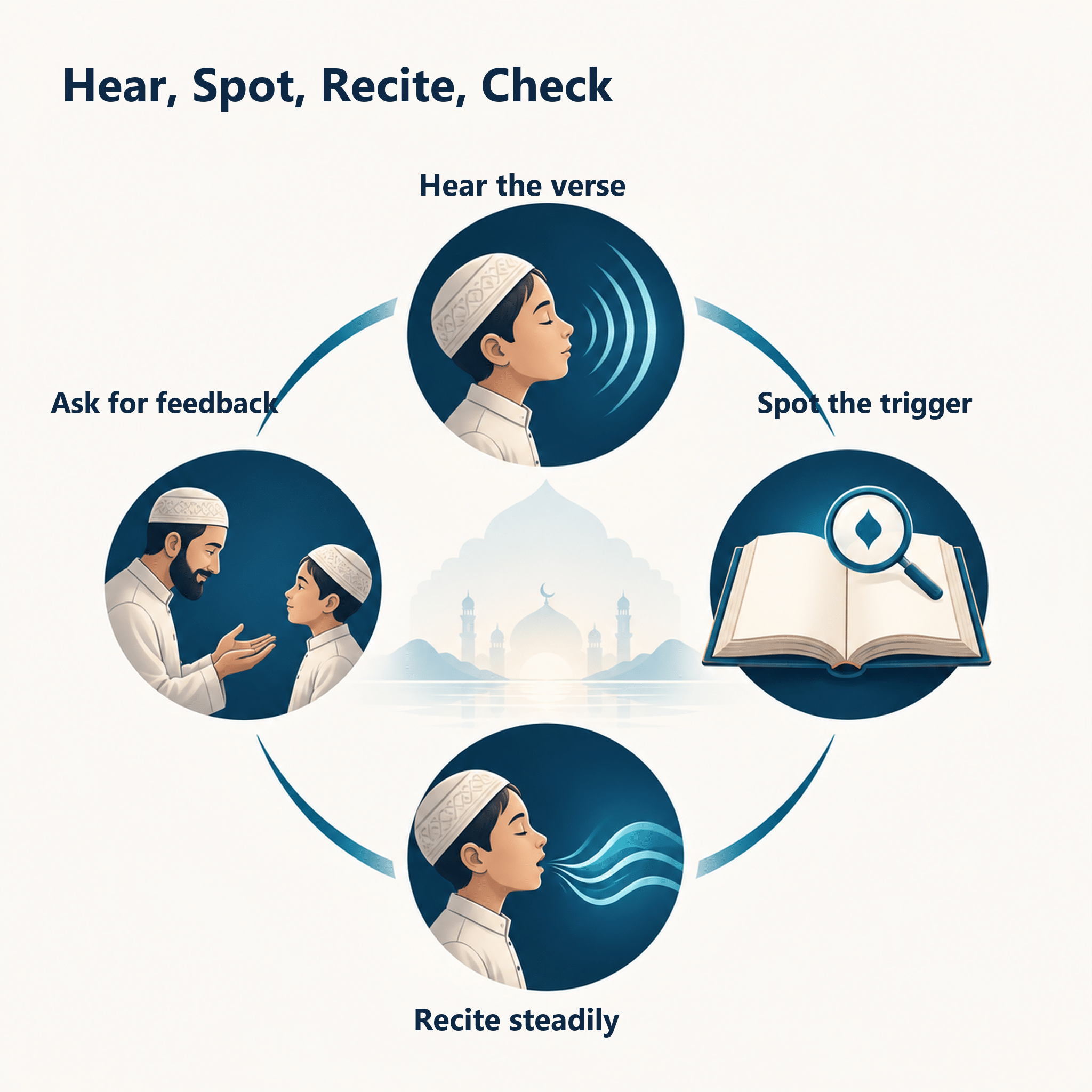
Practice ghunnah by finding the trigger in a short verse, listening to a reliable reciter, repeating at a steady pace, and asking a teacher to check your sound.
Start with a doubled noon or meem, where the shaddah is easy to spot. Then compare clear, merged, and concealed readings without trying to learn every rule at once.
A Short Listening and Recitation Routine
Use one short Quran passage for the following practice sequence.
- Hear the verse. Listen once without reciting. Notice where the nasal sound is clearly held.
- Spot the trigger. Find the shaddah, silent noon, tanween, or silent meem. Check the next letter when the rule depends on it.
- Recite steadily. Read the full phrase aloud at a comfortable pace. Keep the counted hold proportionate to the rest of your recitation.
- Ask for feedback. Let a qualified teacher hear the phrase and point out the exact letter or transition that needs attention.
Repeat the corrected phrase before moving on. Recordings help you listen; a teacher hears what your voice is actually doing.
Mistakes to Notice Early
The first mistake is giving every noon or meem an obvious two-count hum. The letters always have nasal quality, but a pronounced hold belongs only in its proper context. Compare a voweled noon with a doubled noon and ask whether the two sounds are truly different.
The second mistake is replacing ghunnah with a throat sound or a strained buzz. Keep the voice relaxed and the passage connected. Briefly noticing how pinching the nostrils changes a nasal sound helps locate the resonance. Do not pinch your nose while practicing a full verse; the test interrupts normal recitation.
The third mistake is losing the next letter. In ikhfa, prepare the mouth for the letter after the concealed noon. In iqlab, prepare for baa. In meem-to-meem idgham, let the two meems join without creating an extra vowel. Small transitions carry the rule, so slowing down briefly can reveal where the problem begins.
If you want personal correction, explore our online Tajweed course. Live recitation practice gives a tutor the chance to hear your noon, meem, and transitions, then help you focus on one sound at a time. We recommend that kind of feedback when the written rule makes sense but the sound still feels uncertain.
Frequently Asked Questions About Ghunnah
What does ghunnah mean in English?
Ghunnah means a nasal sound or nasal resonance. In Tajweed, the term describes a sound quality associated with noon and meem. A teacher may also use ghunnah to refer to the measured, audible hold required in specific recitation rules.
Which Arabic letters have ghunnah?
The two letters are ن (noon) and م (meem). Their sound includes natural nasal resonance. Other letters can trigger a rule in which ghunnah is heard, but that does not make those other letters inherent ghunnah letters.
Is ghunnah always held for two counts?
No. Two counts is a practical guide for a clear, prolonged ghunnah, such as a doubled noon or meem and several concealment or merging cases. An ordinary voweled noon or meem is not given the same deliberate hold.
Are yaa and waw ghunnah letters?
No. ي (yaa) and و (waw) can trigger idgham with ghunnah after a silent noon or tanween across words. The two letters with inherent ghunnah remain noon and meem.
What is the difference between ghunnah and idgham?
Ghunnah is the nasal sound quality. Idgham is a rule that merges one sound into the next. Some idgham cases retain a clear ghunnah; idgham before lam or raa does not call for a prolonged nasal hold.
Ghunnah becomes manageable when you connect the sound to a visible trigger. Begin with نّ and مّ, then use the following letter to recognize the silent-noon and silent-meem rules. Keep the sound measured, and compare your recitation with a reliable model. When you want someone to hear your pronunciation and guide the next correction, start a free trial with Hekma Academy.