

Types of Hadith become much clearer when readers see that scholars classify the same narration from several angles. The familiar four types describe authenticity. Other labels describe who a report is attributed to, whether its chain is connected, and how widely the report traveled. This guide explains what Hadith means, why some sources say four types while others say five, and how to handle a Hadith quotation with care.
What Is Hadith?
A Hadith is a transmitted report about Prophet Muhammad’s ﷺ words, actions, approvals, or qualities. Scholars examine each report’s chain and text before judging reliability.
Hadith is the singular and collective English term for reports connected to Prophet Muhammad ﷺ. A report may preserve something the Prophet ﷺ said, an action Companions observed, an approval of a practice, or a description of his character. Muslims study authenticated reports to understand the Prophet’s example, known as the Sunnah.
The Sunnah and Hadith are closely connected, but the words do not mean exactly the same thing. The Sunnah is the Prophet’s normative way and guidance. A Hadith is a report through which scholars identify and study that guidance. A full difference between Hadith and the Quran helps place both sources in their proper relationship.
Isnad and Matn
Every Hadith has two central parts. The isnad is the chain of people who passed the report from one narrator to another. The matn is the reported wording or content. A scholar cannot responsibly judge a Hadith from an attractive quotation card alone because the quotation card often omits both the chain and the original source.
The structure matters because a beautiful sentence is not automatically a Prophetic statement. Hadith scholars trace available routes, examine the people in each chain, compare versions of the wording, and look for irregularities or hidden problems. An Oxford Academic overview of Hadith describes the isnad and matn as the two basic parts of a report.
Hadith and Sunnah
In everyday conversation, Muslims often use Hadith and Sunnah interchangeably. The distinction still helps beginners. A verified Hadith provides evidence about the Prophet’s Sunnah. A weak or fabricated report cannot safely define the Prophet’s Sunnah, even when the reported message sounds inspiring.
Why Do Some Sources Say Four Types and Others Say Five?
Four usually refers to authenticity grades. Five may refer to broader classification lenses or to a system that separates weak and very weak reports.
The phrase “types of Hadith†does not name one fixed master list. Classical Hadith terminology contains many categories because scholars ask several different questions about a narration. One label may describe the report’s reliability. Another label may describe where the report ends. A third label may describe how many people transmitted the report.
The search for 4 types of Hadith usually seeks four authenticity grades:
- Sahih
- Hasan
- Da’if
- Mawdu’
Those four labels are useful because authenticity is the question most readers meet first. A grade helps a reader understand whether scholars accept a report as evidence, treat the report cautiously, or reject the attribution.
The search for What are the 5 types of Hadith? needs a more careful answer. One common teaching framework groups classification into five broad lenses:
- Who a report is attributed to.
- Whether the chain is connected.
- How widely the report was transmitted.
- Features or defects in the chain and text.
- Narrator reliability and the resulting authenticity judgment.
Some writers use a different five-part answer and separate very weak reports from weak reports. Neither approach makes five a universal total. The important lesson is that a narration can carry several labels at once. A report may be Marfu’ because the report reaches the Prophet ï·º, Ahad because the report has limited transmission routes, and Sahih because the report meets authenticity conditions.
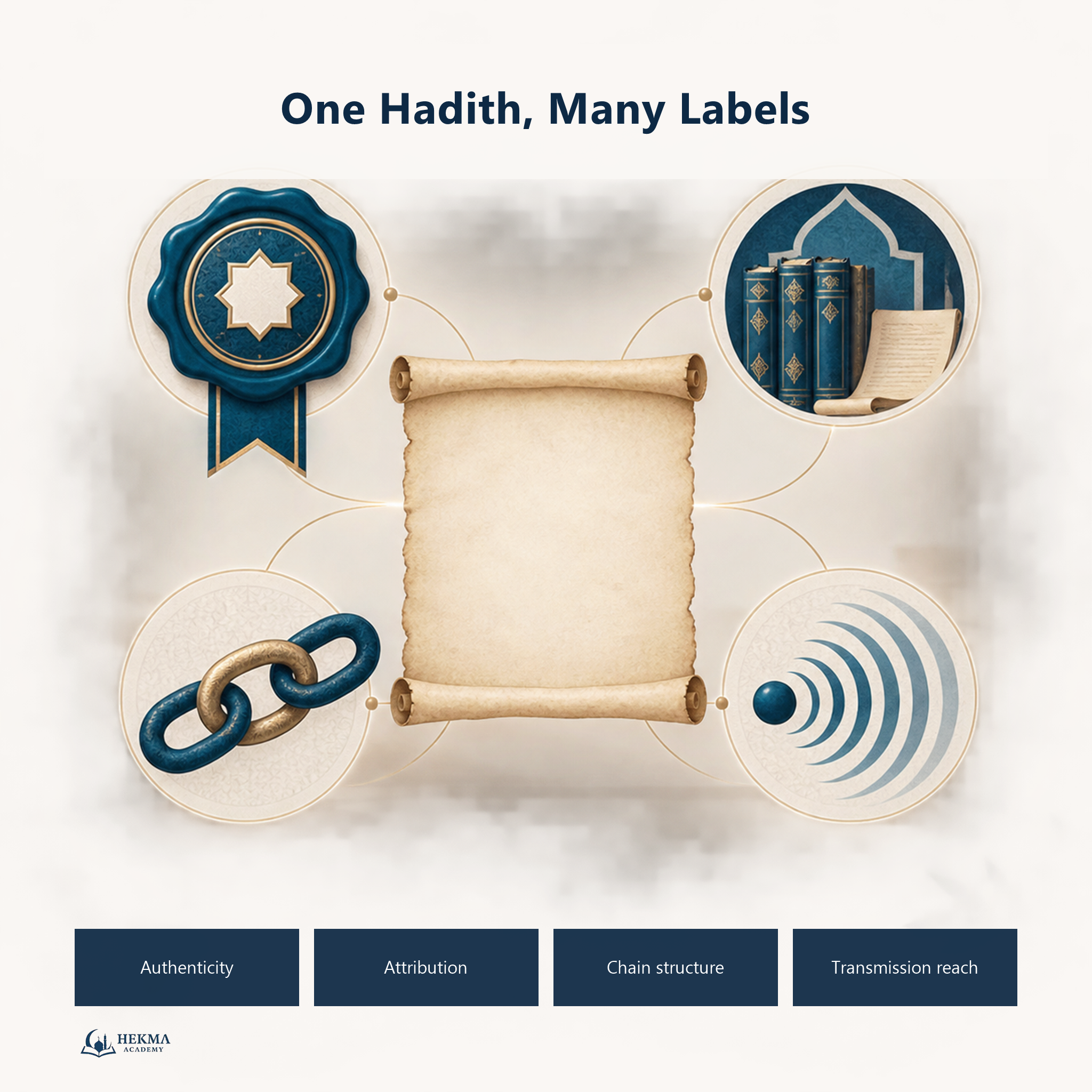
The multi-label approach protects beginners from a common mistake. An Ahad report is not automatically weak, and a Marfu’ report is not automatically sound. Each label answers a different question. Learners who want patient guidance through terms such as isnad, matn, and Sunnah can explore Hekma Academy’s online Islamic courses.
The Four Types of Hadith by Authenticity
By authenticity, the four familiar types are Sahih, Hasan, Da’if, and Mawdu’. The categories range from accepted reports to weak or fabricated material.
Authenticity asks how strongly a report can be attributed to the Prophet ï·º or another early authority. Scholars study chain continuity, narrator integrity, narrator precision, comparison with stronger routes, and hidden defects. The four familiar grades give beginners a useful first map, even though Hadith specialists use many finer distinctions.
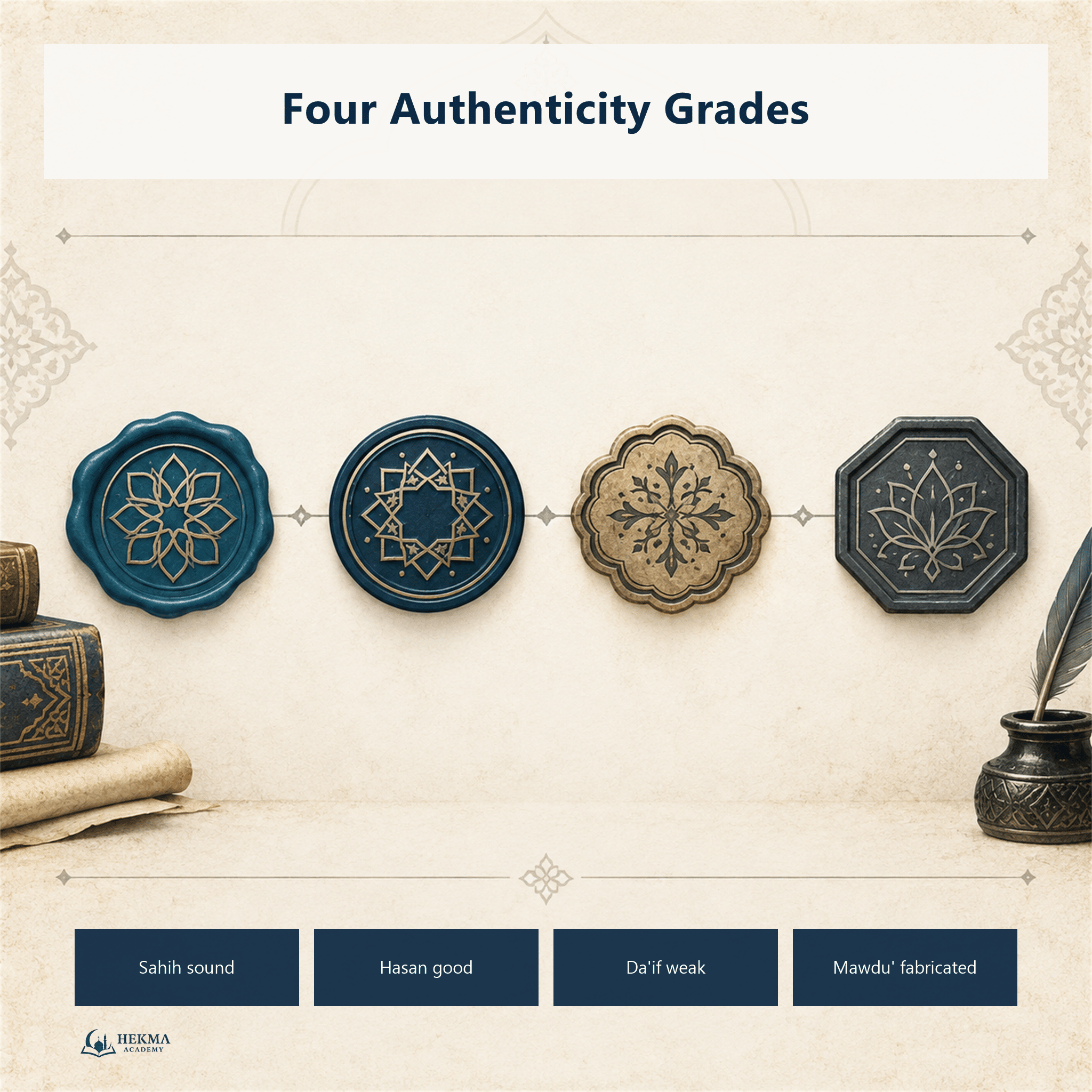
| Grade | Plain meaning | What scholars examine | Beginner practice note |
|---|---|---|---|
| Sahih | Sound | A connected chain, reliable and precise narrators, and no serious irregularity or hidden defect | Treat the report as accepted evidence, while still reading context and scholarly interpretation |
| Hasan | Good | The report broadly meets Sahih conditions, with a lower level of narrator precision | Treat the report as accepted evidence in mainstream Sunni Hadith terminology |
| Da’if | Weak | One or more conditions for Sahih or Hasan are not met | Do not build creed or independent legal conclusions on the report |
| Mawdu’ | Fabricated | The report is judged falsely attributed | Never share the report as Prophetic speech except when warning that the attribution is false |
Sahih Hadith
Sahih means sound. A Sahih report has a connected chain of transmission. The narrators are known for uprightness and careful preservation. The report is also free from serious contradiction of stronger evidence and from a hidden defect that changes the judgment.
Sahih is often translated as authentic, but the label does not give every reader permission to extract a legal ruling without context. Scholars also study language, related Quranic evidence, other narrations, and established legal principles. Authentication and interpretation are connected tasks, but authentication is not the whole task.
Hasan Hadith
Hasan means good. A Hasan report meets the broad conditions of acceptance, but a narrator’s precision is lower than the precision expected for Sahih. The difference does not make Hasan reports spiritually decorative or legally useless. Mainstream Sunni Hadith scholarship generally accepts both Sahih and Hasan reports as evidence.
The distinction teaches a valuable habit. Reliable evidence has levels. A sound report and a good report are both accepted, while scholars still recognize differences in strength.
Da’if Hadith
Da’if means weak. The weakness may result from a missing link, a narrator whose preservation was insufficient, an unclear connection between narrators, or another defect. Da’if does not automatically mean that the report is a deliberate lie. A weak report means that the available evidence does not meet the conditions required for Sahih or Hasan.
Scholars have differed over using some weak reports for virtues of good deeds, exhortation, and similar subjects. The disagreement comes with conditions and does not turn weak reports into a basis for creed or legal rulings. A beginner should avoid turning a weak report into a command, prohibition, or firm statement about Allah and the Prophet ï·º.
Mawdu’ Hadith
Mawdu’ means fabricated. A fabricated report is not merely a report with a weak memory in one chain. A fabricated report is judged falsely attributed to the Prophet ï·º. Scholars compiled works on fabrications so later readers could recognize false attributions and protect the Prophet’s legacy.
The distinction between Da’if and Mawdu’ is especially important when a family member receives a viral quotation. A weak report needs cautious handling. A known fabrication must not be passed on as a Hadith.
The Five Main Ways Scholars Classify Hadith
The five-lens framework answers the question behind many “five types†searches. Each lens asks something different about the same narration.
| Classification lens | Question the lens asks | Sample labels |
|---|---|---|
| Attribution | Who is the report traced to? | Marfu’, Mawquf, Maqtu’ |
| Chain continuity | Is the isnad complete or interrupted? | Muttasil, Mursal, Munqati’ |
| Transmission reach | How widely did the report travel? | Mutawatir, Ahad, Mashhur |
| Chain and text features | Does the route or wording show a special feature or problem? | Mudraj, Shadh, Mu’allal |
| Authenticity | How reliable is the attribution? | Sahih, Hasan, Da’if, Mawdu’ |
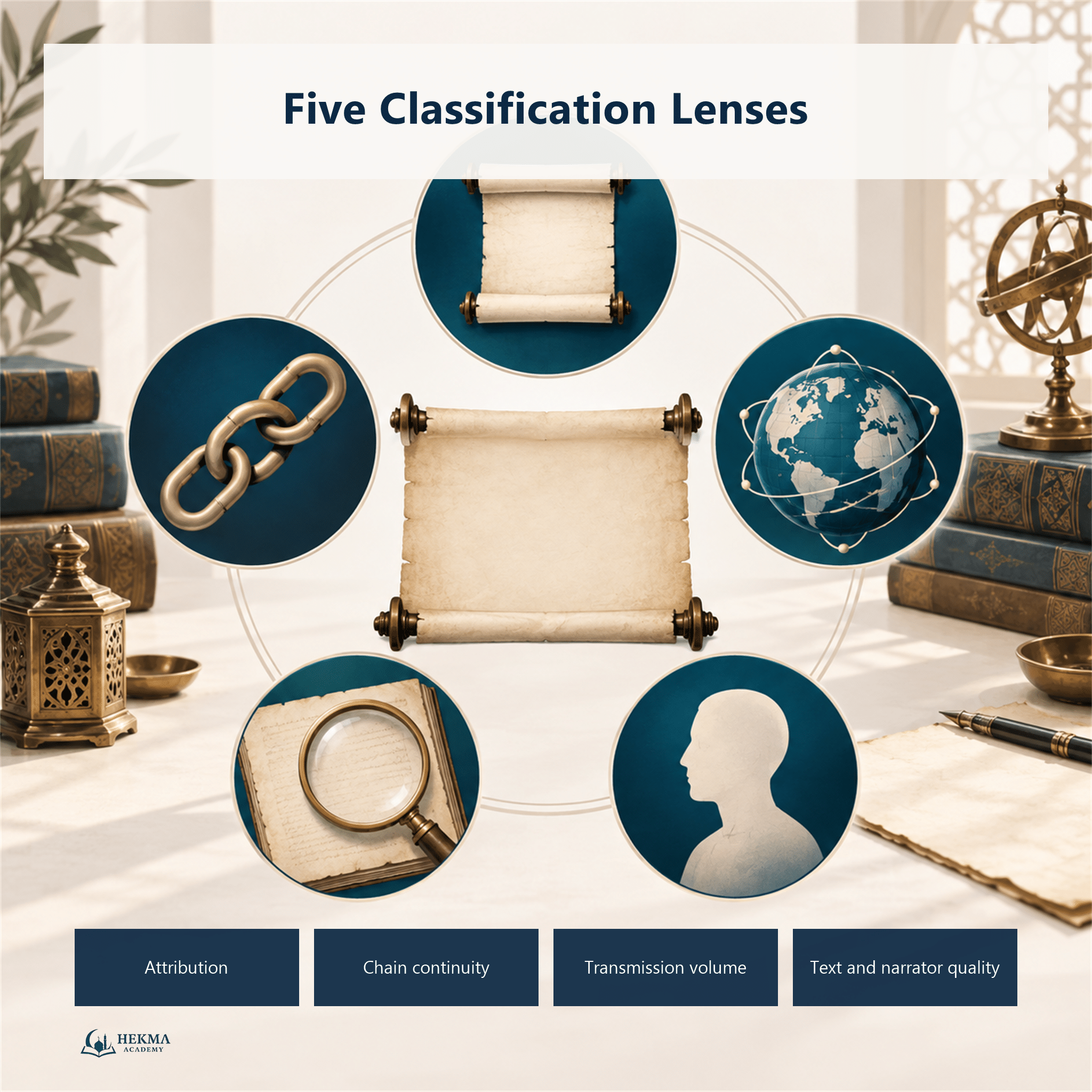
The table explains why a flat list becomes confusing. Marfu’ does not mean Sahih. Mutawatir does not replace a grade. Mursal describes a break of a particular kind, while Da’if gives a broader judgment about acceptability. A specialist may use several labels to describe one report with precision.
Beginners do not need to memorize every advanced term. The useful first step is to ask which question a label answers. Does the label identify the source of the report, the shape of the chain, the number of routes, or the reliability of the attribution?
Types of Hadith by Attribution
Attribution tells readers where a report ends. Attribution does not by itself establish whether a report has a sound chain.
Marfu’ Reports
A Marfu’ report is attributed to Prophet Muhammad ï·º. The attribution may concern a saying, action, approval, or description. Marfu’ identifies the endpoint of the report. A Marfu’ report still needs authentication because a report can reach the Prophet ï·º through a sound chain, a weak chain, or a fabricated chain.
Mawquf Reports
A Mawquf report is attributed to a Companion rather than directly to the Prophet ï·º. A Companion’s statement may be valuable for understanding early Muslim practice, but the label Mawquf keeps the source clear. Readers should not automatically quote a Mawquf statement as “The Prophet said.â€
Maqtu’ Reports
A Maqtu’ report is attributed to a Successor, meaning a member of the generation after the Companions. The word Maqtu’ in this context does not mean the report is broken or false. The label identifies the report’s endpoint.
The Place of Hadith Qudsi
Hadith Qudsi is a special category of report in which the Prophet ï·º relates something from Allah. Hadith Qudsi is not part of the Quran and is not recited as Quran in formal prayer. A Hadith Qudsi also remains subject to Hadith authentication, so a Hadith Qudsi report may be Sahih, Hasan, or weak.
Scholars differ over a further detail. Some scholars describe the meaning as from Allah and the wording as conveyed by the Prophet ï·º. Other scholars describe the wording differently. A beginner does not need to settle that scholarly discussion before learning the shared point: Hadith Qudsi and Quran have different status, transmission, and ritual use.
Types of Hadith by Transmission and Chain Continuity
Transmission labels describe how a report moved through narrators. Transmission volume does not automatically determine an authenticity grade.
Mutawatir and Ahad
Mutawatir describes reports transmitted through numerous routes at every stage in a way that later Sunni theory associates with certainty. Ahad refers to reports below that threshold. Ahad does not mean weak, isolated in every generation, or unimportant. An Ahad report may be Sahih, Hasan, Da’if, or Mawdu’ depending on the evidence for the report.
The distinction is useful because quantity and reliability are not identical questions. A report with many routes still needs careful study. A report with fewer routes may still meet the conditions of Sahih.
Mashhur Aziz and Gharib
Scholars use additional labels for common patterns within Ahad reports. Mashhur often describes a report carried by more than two narrators at a relevant stage. Aziz is commonly used for a report transmitted by two narrators at a relevant stage. Gharib often describes a report with one narrator at a relevant point in the chain.
Technical definitions vary with the scholar and the exact route under discussion. The labels describe transmission patterns. The labels do not function as automatic grades of soundness or weakness.
Connected and Interrupted Chains
A Muttasil chain is connected. A Mursal report commonly describes a Successor who reports directly from the Prophet ï·º while omitting the Companion. Scholars also use terms such as Munqati’, Mu’dal, and Mu’allaq for other forms of interruption.
The terms matter because chain continuity affects a report’s evaluation. The terms do not replace the full work of criticism. A connected chain still requires reliable narrators and comparison with other evidence. An interrupted chain needs careful scholarly assessment rather than an instant social-media verdict.
Reading and Sharing Hadith Responsibly
Check the source, exact reference, scholarly grade, translation, and context before sharing a Hadith. Ask a qualified teacher when the report affects belief or practice.

The science of Hadith can feel large, but responsible sharing begins with a small repeatable habit. The historical work of Hadith critics centered on sources, narrator evaluation, and corroboration, as explained in Jonathan Brown’s study of Hadith criticism. A modern reader can honor that care without pretending to be a Hadith critic.
Before forwarding a quotation, use the following five checks:
- Find the source. Look for the collection, book, chapter, or report number instead of trusting an image alone.
- Check the grade. Find a scholarly grading or a reliable edition that identifies the report’s status.
- Read the context. Review the surrounding narration and translation before applying a line to a new situation.
- Notice the claim. Treat claims about creed, worship, halal and haram, marriage, finance, or public judgment with extra care.
- Ask when unsure. Take difficult questions to a qualified teacher who can explain the evidence and the relevant scholarly context.
The five checks are not a shortcut for independent grading. The five checks help a reader pause before attaching the Prophet’s name to words that may be incomplete, mistranslated, weak, or fabricated.
Parents can model the same care for children. A parent can say, “Let us find where that quote comes from,†rather than presenting every popular saying as Hadith. Hekma Academy’s Islamic Studies for Kids gives families a wider learning path for Quran, Hadith, manners, worship, and Seerah.
New Muslims deserve the same gentleness. No learner needs to solve every scholarly disagreement alone. A welcoming New Muslim Course offers a place to build foundations, ask questions, and learn at a steady pace.
The four familiar authenticity grades give readers a first map. The five-lens framework explains why Hadith terminology contains more than one list. Careful learning protects the Prophet’s ﷺ teachings and gives every learner a calmer way to approach unfamiliar quotations. If you want live guidance through Quran, Hadith, and foundational Islamic studies, Start Your Free Trial to experience the teaching before choosing a study plan.
Frequently Asked Questions
What are the four types of Hadith?
The four familiar authenticity types are Sahih, Hasan, Da’if, and Mawdu’. Sahih means sound, Hasan means good, Da’if means weak, and Mawdu’ means fabricated. The four labels describe reliability, not every possible way scholars classify a report.
What are the five types of Hadith?
There is no single universal five-item list. A common answer gives five classification lenses: attribution, chain continuity, transmission reach, chain and text features, and authenticity. Some writers instead count five authenticity levels by treating very weak reports separately from weak reports.
What is the difference between Sahih and Hasan Hadith?
Both Sahih and Hasan reports are generally accepted in mainstream Sunni Hadith terminology. A Sahih report meets the highest conditions of narrator precision. A Hasan report meets the broad conditions of acceptance with a lower level of precision in one or more narrators.
Does Da’if mean fabricated?
No. Da’if means weak because the report does not meet the conditions of Sahih or Hasan. Mawdu’ means fabricated and refers to a report judged falsely attributed to the Prophet ï·º. A weak report needs caution, while a known fabrication must not be shared as Prophetic speech.
What is Hadith Qudsi?
Hadith Qudsi is a report in which the Prophet ï·º relates something from Allah. Hadith Qudsi is not Quran and is not recited as Quran in formal prayer. Like other Hadith, each Hadith Qudsi report needs authentication.