



Quran memorization techniques work best when new verses receive accurate teaching, active practice, and regular review. For a family balancing school, work, and worship, the challenge is often building a routine that lasts. These nine techniques show you how to choose manageable passages, recite with care, test memory without looking, and protect earlier memorization. Use them together, then adjust the pace to your or your child’s actual recall.
1. Check Recitation Before Memorizing New Verses
The first task is to make sure the words sound right. Hifz means memorizing the Quran, and accurate recitation belongs at the heart of that work. A learner who repeatedly practices an uncertain sound may later have to relearn the same passage. Begin with a short portion that you or your child can read aloud. Let a capable teacher hear the Arabic before the words become a daily memory target.
Tajweed is the set of rules that guides correct Quranic pronunciation and recitation. A beginning learner does not need to master every rule before memorizing anything. The learner does need to know where a letter is pronounced, which vowels are long or short, and where a recitation mistake keeps recurring. A teacher can focus on the errors that matter in the current passage. Then the learner can practice that passage with a sound model.
For a child, correction should be calm and specific. Say, “Let’s listen to that sound again,” rather than “You always get this wrong.” For an adult, privacy and patience matter just as much. A brief check before new memorization saves frustration and gives the learner a sound foundation.
Our Quran memorization course offers live instruction for families who want a teacher to hear recitation and help shape the next portion. Whatever teaching arrangement you choose, ask the teacher to identify one or two priority corrections at a time. A short, accurate passage gives you a better starting point than a longer passage full of unresolved doubts.

2. Choose a Small Passage You Can Sustain
The right daily portion is the amount the learner can pronounce accurately and recall later. A page target may sound motivating, but a large portion becomes costly when yesterday’s work has already faded. Start with one short ayah, a few lines, or a brief surah according to reading ability. An ayah is a verse; a surah is a chapter. The number of words matters less than their difficulty and the time available for review.
Many families begin with familiar passages used in prayer. A short chapter gives a child an understandable finish line, while an adult beginner gains a passage that can be revisited often. Our guide to short surahs for beginners offers possible starting points. The guide is a menu, not a required order. If a teacher recommends a different passage because of a learner’s level or prayer needs, follow the more relevant plan.
Keep the new portion stable for several ordinary days. Watch what happens when the learner returns without a recording or open page. If the passage is shaky, repeat or reduce the next portion. If recall remains sound and review still fits the day, there may be room to add more. Make the decision from recitation, not from a comparison with another family.
Small work is still meaningful work. A portion that survives school days, tired evenings, and regular review creates a foundation for the next ayah. Children also need time to enjoy and understand a chapter, not simply finish it.
3. Listen, Imitate, and Repeat Aloud
Listening gives the learner a model of sound and rhythm. Select one careful recitation of the passage. Listen to a short phrase, pause, and repeat it aloud. Then compare the learner’s version with the model and with teacher feedback. Repeat the phrase until the learner knows what to listen for, rather than counting repetitions toward a universal number.
An audio recording is useful when a teacher cannot be beside the learner every day. The recording lets a parent replay a difficult sound and lets an adult rehearse at a convenient time. Yet hearing a passage in the background is different from producing it accurately. A learner might recognize every word while still being unable to recite without the recording. Spoken practice closes that gap.
Listening, reading, and speaking work well together because the task itself involves sound, text, and oral recall. You do not need to decide that your child is an “auditory learner” or a “visual learner.” Try the tools that serve the current difficulty. A child struggling with a letter needs a clear spoken model and correction. A learner losing place on the page may benefit from keeping the same Mushaf, the written Quran copy, during practice.
When a phrase includes unfamiliar pronunciation, pause and ask a teacher instead of guessing from transliteration. Our Tajweed rules with examples explain common rules, while live correction addresses the learner’s actual recitation. Audio supports the teaching relationship; it does not replace a listener who can identify an error.
4. Break Verses Into Meaningful Units
A long ayah feels more manageable when you divide it into small, sensible units. Read the whole ayah first so the learner hears its flow. Then work on the first phrase, add the next phrase, and recite them together. Continue until the complete ayah holds together without prompts. The final test is the whole passage, not a collection of isolated fragments.
Do not split Arabic wherever a line happens to end on the page. Some pauses interrupt the sense or make the next phrase awkward to start. A teacher can point out a suitable stopping place, especially in a longer verse. If you do not yet understand the Arabic, use the teacher’s guidance and a trustworthy translation of meaning to orient the practice.
Try connecting each new unit to the one before it. After learning the second phrase, recite the first and second together. After learning the third, return to the beginning. The learner is practicing the transition as well as each individual phrase. That matters because a student may know every phrase separately but hesitate between them during prayer or a teacher check.
Some families like a fixed repetition structure, while others need more practice at one transition. Watch for the problems covered in our guide to common Quran memorization mistakes, especially rushing into new material before earlier words are secure. If the learner still misses a word, slow down and correct it. If the whole ayah is secure, move forward without adding empty repetitions.

5. Recite From Memory Before Looking Again
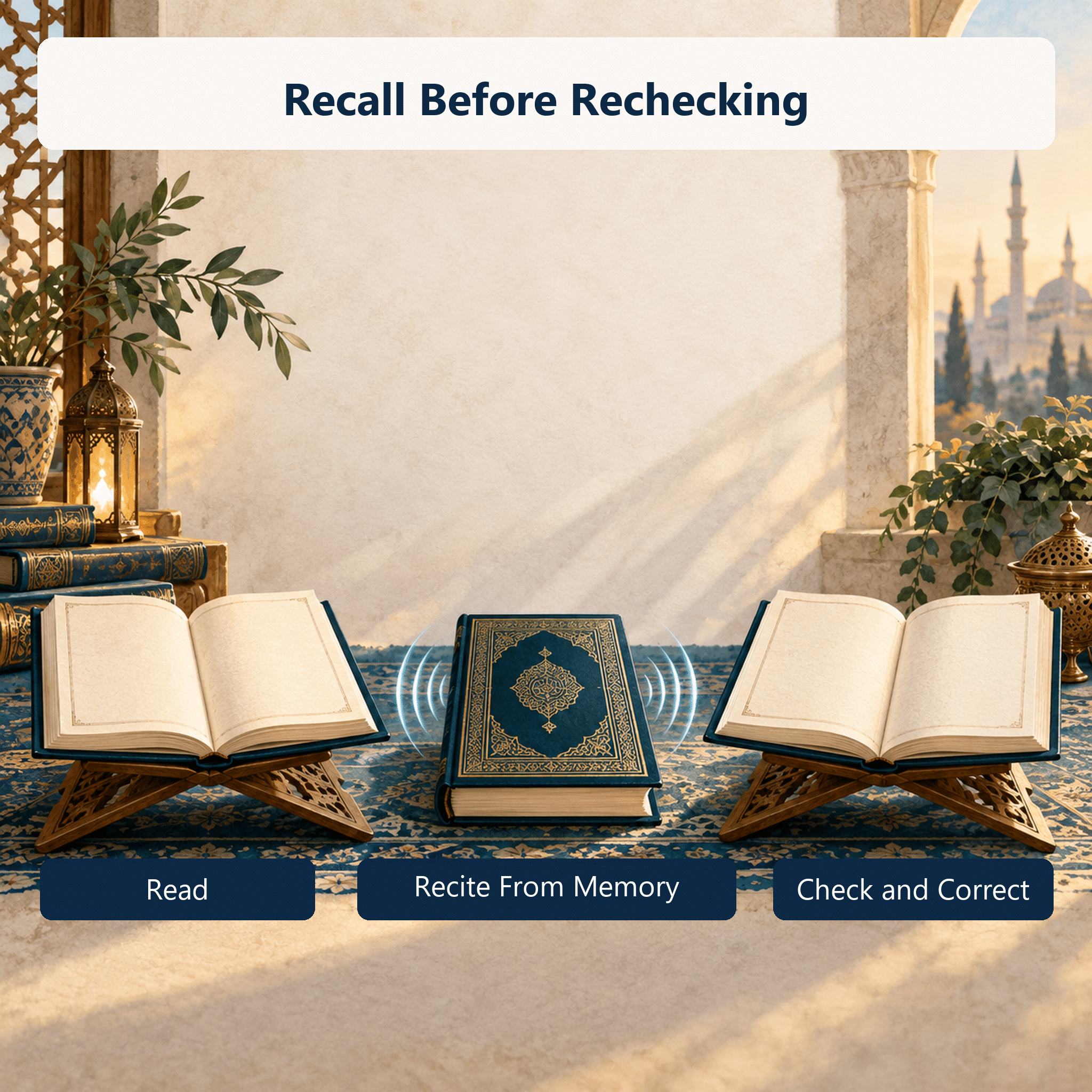
Reading a passage many times makes it familiar. Familiarity is useful, but the real question is whether you can recite the passage without looking. After a few accurate readings, close the Mushaf or cover the lines. Recite aloud, then uncover the text and check the exact point where memory failed. Correct that point and try again from just before it.
This practice is called retrieval: bringing information out of memory rather than taking it in again. In experiments with written learning material, retrieval practice improved later retention compared with spending the same time rereading. The experiments did not test Quran memorization specifically. Applying the principle to Hifz means giving the learner frequent chances to recite from memory and then checking accuracy.
For a young child, make the check low pressure. Invite one line, listen, and offer a prompt only when needed. If the child is tired, stop at a smaller unit. For an adult, resist the temptation to peek at the first uncertain word immediately. A short attempt often shows whether the problem is the opening word, the sequence, or the ending.
Keep a simple record of repeated mistakes. A mark beside a difficult transition or a note for the teacher is enough. Do not turn the page into a wall of scores. The purpose of checking is to decide what to practice next. When an ayah comes out clearly without the page, the learner has stronger evidence of recall than a feeling of familiarity provides.
6. Revisit Earlier Passages Across the Week
New verses need attention, but earlier verses need a place in the routine too. Muraja’ah means planned review of memorized Quran. Without it, the learner may add material while losing access to passages learned weeks ago. Protect some review time on ordinary days, even if new memorization has to become smaller.
Spread review across the week. Research on distributed practice in verbal recall supports returning to learned material after a gap rather than putting all practice into one block. The research does not identify one ideal interval for Quran memorization. A practical Hifz plan therefore responds to how well a particular learner remembers each passage.
New, recent, and older work have different jobs:
| Material | What to check | Useful response |
|---|---|---|
| New passage | Can the learner recite it later without looking? | Revisit it soon and correct uncertain words. |
| Recent passage | Can the learner begin and link verses smoothly? | Rotate it through several practice sessions. |
| Older passage | Can the learner recite it after a longer gap? | Return more often to weak chapters. |
As memorization grows, older passages take more time. A schedule that worked for three short surahs may not work for several juz. Juz is one of the Quran’s thirty parts. Reduce new work when older material becomes unstable, and let the teacher help decide how much review the learner can sustain. Our Quran memorization schedules provide several adaptable ways to give new and old material a place without pretending one timetable fits every family.

7. Connect the Words With Their Meaning
Memorization should leave room to understand what a passage is saying. A beginner may not know Arabic yet, but a trustworthy translation of meaning or a teacher’s brief explanation gives the chapter context. When a child learns a short surah, discuss its central message in ordinary language. Ask what the chapter praises, asks, warns about, or teaches.
Meaning does not replace the Arabic words. A learner must still pronounce and recall the revealed text accurately. Understanding adds a reason to return to the passage and helps a family speak about the Quran beyond a progress chart. A parent can ask, “What did we learn from this surah?” without turning every practice session into a long lesson. A simple conversation can be enough for a young child.
For an adult, notice where the meaning changes across an ayah. The sense of the passage gives its sequence a clearer structure. Use an established translation and ask a qualified teacher about wording that is unclear. Avoid making a private guess about a complex verse from one English phrase. Translation is an aid to understanding, while Tafseer is a more detailed explanation of Quranic meaning and context.
We recommend pairing one small piece of meaning with the current memorization target. Keep the practice proportionate: read or hear the explanation, return to the Arabic, and recite from memory. There is no need to claim a fixed memory gain from understanding. The benefit here is a more thoughtful relationship with the words the learner is working to retain.
8. Recite to Someone Who Can Correct You
Self-checking is essential, but a learner cannot always hear their own mistakes. Regular recitation to a competent teacher adds another set of ears. The teacher can notice pronunciation, missing words, weak transitions, and passages that only sound secure when the learner starts from the beginning. That feedback helps decide whether to add new material or repair older work.
A parent has an important role even without advanced Tajweed knowledge. Make space for practice, listen with interest, encourage a child to try, and note questions for the teacher. Do not feel obliged to correct a sound you cannot distinguish confidently. A parent who says, “Let’s ask your teacher about that word,” models care for accuracy without creating anxiety.
Choose a review arrangement that suits the learner. A beginning child may do better with brief, regular checks and a warm relationship. An adult may prefer private lessons where hesitant recitation feels safe. A trusted local teacher, a suitable community class, or live online instruction can all provide human feedback when the teacher can genuinely listen and correct.
Hekma’s live Quran lessons give families an option when local access is limited or school and work make travel difficult. We recommend asking any prospective teacher how they balance new memorization, correction, and Muraja’ah. The most useful plan is the one that responds to the learner’s actual recitation and remains workable at home.
9. Build a Gentle Routine and Adjust After Missed Days
A good routine fits ordinary life. Pick a repeatable period when the learner is reasonably alert and the household can protect a few minutes of focus. For one family, that may be after Fajr. For another, it may be after school or before bedtime. No clock time works for everyone. The aim is a dependable setting for accurate recitation, a small new portion when appropriate, and review.
Keep the environment simple. Put the Mushaf, a pencil for error notes, and any approved audio in one place. Silence distractions for the short practice window. Let a child know what the session includes and when it will end. Some days may be review-only. Such a day still protects Hifz, especially when the learner is tired or older passages need attention.
If you miss a day, restart gently. First ask the learner to recite the last secure passage and the most recent portion. Check where recall is weak. Repair those words before adding new ones. After several missed days, reduce the next target rather than trying to repay every missed session at once. The plan should bend around exams, travel, illness, and family needs without turning a break into shame.
A brief weekly check helps: Which surah feels secure? Which opening needs a prompt? Which words need teacher correction? Use those answers to adjust the next week. Progress is more than the number of new lines. Clear recitation, reliable recall, and a learner who still wants to return to the Quran all matter.
The nine techniques work as one cycle: learn a small passage accurately, practice aloud, retrieve it without looking, and return to it over time. Start with the technique that addresses your present obstacle. If pronunciation is uncertain, seek correction first. If old surahs are fading, give Muraja’ah more space. If the routine keeps collapsing, make the daily target smaller.
When you want help tailoring that cycle to your or your child’s level, request a trial lesson with Hekma Academy. Share your current reading ability, memorization goal, available study time, and passages that need review. A teacher can then help you discuss a realistic next step.
Frequently Asked Questions
How many times should I repeat an ayah to memorize it?
There is no single repetition count for every learner or ayah. Read the passage accurately, repeat it aloud, then test it without looking. Check the missed words and repeat those points. Move on when the whole passage is secure enough to revisit later, not when a preset number is reached.
Is listening to Quran enough for memorization?
Listening gives a valuable model, especially for pronunciation. Memorization also requires you to produce the Arabic from memory. Pause the recording, recite aloud, check the words, and seek teacher feedback when sounds or pauses are uncertain. Background audio alone does not show whether a learner can recall a passage.
Should a child memorize new verses every day?
Only when the child’s current recitation and earlier memorization are holding up. A review-only day is appropriate when a child is tired, busy, or struggling with older work. Keep the portion small enough for the child to recite accurately and revisit later. Ask the teacher to adjust the pace with you.
What should I do if I forget a surah I learned before?
Return to the surah without blame. Read it accurately, divide weak sections into small units, and test each unit from memory. Rejoin the whole surah and place it back into regular Muraja’ah. If the same error returns, ask a teacher to listen and identify the point that needs correction.
Do beginners need a Quran memorization teacher?
A competent teacher is especially helpful when a beginner is unsure about pronunciation or cannot identify their own mistakes. Home practice remains essential between lessons. If regular classes are difficult, arrange periodic checks where possible and keep new portions modest until someone qualified can hear the recitation.