



A Quran memorization schedule should protect what you have learned while making room for steady new Hifz. The right timetable depends on your available time, reading accuracy, existing memorization, and recall. These seven schedules give adults and parents practical options for short or extended daily practice, school-day routines, weekly Muraja’ah, and recovery after missed days. Every example is a starting structure that should adjust to the learner’s real retention.
Hifz means memorization of the Quran. Muraja’ah means structured revision of passages you have already learned. A workable schedule gives both activities a clear place. It also separates recent memorization from older material, since each needs a different kind of attention.
1. 20-Minute Quran Memorization Schedule for Busy Adults
This 20-minute schedule is a minimum sustainable routine for a busy adult or beginner. The goal is not to cover a fixed number of lines. The goal is to complete new Hifz and meaningful review without rushing either task.
| Time | Activity | Purpose |
|---|---|---|
| 6 minutes | Recite yesterday’s portion from memory | Stabilize recent Hifz and reveal weak transitions |
| 7 minutes | Learn a small new portion accurately | Add only what fits the available attention |
| 5 minutes | Review an older passage | Keep earlier memorization in active rotation |
| 2 minutes | Recite the new portion without looking | Check whether the words are retrievable |
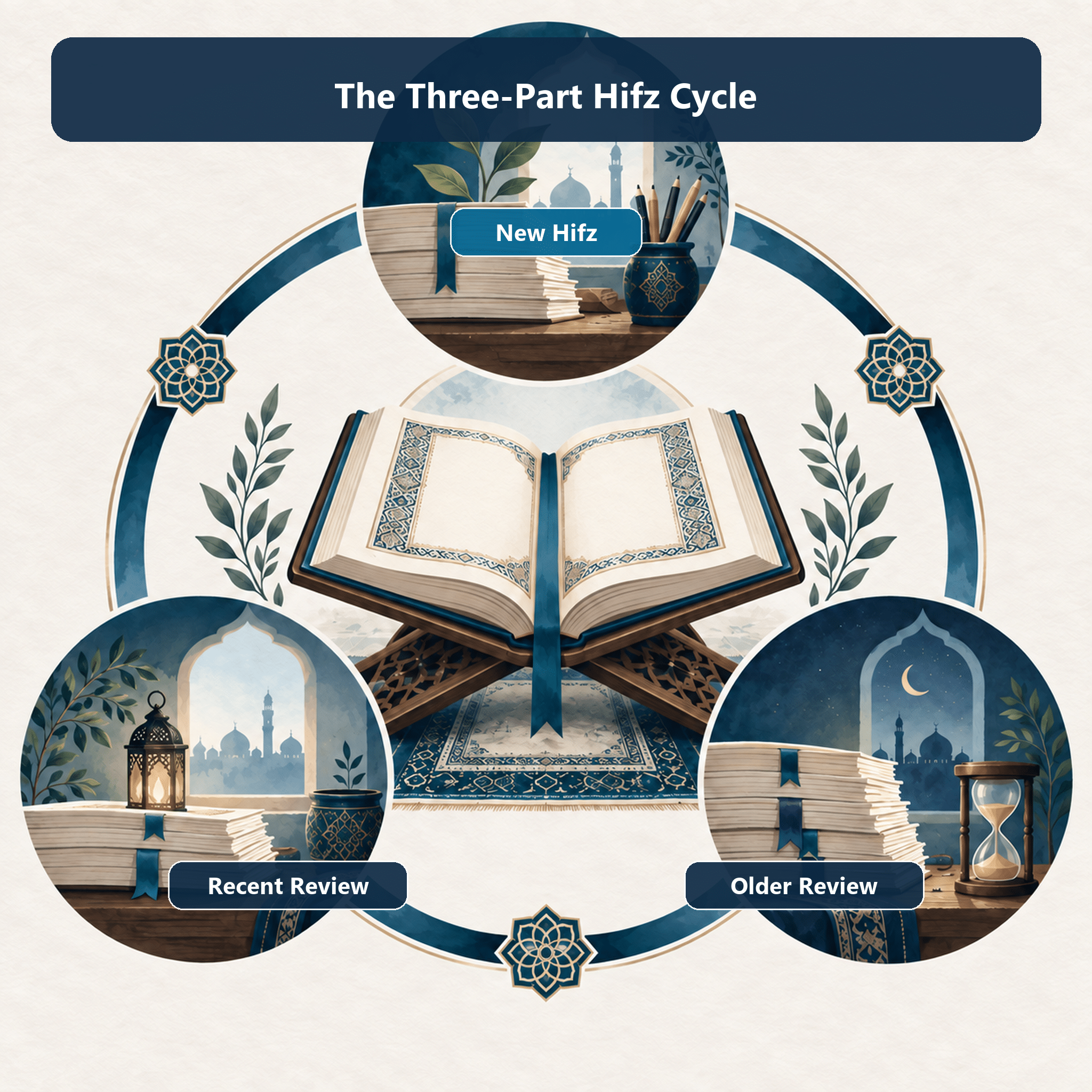
The three categories are sometimes called sabaq, sabqi, and manzil. Sabaq is today’s new lesson. Sabqi is recent material that still needs frequent attention. Manzil is older memorization reviewed on a continuing rotation.
The table does not require every learner to divide time with exact precision. If yesterday’s passage is weak, use more of the session for review. Reduce the new portion instead of racing the clock. Research on retrieval practice and learning supports the value of recalling material rather than relying only on rereading.
Choose a dependable daily anchor. After Fajr works well for many learners because the home is often quiet. Another time may fit your concentration and obligations better. Compare possible study periods by quiet, attention, and how reliably each period fits your normal day.
If one uninterrupted block is difficult, split the session. Review recent verses in the morning, practice new Hifz at lunch, and recite an older passage in the evening. Keep the new portion small enough to test again the next day.
2. 40-Minute Balanced Quran Memorization Schedule for Adults
This 40-minute plan suits an adult who has a stable daily study period and wants a balanced part-time routine. The additional time belongs to deeper recall and correction, not only to more new verses.
| Time | Activity | Purpose |
|---|---|---|
| 10 minutes | Review recent memorization | Strengthen material from the last several sessions |
| 12 minutes | Read and memorize a new portion | Build accurate familiarity before recall |
| 8 minutes | Recite the new portion without looking | Find omissions, substitutions, and weak links |
| 10 minutes | Rotate through older memorization | Protect long-term recall |
Before using this plan, check the skill that currently limits you. Some learners need better Arabic decoding. Others read comfortably but struggle with pronunciation, linking verses, or retaining old pages. If reading each word requires heavy prompting, use part of the 40 minutes for reading foundations. The guide on how to read Quran for beginners explains that earlier pathway.
Use four questions to choose the new daily portion:
- Can you read the assigned words accurately before memorizing them?
- Can you recite the portion later without looking?
- Can you review yesterday’s portion without losing today’s full session?
- Can you repeat the routine on an ordinary workday?
A “yes” to all four questions suggests that the target is manageable. One weak answer is a reason to hold the target steady. Several weak answers mean the portion should shrink while reading or review receives more time.
Do not increase the new amount after one unusually easy day. Follow the same target for about two weeks and observe recall. A sustainable target should survive tired evenings, busy mornings, and minor disruptions. Consistency matters more than an impressive first week.

3. 60-Minute Quran Memorization Schedule for Deeper Practice
This one-hour schedule is designed for learners who can protect a longer period of focused practice. A full hour should produce better correction, stronger connections, and broader Muraja’ah. The extra time should not automatically double the new portion.
| Time | Activity | Purpose |
|---|---|---|
| 15 minutes | Recite recent Hifz from memory | Test the material most vulnerable to forgetting |
| 15 minutes | Prepare and memorize new verses | Read accurately, listen, repeat, and connect phrases |
| 10 minutes | Recite new verses without the Mushaf | Test retrieval and correct weak points |
| 15 minutes | Review older memorization | Continue the manzil rotation |
| 5 minutes | Record errors and the next assignment | Give tomorrow’s session a clear starting point |
Keep the same Mushaf when practical. A familiar page layout helps you notice where a verse appears, although visual familiarity cannot replace accurate recall. Read the new passage aloud. Divide a long ayah into meaningful phrases, then join the phrases before moving forward.
If the new portion contains uncertain pronunciation, stop and correct the reading first. Repeated errors become harder to notice when the learner has rehearsed them many times. A live teacher can listen for a changed vowel, missing word, or unclear articulation point that a written planner cannot detect.
Hekma’s Quran memorization course provides a guided option for adults and children who want live recitation feedback and an individualized balance between new Hifz and Muraja’ah. A teacher should adjust the assignment to your recall, not force every learner through the same page target.
End the session by naming the exact verses for tomorrow. Also record one weak transition from today’s practice and one older passage due for review. A clear note removes guesswork from the next session.
4. Short-Session Quran Memorization Schedule for Young Children
A young child’s schedule should favor brief, positive encounters with accurate recitation. The child does not need to sit through a long adult-style study block. Several short encounters often fit family life and a child’s attention better.
| Session | Approximate time | Activity | Adult support |
|---|---|---|---|
| First exposure | 3 to 5 minutes | Listen and follow a very short passage | Model calm attention and correct audio |
| New memorization | 5 to 8 minutes | Repeat one small phrase or ayah | Prompt gently and stop before frustration |
| Shared review | 5 minutes | Recite yesterday’s portion together | Praise careful effort, not speed |
| Later recall | 2 to 4 minutes | Ask for the passage without the text | Note where help is needed next time |
These times are examples, not developmental rules. A child’s reading ability, interest, sleep, school demands, and teacher guidance matter more than a universal age table. Some children are ready for a small independent assignment. Others need listening, letter recognition, and correct reading before formal Hifz becomes the main task.
Choose a passage that matches the child’s current recitation. Hekma’s guide to short surahs for beginners and prayer offers a useful starting pool, but the easiest passage differs by learner. Familiarity from salah or family recitation may help a child begin confidently.
Keep correction specific. Instead of saying “wrong,” repeat the word accurately and invite another attempt. End while the child can still succeed. A short final recitation creates a clear memory of what was achieved.
Sleep also deserves protection. Memory research supports sleep’s role in consolidation across children and adults. That evidence does not mean that audio played before sleep will memorize the passage for a child. Practice still requires attention, recall, and correction.

5. School-Day Quran Memorization Schedule for Older Children
This schedule fits a child who can read with growing independence and has a predictable school routine. It places the most demanding work during a calm period and keeps later review short.
| Time | Activity | Purpose | Busy-day adjustment |
|---|---|---|---|
| Before school or after Fajr | 10 to 15 minutes of new Hifz | Use a quiet period for careful learning | Cut the new portion in half |
| After school | 5 to 10 minutes of recent review | Test the morning portion after a delay | Review only, with no added verses |
| Early evening | 10 to 15 minutes of older Muraja’ah | Maintain previous memorization | Recite one strong and one weak passage |
| Teacher or parent check | 5 minutes when available | Correct pronunciation and mark errors | Move the check to the next suitable day |
Do not make the child “repay” a demanding school day with a doubled assignment tomorrow. Keep Muraja’ah moving and return to the normal new portion when concentration improves. During exams, a review-only week may protect more progress than forcing new Hifz into an overloaded routine.
Parents can track completion, but listening quality matters more than a checked box. Notice repeated hesitation, changed word endings, and verses that only appear with prompts. Bring those points to the child’s teacher. When pronunciation is the main obstacle, guided study such as an online Tajweed course may need to support the memorization plan.
Avoid comparisons with siblings or classmates. One child may add verses quickly but require more revision. Another may progress slowly and retain strongly. The useful measure is whether the child can recite the assigned passage accurately and return to older work with reasonable confidence.
The routine should leave space for sleep, schoolwork, play, and family life. Hifz is a long relationship with the Quran. A schedule that creates constant conflict is giving the family important information. Reduce the load and rebuild consistency.
6. Weekly Muraja’ah Schedule for Stronger Retention
A weekly schedule prevents recent pages from becoming an uncontrolled backlog. It also gives older memorization a predictable rotation. The example below uses five ordinary practice days, one consolidation day, and one lighter day.
| Day | New Hifz | Recent review | Older review | Special focus |
|---|---|---|---|---|
| Monday | Normal portion | Friday and weekend work | Rotation section A | Mark weak transitions |
| Tuesday | Normal portion | Monday’s portion | Rotation section B | Recite without looking |
| Wednesday | Normal portion | Monday and Tuesday | Rotation section C | Connect adjacent passages |
| Thursday | Normal portion | Wednesday’s portion | Rotation section D | Correct recurring errors |
| Friday | Smaller portion | Full week’s recent work | Short older review | Prepare for the weekly check |
| Saturday | None or very small | Recite the week’s Hifz | Revisit marked weak pages | Teacher or family check |
| Sunday | None | Light recent review | One comfortable older passage | Rest, reflect, and plan |
The rotation sections can be surahs, pages, or another consistent unit. Choose a unit you can track easily. If the memorized amount is small, older review may cover everything several times each week. As the amount grows, the rotation becomes longer and needs more protected time.
Islamic teaching gives Muraja’ah a deeper purpose than productivity alone. An authentic narration urges believers to keep attending to the Quran because memorized words readily escape, using the image of a camel leaving its restraint (Sahih al-Bukhari 5033). Regular review is therefore part of caring for what has been learned.
Watch for three signs that the weekly balance needs to change:
- Several recent passages require prompts before the first ayah is complete.
- Older passages disappear unless you look at the page.
- The same pronunciation or sequence errors return after correction.
When these signs appear, pause or reduce new Hifz. Give the reclaimed time to weak material. Hekma’s guide to common Quran memorization mistakes explores other habits that weaken retention.
7. Catch-Up Quran Memorization Schedule After Missed Days
After missed days, protect recall before adding a larger new assignment. Doubling today’s new portion usually creates more fragile material. A recovery plan should restore recent and older review, then reopen new Hifz gradually.
| Gap | First priority | New Hifz | Condition for returning |
|---|---|---|---|
| One missed day | Recite the last two assigned portions | Half or none | Recent Hifz returns with few prompts |
| Three missed days | Review the current week’s material | Pause for one session | The week’s passages connect accurately |
| One missed week | Test recent and older passages separately | Pause until weak areas are mapped | A teacher or self-check confirms a smaller restart point |
For a one-day gap, begin with yesterday’s due review. If recall is stable, add a smaller new portion. After several missed days, use the first session only to find what remains strong and what needs repair. A longer gap deserves a reset of the schedule, not punishment.
Keep a simple record with six fields:
- date;
- new passage;
- recent review;
- older review;
- words or transitions missed;
- correction to revisit.
The record should guide decisions, not create guilt. If the same passage remains weak across several checks, move that passage into more frequent review. If reading errors cause the problem, ask a qualified teacher to hear the passage before repeating it again.
Use a minimum viable session on unpredictable days. Five minutes of recent recall and five minutes of older review preserve the routine even when new Hifz must wait. A smaller completed session is more useful than an ambitious plan repeatedly postponed.

A useful Quran memorization schedule fits your present life while protecting accurate recitation and long-term review. Choose one schedule, test the routine for two weeks, and adjust the new portion from real recall. Adults and parents do not need to chase someone else’s pace. They need a plan that remains steady when ordinary life becomes busy.
If you want help matching new Hifz and Muraja’ah to your current level, start your free-trial request. Share what you can read now, what you hope to memorize, what needs revision, your available daily time, and your time zone. The form requests a trial; tutor availability and lesson times still need confirmation.
Frequently Asked Questions
How much Quran should a beginner memorize each day?
A beginner should memorize the smallest portion that can be read accurately, recalled later, and reviewed the next day. That amount may be one ayah, several lines, or a short passage. Keep the target unchanged for about two weeks before increasing it. If yesterday’s work repeatedly consumes the whole session, reduce the new portion.
What is the best time of day to memorize the Quran?
The best time is a quiet, repeatable period when you can concentrate and recite aloud. Many learners choose after Fajr, while others focus better after school, before work, or in the evening. Consistency and attention matter more than copying another person’s clock.
How much time should Muraja’ah take?
Muraja’ah should receive at least enough time to test recent and older passages without rushing. The required time grows as your memorized portion grows. When older recall weakens, shift time away from new Hifz until the revision cycle becomes stable again.
What should I do after missing several days?
Resume with review instead of doubling the next assignment. Test the most recent passages, identify weak areas, and pause new Hifz for a session when necessary. Restart with a smaller new portion once recent recall is steady.
Should children memorize before they read Arabic fluently?
Children may learn short passages through listening and guided repetition, especially for prayer. However, weak reading and uncertain pronunciation require close adult or teacher support. As formal Hifz grows, accurate reading and correction become increasingly important because repeated errors are difficult to notice after they feel familiar.