

Learning how to read Quran for beginners does not require prior Arabic knowledge or a polished voice. The process begins with recognizing Arabic letters, hearing their correct sounds, and learning the marks that guide pronunciation. From there, you can join letters into words, read short passages, and introduce Tajweed gradually. This guide gives adult beginners and new Muslims a patient, practical path they can follow without rushing or feeling embarrassed by their starting point.
Can a complete beginner learn to read the Quran?
Yes. A complete beginner can learn Quran reading by building four skills gradually: letter recognition, accurate pronunciation, vowel-mark reading, and guided recitation practice.
You do not need to speak Arabic before beginning. Speaking, understanding, and reading Arabic are related skills, but they are not identical. A learner can begin decoding Quranic Arabic while continuing to develop vocabulary and understanding separately.
Progress usually feels uneven at first. Some letters look similar, several sounds may be unfamiliar, and connected Arabic writing changes the appearance of letters. Those challenges are normal features of learning a new script. They do not mean that a learner lacks ability.
Islamic teaching also gives struggling readers reason for hope. A hadith narrated by Aishah describes a reward for the proficient reciter and two rewards for the person who recites with difficulty and keeps trying. The report appears in Jami at-Tirmidhi 2904. The message does not turn difficulty into failure. Difficulty can be part of sincere learning.
New Muslims may also be learning prayer, beliefs, and daily practices at the same time. A narrow first goal can reduce pressure. Focus first on identifying letters and reading fully marked words. Hekma Academy’s welcoming course for new Muslims offers a broader foundation when Quran reading is one part of a new learner’s journey.
What should you learn before reading from the Mushaf?
Begin with Arabic letter sounds, their connected forms, and the marks for short vowels, doubled consonants, pauses, and elongation before attempting complete Quranic verses.
A Mushaf is a written copy of the Quran in Arabic. Most printed Mushafs use a fully marked script. The marks help readers identify vowels, doubled sounds, pauses, and other recitation details. Beginners should learn what the most common marks do before trying to read a full page.
Start with the 28 Arabic letters. Learn the sound of each letter, not only its English transliteration. English spellings such as “s,” “h,” or “th” cannot represent every Arabic sound precisely. Several Arabic letters come from different positions in the mouth or throat even when English speakers hear them as similar.
Arabic writing runs from right to left. Many letters also take different visual forms at the beginning, middle, or end of a word. The underlying letter remains the same. The Unicode Standard’s Arabic-script guidance explains how joining context changes the displayed form of Arabic letters.
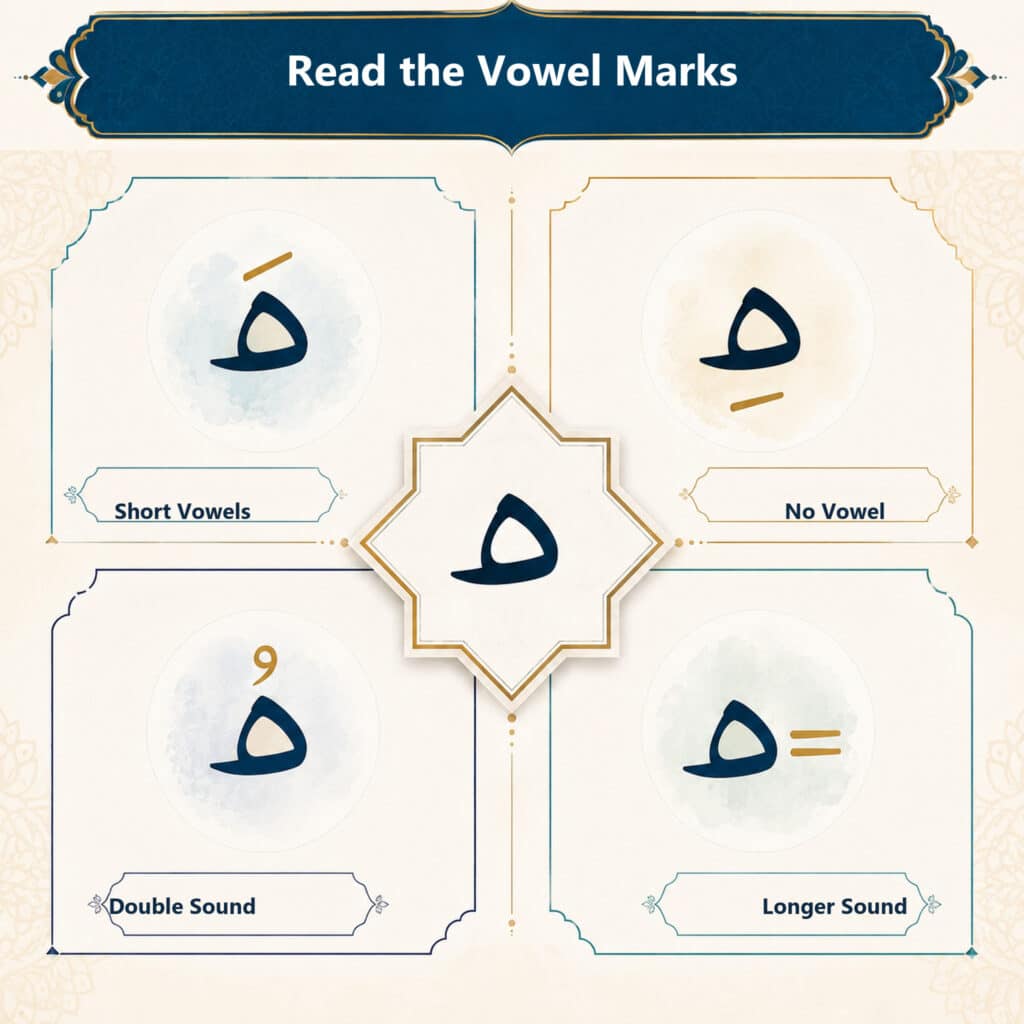
Next, learn the three short-vowel marks. Fathah gives a short “a” sound, kasrah gives a short “i” sound, and dammah gives a short “u” sound. Sukun indicates the absence of a following short vowel. Shaddah doubles a consonant sound. Madd signs and letters indicate elongation in specific contexts.
Research on early Arabic reading describes fully vowelled Arabic as more transparent because diacritics supply pronunciation information. The same research notes that Arabic letters are cursive and can change form according to position. Those features make letter recognition and vowel marks sensible starting points for beginners. See the open-access study on early Arabic reading acquisition.
A structured primer can organize the foundations from simple to more complex patterns. The online Noorani Qaida course is designed around letters, joined forms, pronunciation, and foundational Quran reading. A primer supports Quran reading, but a primer is not a race to finish pages.
How do you read the Quran step by step?
Learn the letters, connect their forms, read vowel marks, blend simple words, practice short verses slowly, add basic Tajweed, and seek correction from a qualified teacher.
The seven steps below follow a practical learning order. A teacher may adjust the order after hearing your reading. A learner who already recognizes Arabic letters, for example, may need pronunciation work rather than another complete alphabet course.
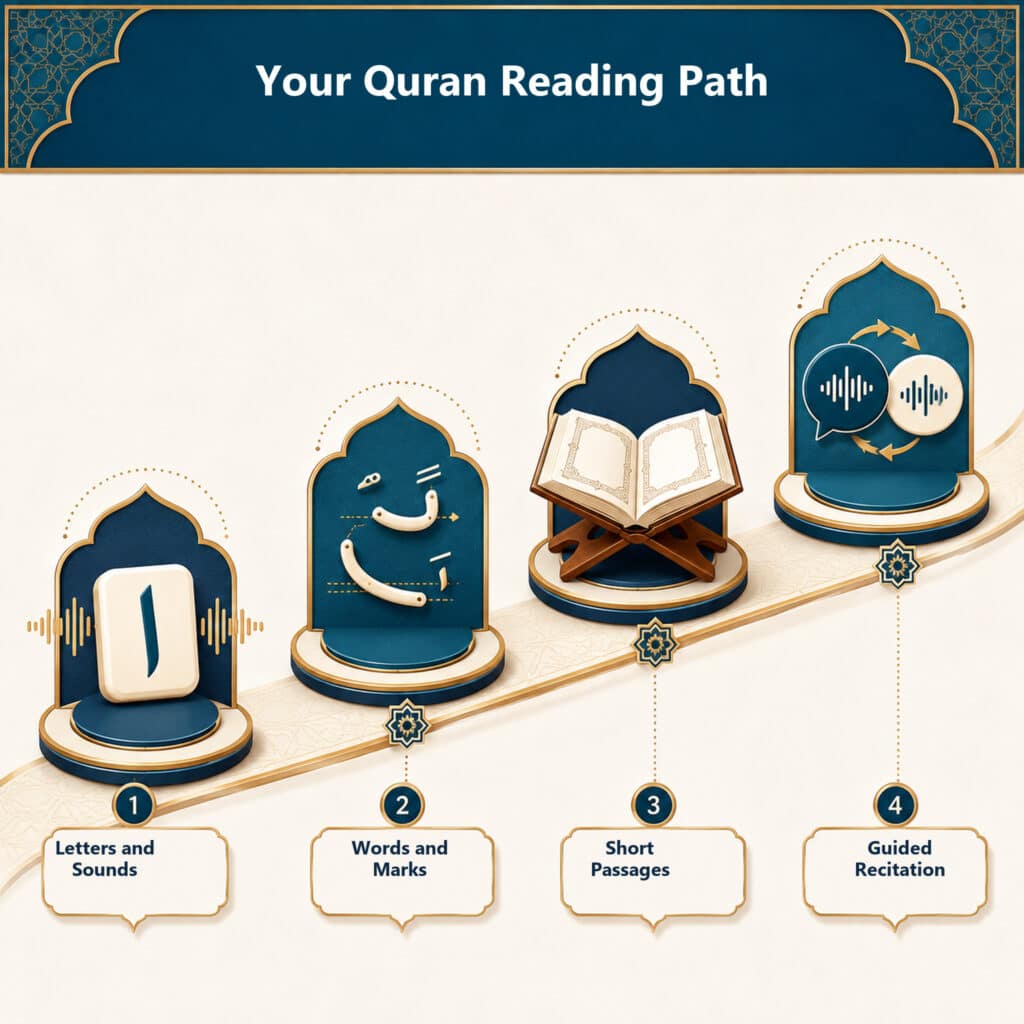
1. Learn each Arabic letter and sound
Study a small group of letters at a time. Look at the letter, listen to a clear model, and repeat the sound aloud. Then recall the sound without hearing the model first. The recall attempt shows whether recognition is becoming active knowledge.
Pay special attention to letters that share a basic shape but differ by dots. Also separate letters that sound close to an English-speaking beginner. The Open University’s lesson on Arabic letters with close articulation points demonstrates why careful listening and repetition matter.
Do not force an Arabic sound into the nearest English sound. Watch the teacher’s mouth when possible, then notice where your tongue, lips, or throat produce the sound. A teacher can correct the sound before an inaccurate habit becomes familiar.
2. Recognize connected letter forms
After isolated letters become familiar, study each letter inside simple words. Practice initial, middle, final, and isolated appearances where the letter supports those forms. Some letters connect on both sides, while others interrupt the visual connection.
Read slowly enough to identify the underlying letters. Pointing to one letter at a time can help during early lessons. Gradually shift from identifying separate shapes to seeing a short word as a readable unit.
3. Read short vowels and essential marks
Add one mark at a time. Begin with fathah, kasrah, and dammah. Read simple combinations such as one consonant plus one short vowel. Add sukun and shaddah only after the three basic vowels feel stable.
Say every combination aloud. Silent recognition cannot show whether the mouth is producing the intended sound. Keep the pace slow, and avoid guessing from the overall shape of a word.
Transliteration can provide temporary support, especially for a new Muslim who needs to participate in prayer. However, transliteration should not become the main reading system. English letters cannot display all Arabic sounds, joining patterns, or recitation marks reliably.
4. Blend letters into syllables and words
Move from isolated sounds to two-letter and three-letter combinations. Hold each sound only for its proper length, then join the sounds without inserting extra vowels. A common beginner habit adds an English-style “uh” after a consonant. Listening and immediate correction help remove that habit.
Use fully vowelled examples during this stage. Pronunciation becomes less ambiguous when short vowels are visible. Repeat a small set until the reading feels accurate, then introduce new combinations.
5. Begin with short, fully vowelled passages
Choose a small passage with clear print and reliable audio. Short surahs often feel manageable because the learner can revisit the same lines without navigating a long page. Reading a short passage well is more useful than rushing through several pages inaccurately.
Listen once while following the text. Then read one phrase aloud. Compare the phrase with the model, mark one difference, and repeat. Avoid copying melody before the letters and vowel lengths are correct.
The Quran instructs believers to recite with measured recitation in Surah Al-Muzzammil 73:4. Another passage describes recitation at intervals in Surah Al-Isra 17:106. Both passages support a deliberate approach rather than hurried page counts.
6. Introduce beginner Tajweed through practice
Tajweed means the rules governing correct Quranic pronunciation and recitation. Begin with rules that affect the passage in front of you. Apply one rule during real reading instead of memorizing many definitions without practice.
Start by distinguishing letter sounds and their articulation points, known as Makharij. Then learn basic elongation, nasal sounds, and stopping guidance as those features appear. A color-coded Tajweed Mushaf may help, but colors differ between editions. Always learn the legend used by your copy.
The aim is attentive recitation, not an impressive performance. Surah Al-Qiyamah 75:16 warns against hastening the tongue during recitation. A calm pace gives the learner time to notice letters and apply correction.
7. Recite to a teacher and record corrections
Audio can model a recitation, but audio cannot tell you what your own mouth produced. A qualified teacher listens for substituted letters, incorrect vowel lengths, missed doubling, and unsuitable stopping points. Live feedback makes practice specific.
Keep a simple correction record after each lesson. Write the letter, word, or rule that needs attention. Review only a few corrections in the next practice session. A short record turns general frustration into a clear next action.
Hekma Academy publishes individual tutor profiles with each tutor’s stated background. Review the relevant profile and ask which tutor teaches absolute beginners. Tutor-specific credentials and current availability should be confirmed before enrollment.
Which Tajweed rules should beginners learn first?
Beginners should first learn accurate letter articulation, basic elongation, clear doubled sounds, simple nasal sounds, and dependable stopping. Detailed rule families can follow stronger decoding.
Tajweed protects precision in Quranic recitation, but an extensive rule list can overload a new reader. The beginner’s first task is to connect a visible mark with the correct sound. A small applied foundation is more useful than advanced terminology that the learner cannot yet hear or use.
The following table organizes an appropriate starting focus. The exact sequence may change according to a teacher’s assessment.
| Beginner focus | What the focus controls | First practice action |
|---|---|---|
| Makharij | Where a letter sound is formed | Contrast two similar letters aloud |
| Short vowels | The immediate vowel after a letter | Read fully marked letter combinations |
| Shaddah | A doubled consonant | Hold the consonant without adding a vowel |
| Basic madd | Required sound length | Copy a teacher’s counted model |
| Basic ghunnah | A controlled nasal sound | Listen, repeat, and receive correction |
| Stopping | Where and how recitation pauses | Learn the marks in your Mushaf |
The King Fahd Complex describes scholarly supervision of Mushaf vocalization, pauses, Quranic readings, and Tajweed materials. That institutional overview shows why recitation marks should be learned as part of a transmitted system, not improvised from typography alone. See the Complex’s page on Quran and Tajweed supervision.
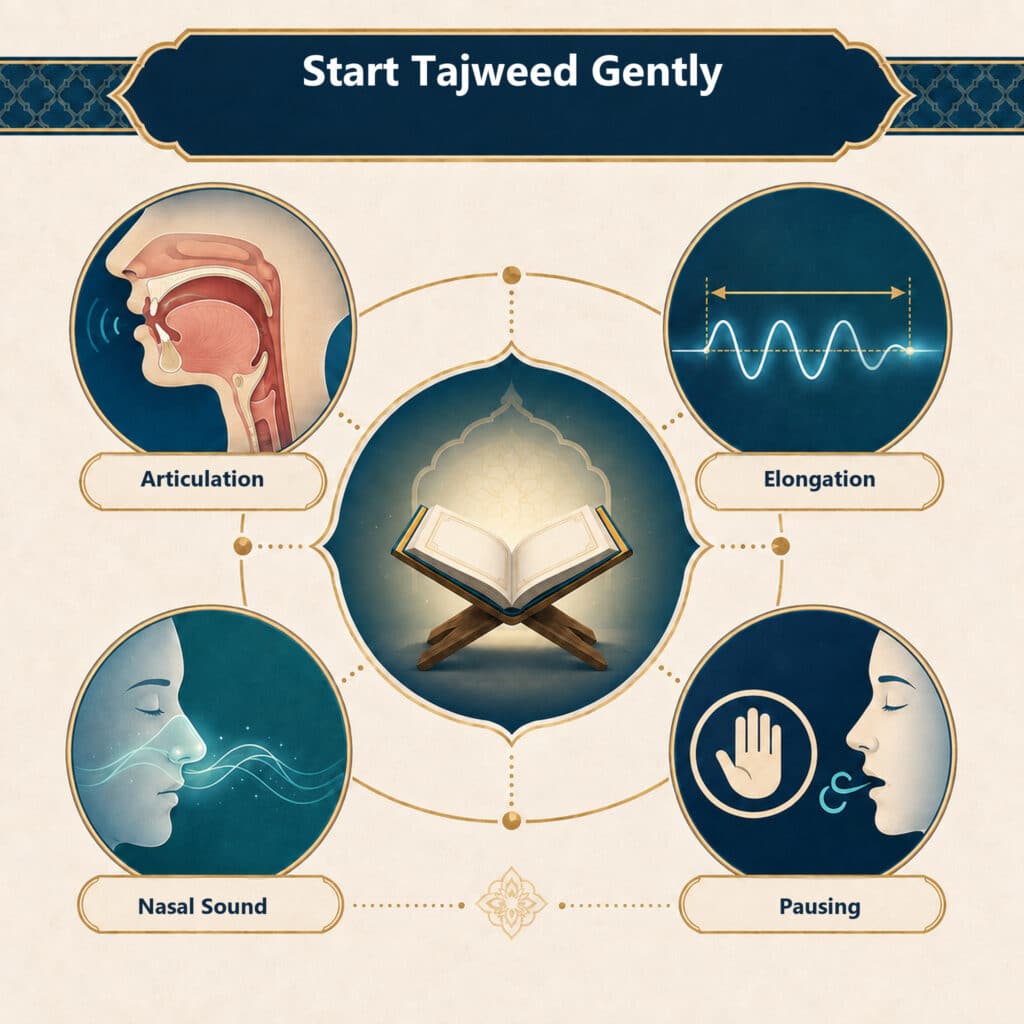
Hekma Academy’s online Tajweed course describes a beginner level that starts with letters, their characteristics, and basic pronunciation. Ask for an assessment so the study plan begins with the skills you actually need.
How often should a beginner practice Quran reading?
Practice for about 15 focused minutes most days. Short, repeated sessions with listening, reading aloud, correction, and review are more manageable than occasional long sessions.
Regular contact helps letters and sound patterns remain familiar. A 2025 meta-analysis of classroom studies found an overall advantage for distributed practice over massed practice, although the best spacing varies by material and learner. The study supports spreading learning across sessions rather than concentrating the same total time into one sitting. Review the distributed-practice meta-analysis for the underlying evidence.
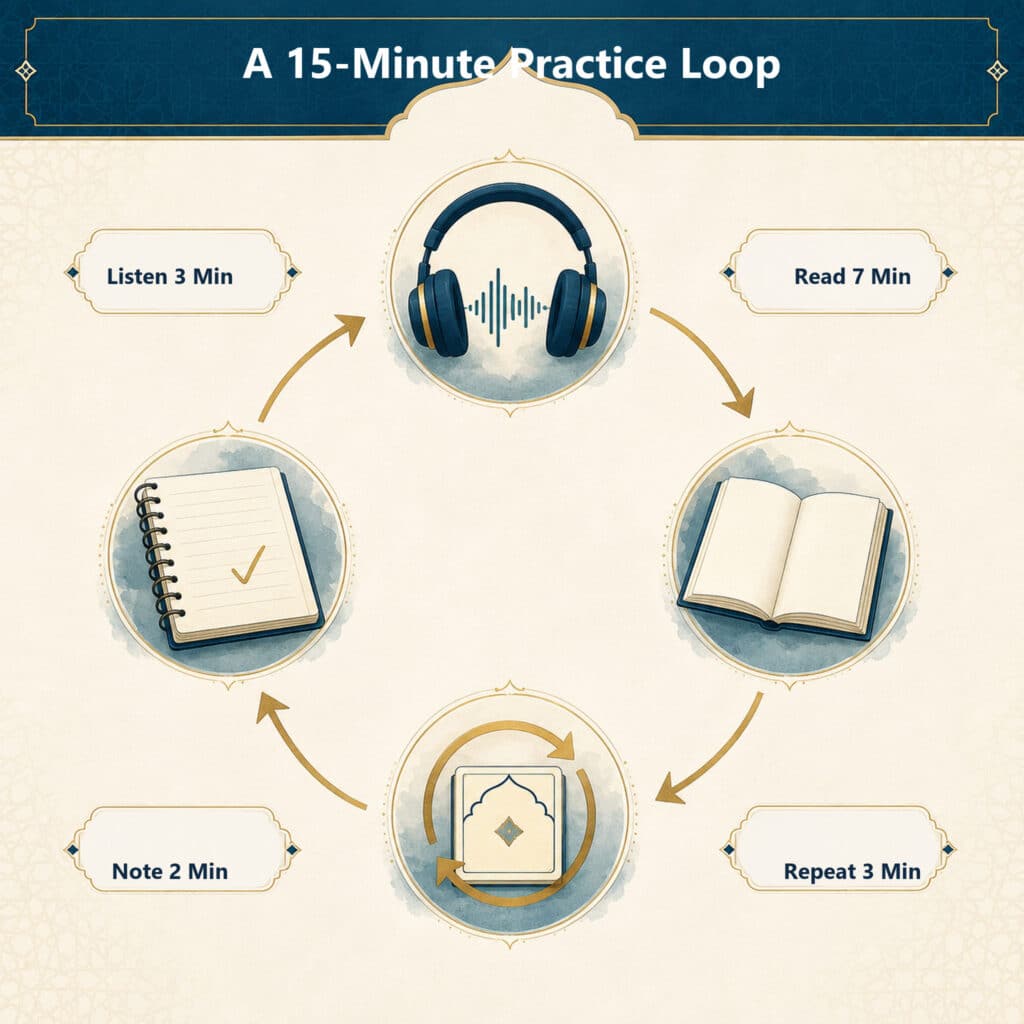

A beginner can use the following suggested routine. The timings are flexible, and the routine does not promise a particular learning speed.
- Listen to the day’s letters or passage for three minutes.
- Read aloud from the marked text for seven minutes.
- Repeat the hardest part without the audio for three minutes.
- Note one correction or question for two minutes.
The final recall attempt matters because recognition can feel stronger than independent reading. A large classroom meta-analysis found that low-stakes testing generally improved learning, with results shaped by feedback and other conditions. For Quran reading, “testing” can mean attempting a letter or line before replaying the model, then checking the attempt. See the retrieval-practice review.
Five focused days may suit one learner, while three longer sessions may suit another. Choose a schedule you can maintain. Accuracy and consistent return matter more than an ambitious plan that ends after one week.
What mistakes slow down Quran reading progress?
Most beginner difficulties come from rushing, avoiding audible practice, or repeating errors without feedback. A clear correction process is more helpful than self-criticism.
The table below pairs common habits with practical corrections. The corrections keep the focus on actions within the learner’s control.
| Common mistake | Why the mistake causes difficulty | Better next action |
|---|---|---|
| Relying only on transliteration | English letters cannot represent every Arabic sound | Use transliteration briefly beside Arabic text |
| Racing through the alphabet | Weak recognition follows the learner into words | Review small letter groups from memory |
| Practicing only in silence | Silent reading hides pronunciation problems | Read aloud at a comfortable volume |
| Memorizing rules without applying them | Definitions remain separate from recitation | Apply one rule to one short passage |
| Copying melody before accuracy | Melody can hide missed letters or lengths | Establish letters and timing first |
| Practicing errors repeatedly | Repetition can strengthen the wrong pattern | Seek feedback and repeat the corrected form |
| Comparing yourself with fluent readers | Comparison replaces useful diagnosis with pressure | Track your own specific corrections |
Another common mistake is waiting for confidence before reading aloud. Confidence often develops after supported practice, not before practice. Give a teacher permission to stop and correct one issue at a time. Too many corrections at once can make a beginner lose the reading thread.
Also avoid switching constantly between primers, teachers, reciters, and color systems. Choose one main learning path for several weeks. Add another resource only when the new resource solves a specific problem.
Begin your Quran journey with patient guidance
Quran reading begins with a modest goal: recognize the letters, produce their sounds, and follow the marks on the page. Short passages and repeated practice can then build steadier decoding. Tajweed grows through attentive application, while a teacher helps identify errors that recordings and books cannot hear.
You do not need to wait until you feel ready. Begin at your current level and let an assessment define the next step. Hekma Academy offers live online guidance shaped around a learner’s level, pace, and goals. Start your free trial to experience the teaching approach before choosing a study plan.
Frequently asked questions
Can I learn to read Quran if I do not know Arabic?
Yes. You can learn to decode and pronounce Quranic Arabic without already speaking Arabic. Reading does not automatically provide comprehension, so study translation, vocabulary, and Tafseer alongside recitation when you are ready. Begin with the Arabic letters and fully vowelled words.
Should beginners start with Noorani Qaida?
Noorani Qaida can give beginners a structured route through letters, joined forms, vowels, and foundational pronunciation. Another reliable primer may also work. The important qualities are a clear sequence, accurate modeling, applied practice, and correction from a knowledgeable teacher.
Can I learn Quran reading without a teacher?
Books and recordings can help you recognize script and imitate recitation. However, those resources cannot hear your pronunciation. Teacher feedback becomes especially valuable for articulation points, vowel length, doubled sounds, nasal sounds, and stopping. A blended approach uses independent daily practice between live corrections.
How long does learning to read the Quran take?
No single timeline fits every beginner. Previous exposure to Arabic, practice frequency, sound discrimination, lesson quality, and individual pace all affect progress. Use skill milestones instead of a deadline. First recognize letters, then read marked words, short phrases, and short passages with increasing independence.
Should I learn Tajweed before reading the Quran?
Learn Tajweed alongside reading, but introduce the rules gradually. Accurate letter sounds and short vowels come first. Apply basic Tajweed to the words you can already decode, then expand the rule set as reading becomes steadier. A teacher can decide which correction deserves priority.