

Qalqalah in Tajweed is the brief release you hear when one of five Arabic letters has no vowel. Beginners often call the sound a “bounce,” but a correct Qalqalah does not add an extra vowel or stretch the letter. In this guide, you will learn the five letters, when the rule applies, why books describe two types or three degrees, and how to recognize each case in Quran verses. The examples give you a way to listen and practice with care.
What Qalqalah Means in Tajweed
Qalqalah is a short, audible release of one of five Arabic consonants when that consonant has no following vowel. The release keeps the letter clear without adding a vowel.
Tajweed means the rules and practices for accurate Quran recitation. Within Tajweed, every Arabic letter has a makhraj, or place where its sound is formed. Some letters close the airflow firmly at that place. If you try to hold such a letter without a following vowel, its sound may seem to disappear. Qalqalah gives the letter a brief release, so a listener can hear it clearly.
The Arabic word qalqalah conveys movement or shaking. “Bounce” and “echo” are useful English comparisons, provided you treat them as listening cues. You do not shake your head, repeat the consonant, or sing a second syllable. The sound comes from releasing the contact that made the consonant.
For a simple example, close your lips to make بْ (bāʾ with sukoon). A light release lets the consonant be heard. If you open into “ba,” you have added a vowel. If you keep the lips closed with no release, the consonant becomes hard to hear. The useful middle ground is short and controlled.
Why the Sound Bounces
The five Qalqalah letters share a firm closure in their pronunciation. A sukoon means the consonant has no following short vowel. The reciter forms the consonant at its own makhraj, then releases the closure. That release is the audible feature called Qalqalah.
The feature is part of the letter’s proper pronunciation in this condition. You should still hear ق as qāf, ط as ṭāʾ, and ب as bāʾ. A louder bounce cannot repair a letter formed at the wrong place. Clear articulation comes first; the release follows naturally.
What Qalqalah Is Not
Qalqalah is neither a new short vowel nor a long note. A learner may accidentally turn دْ into “da,” “di,” or “du” while trying to make the bounce audible. Another learner may draw the release out until it sounds like an echo effect. Neither habit reflects the concise sound described by the rule.
The sound is also different from Madd, the lengthening of a vowel. Qalqalah concerns a consonant with no following vowel. Keeping that distinction in mind prevents you from measuring the bounce in vowel counts.
The Five Letters of Qalqalah
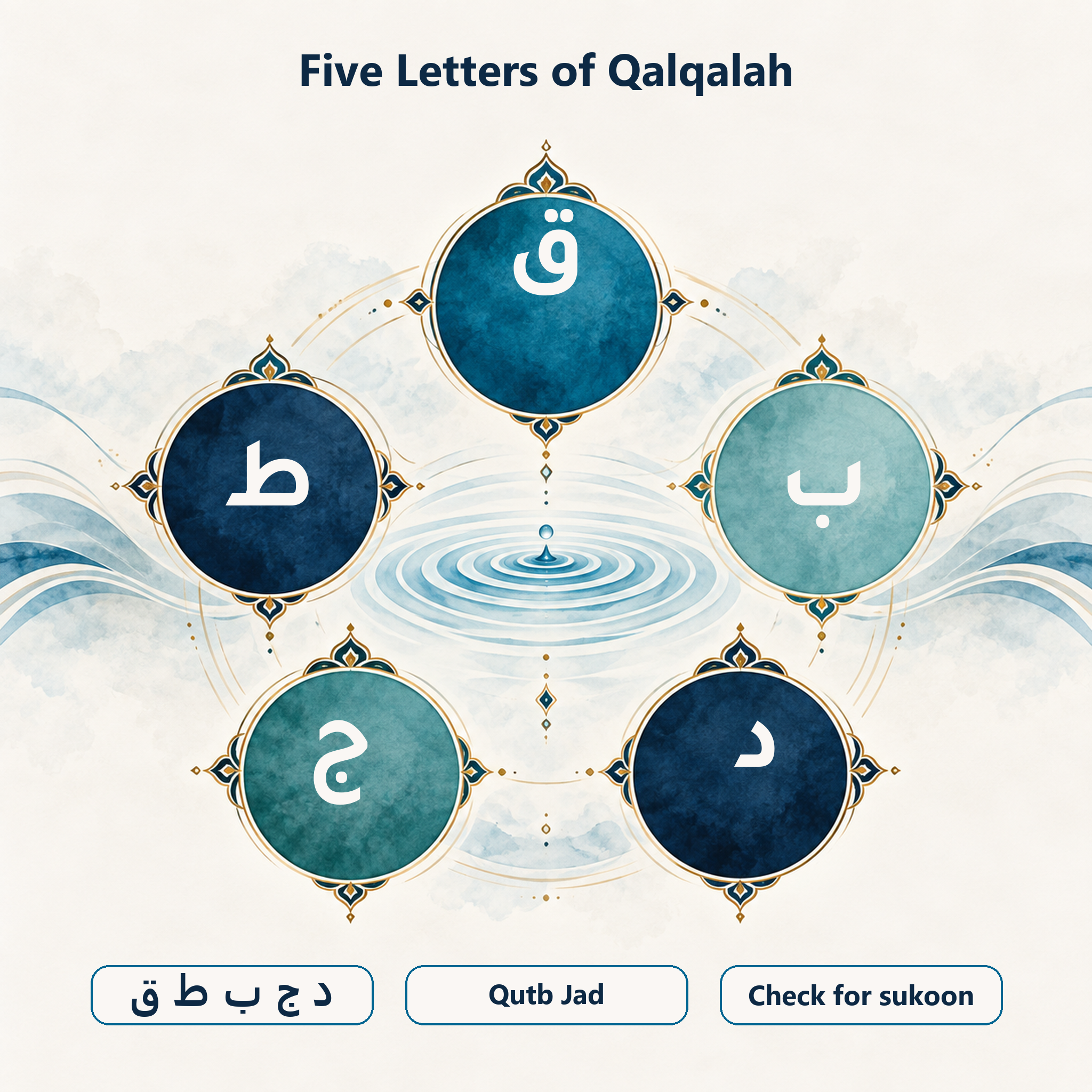
The Qalqalah letters are ق, ط, ب, ج, and د. The phrase قُطْبُ جَدٍّ (Qutb Jad) helps you remember them, but each letter retains its own articulation point.
Read the phrase as a memory aid, not as a Quran quotation. Its five consonants give you the complete set: ق (qāf), ط (ṭāʾ), ب (bāʾ), ج (jīm), and د (dāl). No sixth letter joins the set simply because it also sounds sharp or has a written sukoon.
Qutb Jad as a Memory Aid
A beginner may recognize ب and د quickly but need more time with ق, ط, and ج. Give each letter its own attention. If you substitute ك for ق, the bounce will not make the original letter accurate. The same concern applies when ط becomes the lighter ت.
Keep Each Letter’s Own Sound
The two lips meet for ب. The tongue forms ق, ط, ج, and د at different places. Those details shape the consonant before you release it. Our makharij al huroof guide explains how Arabic articulation points help you keep nearby sounds distinct.
Do not make every Qalqalah letter sound like the same English “uh” or “ah.” First identify the Arabic letter, then form its proper contact, and finally release the contact without a new vowel. The letter’s own sound should remain recognizable. If you are helping a child, praise careful listening before asking for a stronger bounce. Volume is a poor substitute for precision.
When the Qalqalah Rule Applies
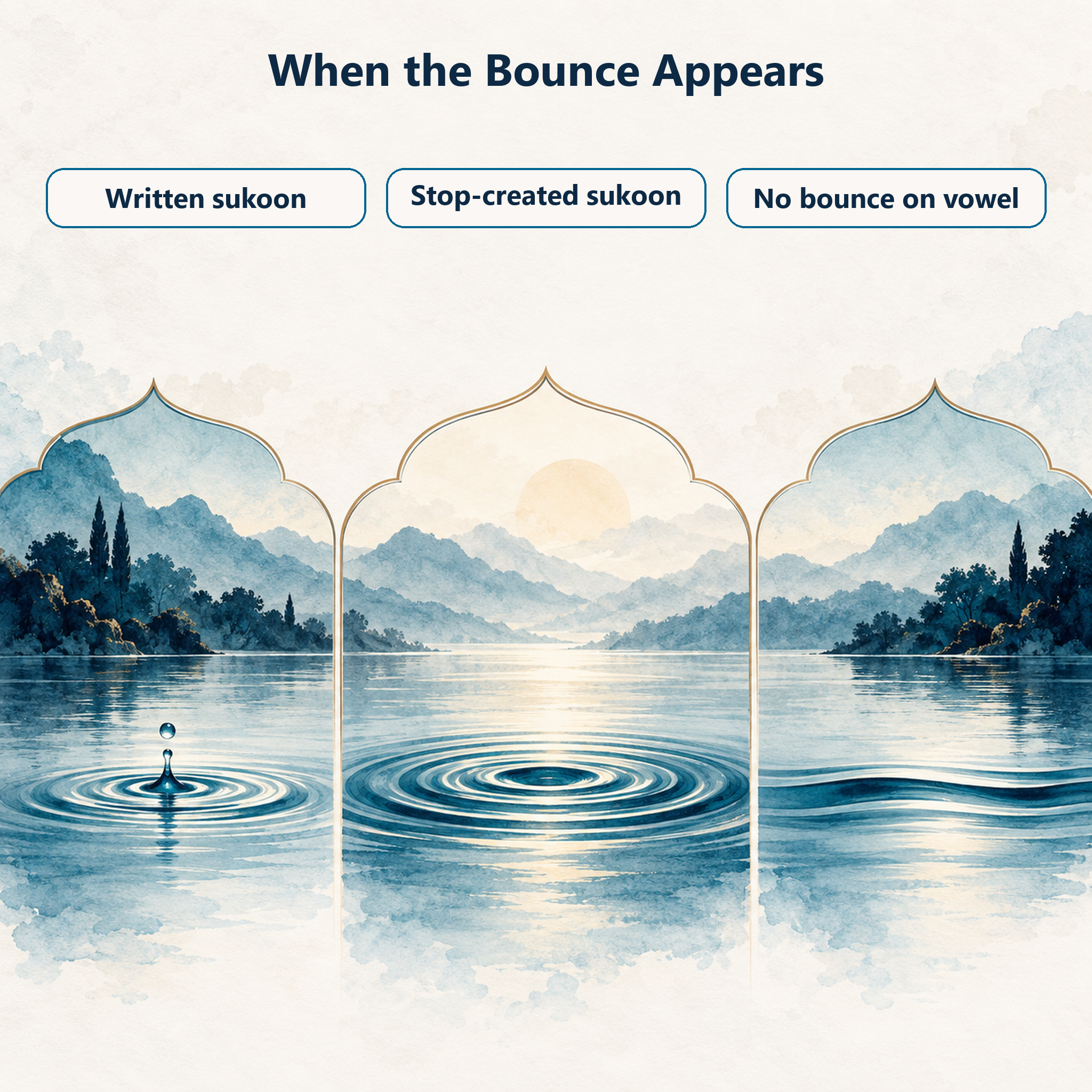
Apply Qalqalah when a Qalqalah letter has sukoon, whether written within a word or created when you stop on its final letter. A normally voweled letter has no Qalqalah while you continue.
The sukoon mark, ْ, shows that a letter has no following short vowel. In many Quran words, the mark is visible over a Qalqalah letter. Stopping at the end of a word also makes its final letter vowelless in pronunciation, even if the printed word shows a vowel ending. The listening condition is the same: a member of ق ط ب ج د is pronounced without a following vowel.
Written Sukoon Inside a Word
In خَلَقْنَا (khalaqnā, “We created”) at Quran 50:16, the قْ has a written sukoon. You hear a brief release from qāf before moving to ن. The word continues, so the release stays light. You do not insert a short vowel between the two letters.
The same principle applies in أَطْعَمَهُم (aṭʿamahum, “He fed them”) at Quran 106:4. The طْ is vowelless within the word. Form the heavier ṭāʾ correctly, release it, then move to ع. The bounce should not turn ṭāʾ into an extra “ta” syllable.
Sukoon Created by a Stop
Consider أَحَدٌ (aḥadun, “One”) at Quran 112:1. If you continue the recitation, its final د carries an ending sound. If you stop at the verse end, you say aḥad and the final د becomes vowelless. Qalqalah then makes that final letter clear.
The written ending and the spoken stopping form are different. This is why a verse example must say whether you are continuing or stopping. Reading the page alone does not tell the whole story. Your stopping choice matters.
When a Vowel Means No Bounce
If a Qalqalah letter carries fatḥah, kasrah, or ḍammah, it already has a following short vowel. Pronounce the letter and vowel normally while continuing. Do not add a separate Qalqalah bounce to every visible ق, ط, ب, ج, or د.
For example, the first ق in قُلْ (qul, “say”) at Quran 112:1 has a ḍammah. The Qalqalah rule does not apply to that voweled ق. The final لْ is also not a Qalqalah letter. These two quick checks prevent a great deal of over-application.
Types of Qalqalah and the Three Degrees
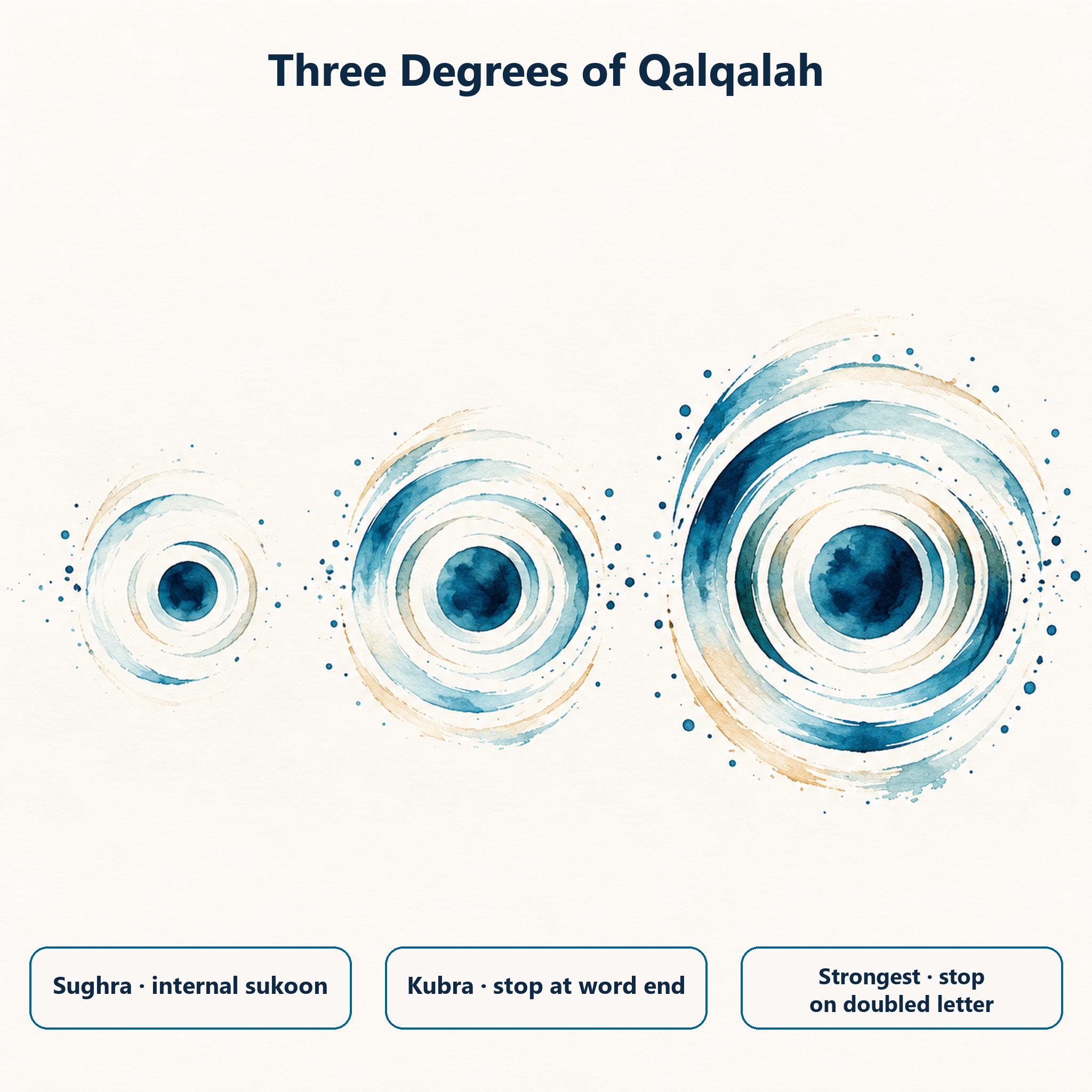
Many primers name two types, Sughra and Kubra. For finer listening, teachers distinguish a third, strongest case when you stop on a doubled Qalqalah letter. The names for three degrees vary.
The basic distinction is easy to hear: an internal vowelless letter receives a light release; a final letter on which you stop receives a clearer release. A shaddah, ّ, marks a doubled consonant. When you stop on a final doubled Qalqalah letter, its release becomes most pronounced. The respected introductory manual An Introduction to Tajweed describes these three sound situations while naming the first two Sughra and Kubra.
The table compares the three sound situations. Its labels are useful for learning, but your teacher’s terminology may differ.
| Degree | Reading condition | Quran example | What to hear |
|---|---|---|---|
| Sughra, lesser | A Qalqalah letter has written sukoon within a word, and reading continues. | خَلَقْنَا (khalaqnā), 50:16 | A light, quick release. |
| Kubra, greater | You stop on an undoubled final Qalqalah letter. | الْفَلَقِ (al-falaq), 113:1, when stopping | A clearer release at the stop. |
| Strongest doubled case, sometimes called Akbar | You stop on a final Qalqalah letter with shaddah. | وَتَبَّ (wa tabb), 111:1, when stopping | The most pronounced release, without adding a vowel. |
The table describes relative clarity, not a timed duration. None of the three cases calls for a theatrical or prolonged sound.
Sughra for a Light Release
Qalqalah Sughra means the lesser form. You normally meet the light release inside a word with original sukoon, as in خَلَقْنَا. The next letter arrives immediately, so you should not pause to showcase the bounce. The listener should still hear qāf distinctly.
A vowelless Qalqalah letter at a word boundary may also be followed by another word without a stop. Some teaching schemes discuss that case separately. The fundamental pronunciation remains a brief release as the recitation continues. Do not assume that a word boundary alone creates the stronger stopping sound.
Kubra When You Stop
Qalqalah Kubra means the greater form. A stop on الْفَلَقِ (al-falaq, Quran 113:1) leaves ق without its following vowel in pronunciation. Because the recitation ends there, the release is more apparent than the light internal case. The same idea applies when you stop on أَحَدٌ (aḥadun, Quran 112:1) and pronounce the final د without its written ending vowel.
Do not mistake “greater” for “longer.” The release is clear and contained. A drawn-out consonant or added “uh” changes the exercise from articulation to embellishment.
The Strongest Doubled-Letter Case
At the end of وَتَبَّ (wa tabb) in Quran 111:1, the بّ has a shaddah. When you stop on that word, the doubled bāʾ ends in a particularly clear Qalqalah release. The doubled consonant should still sound like one word ending, not two separate bounces followed by a vowel.
The distinction matters because the same verse also contains تَبَّتْ (tabbat). That word ends in ت, which is not among the five Qalqalah letters. وَتَبَّ, at the verse end, supplies the doubled ب example. Matching the rule to the correct word protects you from memorizing a faulty example.
Why Three-Type Labels Differ
You may see a page list “three types of Qalqalah” as Sughra, Kubra, and Akbar. Another teacher may say Sughra, Wusta, and Kubra, assigning “Kubra” to the strongest doubled case. Other primers keep just two names and describe the doubled case within the greater category. These are teaching labels for the strength and context of the same five-letter rule.
If a lesson uses unfamiliar names, ask what each name means in actual recitation: Is the letter inside a word? Are you stopping? Is the final letter doubled? Those three checks are more reliable than memorizing a label without its condition. Follow your teacher’s terminology consistently while keeping the sound situations clear.
Qalqalah Examples from the Quran
Qalqalah examples from the Quran become useful when you identify the exact letter, verse, and reading condition. The first five rows below give one internal-sukoon example for each Qalqalah letter. The last three show what changes at a stop.
| Target letter | Quran word and reference | Reading condition | What to notice |
|---|---|---|---|
| قْ | خَلَقْنَا (khalaqnā), 50:16 | Continue through the word. | Release qāf before ن. |
| طْ | أَطْعَمَهُم (aṭʿamahum), 106:4 | Continue through the word. | Keep the ṭāʾ distinct before ع. |
| بْ | أَبْصَارِهِمْ (abṣārihim), 2:7 | Continue through the word. | Release the lips for bāʾ before ص. |
| جْ | يَجْعَل (yajʿal), 65:2 | Continue through the word. | Hear jīm before ع. |
| دْ | يَدْخُلُونَ (yadkhulūna), 110:2 | Continue through the word. | Release dāl before خ. |
| Final ق | الْفَلَقِ (al-falaq), 113:1 | Stop on the word. | The final qāf becomes vowelless. |
| Final د | أَحَدٌ (aḥadun), 112:1 | Stop on the word. | The ending becomes aḥad. |
| Doubled final بّ | وَتَبَّ (wa tabb), 111:1 | Stop on the word. | Hear the strongest release without another vowel. |
One Example for Each Letter
The five internal examples make a useful first practice set because every target consonant has a visible sukoon. Begin with the letters you already recognize. In أَبْصَارِهِمْ, for instance, the lips close for بْ and release before the next consonant. In يَدْخُلُونَ, the tongue releases دْ before the word moves to خ.
Examples That Change When You Stop
The stopping examples require a small decision by the reciter. In أَحَدٌ, the written ending has tanween, a doubled vowel mark. On stopping, that ending is not sounded in the same way, and the final د receives Qalqalah. In الْفَلَقِ, stopping makes the final ق vowelless in pronunciation. If you continue into the next phrase, apply the appropriate continuing pronunciation instead.
Compare a Qalqalah release with types of Madd, which concern vowel lengthening. In these examples, you are clarifying a consonant, not adding counts to a vowel. That distinction is especially helpful if the word includes both a long vowel elsewhere and a Qalqalah letter.
How to Pronounce and Practice Qalqalah
Begin with the letter’s normal articulation, then make a brief release without opening into a new vowel. Listen to a reliable recitation and let a qualified teacher check the sound you produce.
Reading a definition is a good start, but Qalqalah is heard in the mouth and ear. We recommend practicing one target letter at a time, then placing it back inside a Quran word. Try the same short passage while reading and while listening. The comparison helps you notice whether your bounce is missing, excessive, or colored by an extra vowel.

Release the Letter Without a New Vowel
Place the letter at its correct makhraj first. For بْ, close both lips. Release them briefly without shaping “ba,” “bi,” or “bu.” For قْ, form qāf in its proper position, then let the consonant release before the next letter. Avoid trying to manufacture one identical bounce for all five letters.
The physical cue is separation after contact, not a large jaw motion. A small, controlled release makes the consonant audible. If your mouth forms a new vowel, shorten the motion and try again at a slower pace. If nothing can be heard, check that the closure actually releases.
Common Mistakes to Hear
An added vowel is the most recognizable mistake. أَبْصَارِهِمْ should not acquire an extra syllable after بْ. A missing release causes the consonant to sound swallowed. An oversized release can interrupt the flow of the verse. Over-applying Qalqalah to other letters is another trap; always return to ق ط ب ج د.
Pronouncing the wrong Arabic letter is a separate problem. If ق sounds like ك, or ط sounds like ت, making a louder bounce will not restore the target consonant. Work on the articulation point before judging the Qalqalah strength. If you are guiding a child, choose one clear listening goal at a time. Gentle correction supports attention better than asking for a dramatic sound.
Practice With Feedback
Use this short sequence with one Quran word before moving to a whole verse:
- Locate the trigger. Find one of ق ط ب ج د and check for written sukoon or a stop that makes the final letter vowelless.
- Listen and recite. Hear the word in a reliable recitation, then say it slowly while keeping the consonant’s own articulation.
- Check the release. Ask whether the letter remained clear, whether a new vowel appeared, and whether the sound stayed brief.
Return to the word at a natural reading pace. Recordings help you compare attempts, but your own ear may miss a familiar mistake. Our online Tajweed course offers guided recitation practice, so a tutor can hear how you form and release the letters.
Qalqalah Questions Beginners Ask
What Is Qalqalah in Tajweed?
Qalqalah is a brief audible release of ق, ط, ب, ج, or د when the letter has no following short vowel. The sound helps the consonant remain distinct. You form the letter at its own articulation point and release it without adding a new “a,” “i,” or “u.”
What Are the Five Letters of Qalqalah?
The five letters are ق ط ب ج د, remembered through قُطْبُ جَدٍّ (Qutb Jad). Learn both the mnemonic and the individual sounds. Recognizing the set lets you find a possible Qalqalah letter, while checking for sukoon tells you whether the rule applies in that reading.
Are There Two or Three Types of Qalqalah?
Many beginner texts name two types: Sughra for a lighter release and Kubra for a stronger stopping release. Teachers may also distinguish a third, strongest degree when the stopped final letter has shaddah. That third case is sometimes called Akbar. Other three-name schemes use Wusta and Kubra differently, so match each label to its actual condition.
Does Qalqalah Apply When the Letter Has a Vowel?
No. While you continue reading, a Qalqalah letter with fatḥah, kasrah, or ḍammah is pronounced with that vowel. Qalqalah applies when the consonant is vowelless. A stop can change a final voweled letter into a vowelless stopping pronunciation, which is why the same printed word may sound different at a pause.
How Do I Practice Qalqalah Without Adding a Vowel?
Begin with one vowelless letter. Form its correct contact, release it briefly, and listen for an extra “a,” “i,” or “u.” Then use a Quran word with a verified sukoon, such as خَلَقْنَا (khalaqnā, 50:16). A tutor can hear the release and help you adjust the sound in context.
The rule is compact: know the five letters, check for sukoon, and give the consonant a clear, brief release. Work slowly enough to hear the difference between a clean bounce and an added vowel. If you would like feedback on your recitation, start a trial with Hekma Academy. A tutor can listen to your current pronunciation and help you choose a sensible next focus.