

Hadith vs Quran is not a choice between two competing books. The Quran is Islam’s primary scripture. Hadith are transmitted reports about Prophet Muhammad’s ﷺ words, actions, and approvals. Muslims study authenticated hadith to understand the Prophetic Sunnah and how Quranic guidance was explained and practiced. This guide compares their authority, wording, transmission, authentication, and everyday use. It also explains why the reliability of an individual hadith must be examined carefully.
What Is the Quran?
The Quran is Islam’s primary scripture, believed by Muslims to be Allah’s revealed words, recited in worship and preserved as a fixed Arabic text.
Muslims believe Allah revealed the Quran to Prophet Muhammad ﷺ through the angel Jibril. The revelation occurred over approximately 23 years. The Quran identifies itself as guidance, a criterion between truth and falsehood, and a reminder.
The precise Arabic wording is central to the Quran’s identity. A translation communicates an interpreter’s understanding of the meanings. A translation is not the Quran itself in the same technical sense as the Arabic revelation.
Quranic recitation is also an act of worship. Muslims recite passages from the Quran in every formal prayer. Muslims may read translations for understanding, but ritual recitation uses the Arabic text.
The Quran describes Allah as the guardian of the revealed reminder. Quran 15:9 states, in meaning, that Allah revealed the reminder and will preserve it. Muslims therefore approach the Quran as the highest textual authority in Islam.
Quranic transmission combined memorization and writing from the earliest Muslim community. A chapter in the Cambridge Companion to the Quran describes the Quran as an oral text that was also written during the Prophet’s lifetime. The article also discusses the later production of the Uthmanic codex.
Readers who want structured help with recitation, memorization, or interpretation can explore Hekma Academy’s Quran courses.
What Is Hadith?
Hadith are transmitted reports describing the sayings, actions, approvals, or qualities of Prophet Muhammad ﷺ. Scholars examine their chains and texts before assigning reliability.
The word hadith can refer to one report or to the wider body of reports. A report usually contains two main parts. The isnad identifies the chain of people who transmitted the report. The matn is the report’s wording or content. Oxford Academic’s introduction to modern hadith studies explains this basic structure and the report’s connection to the Sunnah.
Hadith and Sunnah are closely connected, but the terms are not identical. The Sunnah is the Prophet’s normative example or way. Hadith are reports through which scholars identify and study that example. A hadith is therefore evidence about the Sunnah, subject to authentication and interpretation.
Hadith may describe something the Prophet said, did, permitted, or corrected. Reports also preserve information about worship, ethics, family life, commercial dealings, and the Prophet’s personal qualities. Some early usages included reports from Companions or later authorities. Scholars developed more specific terminology as the field matured.
Hadith collections are also different from a single authored narrative. Compilers organized thousands of reports by subject, narrator, legal topic, or another scholarly purpose. The same Prophetic teaching may appear through several chains and with modest wording differences. Those parallel versions can help critics compare transmission and meaning.
A hadith qudsi reports a meaning attributed to Allah in the Prophet’s words. Hadith qudsi still does not become part of the Quran. Hadith qudsi is not recited as Quran in prayer, and each report remains subject to hadith authentication. The category shows why source, wording, and ritual status must remain distinct.
An online quotation labeled “hadith” does not become reliable through repetition. A proper reference should identify the collection, location, translation, and scholarly grading when relevant. The surrounding chapter or related narrations may also affect interpretation.
Hadith belongs within a larger field of Islamic learning. Hekma Academy’s Islamic courses introduce learners to connected subjects such as Quran, Hadith, Fiqh, Aqeedah, and Seerah.
What Are the Main Differences Between Hadith and the Quran?
The Quran and Hadith differ in origin, wording, status, preservation, and use. The following comparison gives each source its proper place without separating two connected parts of Islamic learning.
| Dimension | Quran | Hadith |
|---|---|---|
| Basic identity | Islam’s revealed scripture | Reports about the Prophet’s words, actions, approvals, or qualities |
| Wording | Muslims believe the Arabic wording is from Allah | Reports were conveyed through human narrators, sometimes with permissible variation in wording |
| Authority | Primary and highest textual authority | Authoritative according to authenticity, meaning, context, and scholarly use |
| Form | One canonical scripture divided into surahs and verses | Individual reports preserved across many collections |
| Transmission | Mass recitation, memorization, and written transmission | Narration through identifiable chains, books, teaching sessions, and manuscript transmission |
| Authentication | The Quranic text is received as a whole through communal transmission | Each report may require evaluation of its chain, text, corroboration, and defects |
| Ritual recitation | Recited as Quran in formal prayer | Not recited as Quran in formal prayer |
| Main function | Establishes Islam’s foundational beliefs, principles, commands, and guidance | Preserves the Prophetic explanation, example, application, and additional guidance |
| Translation | A translation represents the meanings, not the original Arabic Quran | Translations convey a report’s meaning but may differ in precision and terminology |
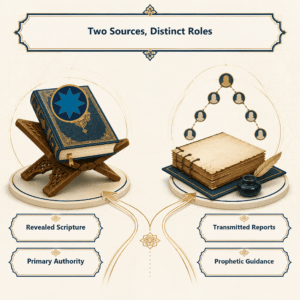
The table does not mean that every Quranic verse functions in the same way or that every hadith carries equal weight. Quranic interpretation considers language, context, other verses, and established scholarship. Hadith interpretation adds another question: how reliably was the report attributed?
The word sahih means that a hadith meets defined standards of authenticity within a scholarly method. The label does not mean that every reader can apply the report without context. Jurists also examine scope, legal indication, related evidence, and the way earlier scholars understood the report.
Muslim traditions share reverence for the Quran, but their hadith collections and methods are not identical. This article follows the mainstream Sunni framework reflected in Hekma Academy’s educational context. The difference should be acknowledged without turning an introductory guide into sectarian debate.
The Quran also differs from tafsir, which means explanation and interpretation of Quranic verses. Tafsir draws upon Arabic, Quranic context, Hadith, early commentary, and other scholarly disciplines. Learners seeking guided interpretation can review Hekma Academy’s online Tafseer course.
How Do the Quran and Hadith Work Together?
The Quran establishes foundational guidance, while the authenticated Sunnah explains, demonstrates, specifies, and applies that guidance. Muslims therefore study both, with the Quran holding primary authority.
The Quran repeatedly connects obedience to Allah with obedience to the Messenger. Quran 4:59 tells believers to obey Allah and the Messenger, then refer disputes to Allah and the Messenger. Quran 16:44 states that the reminder was sent to the Prophet so he could explain what had been revealed.
The relationship becomes clearer when a broad Quranic command requires practical instruction. Three familiar acts of worship illustrate the pattern:
- The Quran commands prayer, while the Sunnah demonstrates its timings, units, movements, and many detailed rulings.
- The Quran commands zakat, while the Sunnah helps explain applicable property, thresholds, amounts, and administration.
- The Quran commands pilgrimage, while the Sunnah preserves the Prophet’s demonstration of many Hajj rites.
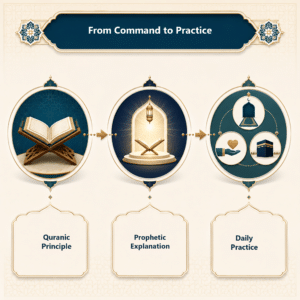
These examples do not reduce Hadith to an instruction manual. Prophetic reports also teach faith, character, mercy, intention, family conduct, and community responsibilities. The examples simply show why many Quranic commands cannot be separated from Prophetic practice.
Egypt’s Dar al-Ifta describes several relationships between the Quran and Sunnah. The Sunnah may confirm a Quranic teaching, explain a general command, specify its application, or provide additional guidance. Its overview of the history and sources of Islamic law presents the Quran and Sunnah as Islam’s foundational revealed sources.
Hadith still requires careful handling. A reader must not use an unreliable report to define the Sunnah. A sound report must also be read with relevant Quranic verses and other Prophetic reports. Islamic legal interpretation developed because responsible application needs more than a search result or isolated translation.
Parents can introduce this relationship gradually. A child may learn a Quranic teaching, see how Prophet Muhammad ﷺ practiced the teaching, and then connect both sources to conduct. Hekma Academy’s Islamic Studies for Kids includes Quran, Hadith, Seerah, beliefs, worship, and manners within one learning pathway.
How Are Hadith Authenticated?
Hadith authentication is a disciplined scholarly process, not a simple check for a famous book title. Early Muslim specialists compared narrations, examined transmitters, traced learning relationships, and looked for errors or hidden defects.
The process can be summarized in five connected stages. Actual hadith criticism is more detailed, and qualified critics may differ in individual judgments.
- Identify the report and its sources. Scholars locate the wording across early collections and gather the available transmission routes. A social post without a traceable reference cannot support serious analysis.
- Examine chain continuity. Critics ask whether each narrator could have received the report from the named teacher. Dates, locations, meetings, and known study relationships all matter.
- Evaluate the narrators. Scholars study a narrator’s integrity, memory, accuracy, books, teachers, students, and performance over time. Reliability is specific evidence, not a vague reputation.
- Analyze the text. Critics compare the wording with stronger narrations and established principles. They look for contradiction, error, interpolation, unusual language, or another hidden problem.
- Seek corroboration and reach a grade. Parallel chains or related reports may strengthen attribution. Scholars then classify the report through technical categories such as sahih, hasan, da’if, or mawdu.
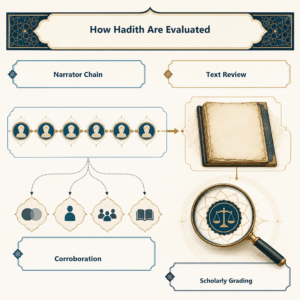
These English labels require nuance. Sahih is commonly translated as authentic or sound. Hasan usually means good or acceptable. Da’if means weak, with weakness ranging from mild to severe. Mawdu refers to a fabricated report. Different scholars may reach different grades because they possess different evidence or weigh technical factors differently.
Dr. Jonathan Brown’s overview of hadith authentication and criticism explains how critics examined source reliability and corroboration. The overview also notes differences between early critical practice and later textbook terminology.
Authentication concerns both individual reports and the transmission of books. Public readings, authorized copies, teacher-student transmission, manuscript comparison, and written records helped preserve hadith collections. A study of hadith literature’s transmission and preservation surveys several of those procedures.
A grade answers an important question about attribution, but a grade does not settle every legal or interpretive question. A qualified scholar may need to reconcile the report with other evidence. The scholar may also determine whether a command is general, specific, obligatory, recommended, contextual, or superseded.
Book titles alone cannot replace report-level checking. A respected collection may contain material selected for different purposes, including supporting reports or comments from early Muslims. Numbering can also vary between editions and websites. A useful citation therefore includes the collection, book or chapter, report number when available, and the grading source. Readers should also compare the Arabic and translation when a disputed meaning depends on one word.
Readers who want guided study should look for teachers with relevant knowledge, clear methodology, and humility about scholarly disagreement. Hekma Academy publishes individual backgrounds so prospective learners can meet Hekma Academy’s tutors before choosing a suitable course.
Can a Hadith Contradict the Quran?
An authentic Prophetic teaching cannot truly oppose the Quran. When texts appear to conflict, qualified scholars recheck authenticity, language, context, scope, and reconciliation before judging.
An apparent conflict can arise for several reasons. A quoted report may be weak, mistranslated, incomplete, or removed from its setting. A Quranic verse may be general while an authenticated hadith explains a specific case. Two texts may address different circumstances. A reader may also mistake a personal inference for the text’s actual meaning.
Scholars therefore avoid declaring a contradiction too quickly. The first question asks whether the report is genuinely attributable to the Prophet ﷺ. The next questions concern language, context, related evidence, and interpretive principles. A ruling should not rest on whichever translation appears first in a search.
Dar al-Ifta’s explanation of the Sunnah as a source of legislation describes confirmation, clarification, and specification rather than rivalry between the sources. The framework helps explain why added detail is not automatically a contradiction.
Some questions still involve legitimate scholarly disagreement. Jurists may disagree about a report’s grade, the scope of a verse, or the strongest reconciliation. Respectful disagreement does not make evidence irrelevant. The disagreement shows why trained interpretation matters.
New Muslims should not feel responsible for resolving complex disputes alone. A sound beginning focuses on clear beliefs, worship, Quran reading, and trustworthy guidance. Hekma Academy’s New Muslim Course provides a beginner-oriented route where foundational questions are welcome.
Why Does the Difference Matter?
The difference between Hadith and Quran affects worship, interpretation, teaching, and the way Muslims share religious information. The Quran has unique status as Allah’s recited revelation. Hadith provides evidence for the Prophetic Sunnah, but individual reports carry different levels of reliability and require context.
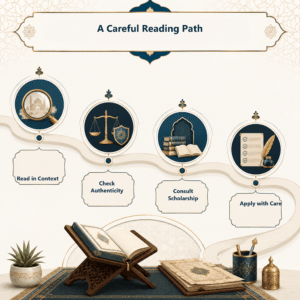
That distinction creates several practical habits. Read the Quran as the primary scripture. Learn the Prophet’s Sunnah through authenticated reports and responsible scholarship. Check a hadith before forwarding a polished quotation. Avoid building a ruling from one translated line. Ask a qualified teacher when sources appear difficult to reconcile.
The goal is not to make Islamic learning inaccessible. Careful study protects the dignity of both sources. Careful study also gives a learner a clearer path from revelation to understanding and practice.
The distinction also supports better family teaching. A parent can identify whether a lesson comes from a Quranic verse, an authenticated Prophetic report, or a scholar’s explanation. A teacher can then explain the evidence at an age-appropriate level. Clear attribution helps learners respect scholarship without confusing commentary with revelation.
Digital sharing makes the same discipline important for adults. Attractive designs often circulate without a source, grade, or context. Pausing before sharing is a form of care. A brief verification protects the reader from attaching the Prophet’s name to words that may not be his.
If you want personal guidance through Quran, Hadith, and foundational Islamic studies, Hekma Academy offers live online learning shaped around your level and questions. Start your free trial to experience the teaching before choosing a study plan.
Frequently Asked Questions
Is Hadith part of the Quran?
No. Hadith are not verses or chapters of the Quran. The Quran is the revealed scripture with its fixed Arabic wording. Hadith are transmitted reports about Prophet Muhammad’s ﷺ teachings, actions, approvals, or qualities. Scholars use authenticated reports to understand the Sunnah and its relationship to Quranic guidance.
Which is more important, the Quran or Hadith?
The Quran holds primary and unique authority as Islam’s revealed scripture. Authenticated Hadith is also authoritative because the Sunnah explains and demonstrates Islamic guidance. “More important” can mislead when the phrase suggests that Muslims should discard one source. The sources have different ranks and functions, and Muslims study them together.
Can Muslims follow the Quran without Hadith?
Mainstream Sunni scholarship says Quranic practice cannot be separated from the authenticated Sunnah. The Quran commands obedience to the Messenger, while the Sunnah preserves the Prophet’s explanation and practice. Detailed performance of prayer and pilgrimage offers clear examples. Muslim groups that reject or limit hadith authority exist, but their position does not represent the mainstream Sunni framework used in this guide.
Are all hadith authentic?
No. Hadith scholars classified reports according to evidence about their chains, narrators, texts, corroboration, and defects. Common classifications include sound, good, weak, and fabricated. Even a sound report needs accurate translation, context, and interpretation before a reader derives a ruling or applies the report to a new situation.
What Is the difference between Hadith and Sunnah?
Hadith are individual reports or the wider body of transmitted reports. Sunnah refers to the Prophet’s normative example, teaching, and practice. Scholars study hadith alongside other evidence to identify the Sunnah. The terms overlap in everyday speech, but the distinction helps readers understand why authenticating a report matters.