Every Arabic letter has a precise place where its sound is formed. In Tajweed, those locations are called makharij al huroof. Learning them helps you distinguish letters that may seem similar, such as ح and ه or ق and ك. Clear articulation also gives Quran recitation a stronger foundation. This guide maps the five major articulation areas and 17 specific points, presents a complete Arabic letters chart, explains common sound pairs, and offers a practical method for guided practice.
What Is Makharij Al Huroof?
Makharij al huroof are the articulation points where Arabic letter sounds begin or become distinct. Learning them helps Quran readers pronounce each letter clearly instead of replacing it with a nearby sound.
The Arabic word makhraj means an exit or point of emergence. Its plural is makharij. The word huroof means letters. Together, makharij al huroof refers to the places from which letter sounds emerge.
Some articulation points involve clear physical contact. The lips meet for ب, for example. Other points are approximate spaces rather than fixed contacts. The long vowels travel through the open cavity of the mouth and throat.
Makharij form one part of Tajweed, the rules for correct Quranic pronunciation and recitation. A reader must also learn sifaat, the characteristics that distinguish each sound. The classical Al-Muqaddimah al-Jazariyyah treats both subjects near the beginning of its Tajweed curriculum.
Allah instructs believers to recite the Quran in a measured way in Surah Al-Muzzammil 73:4. Learning the sound of each letter supports deliberate recitation. Our guide to how to read Quran with Tajweed places letter recognition and pronunciation before more complex rules.
How Are the 17 Makharij Organized?
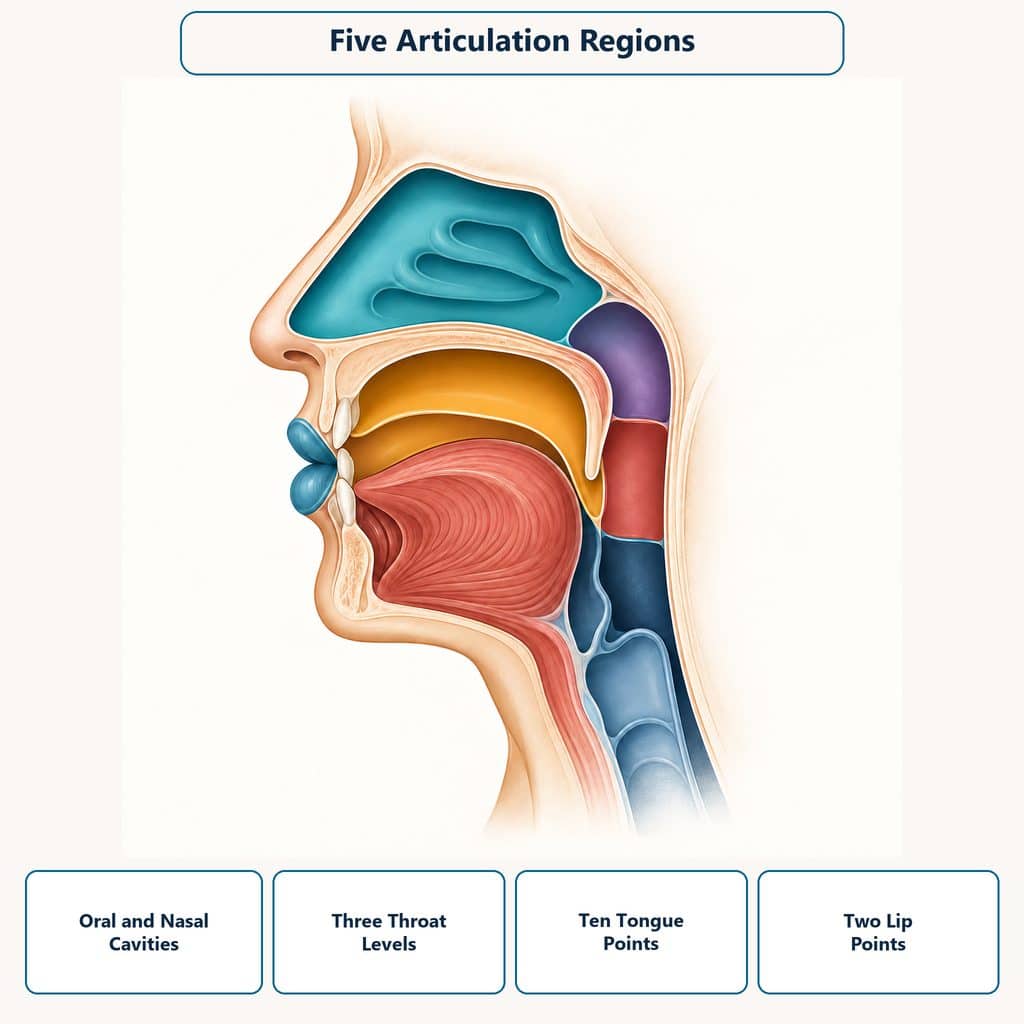
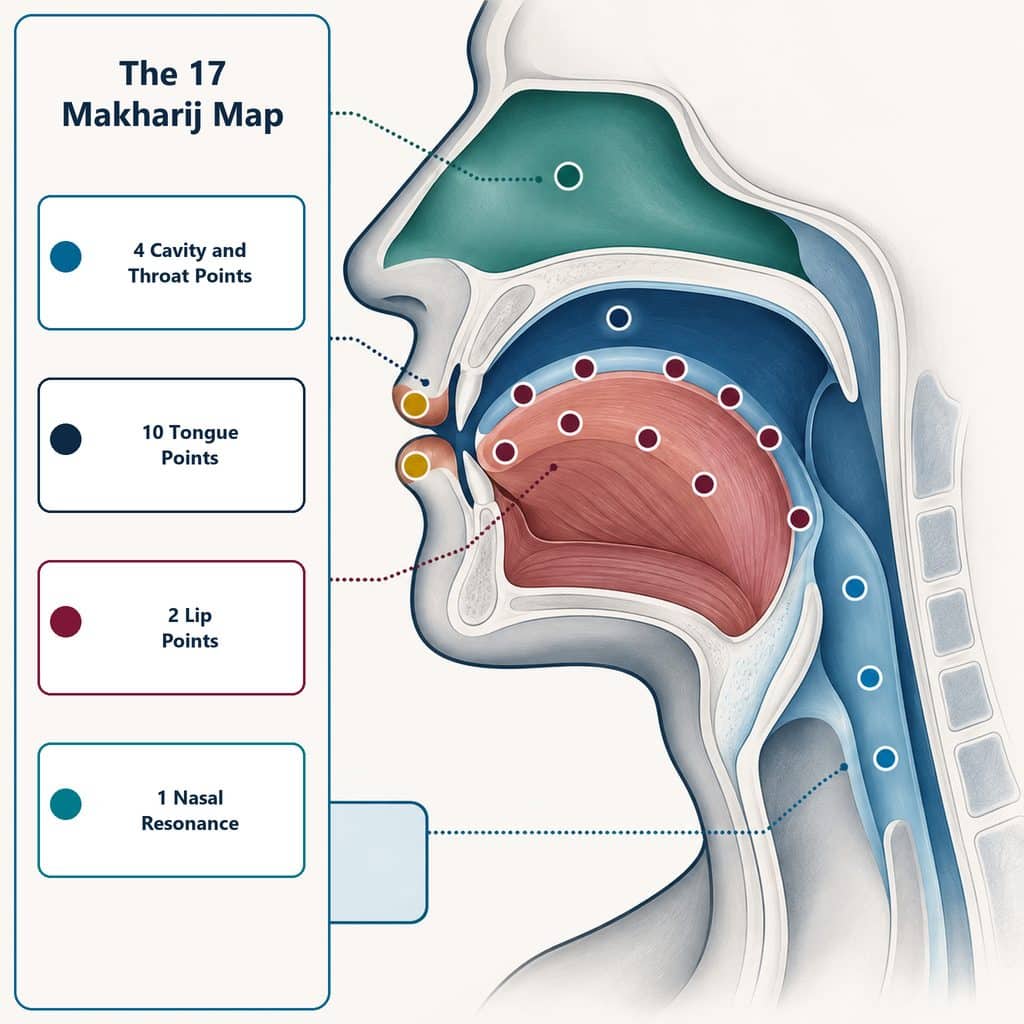
The widely taught system organizes makharij into five broad regions and 17 specific points. The regions are the oral cavity, throat, tongue, lips, and nasal passage.
Imam Ibn al-Jazari presents 17 articulation points in Al-Muqaddimah al-Jazariyyah. A detailed commentary and English translation attributes that position to Al-Khalil ibn Ahmad and notes other scholarly counts. Sibawayh counted 16 because he did not treat the open cavity as a separate point. Al-Farra counted 14 by grouping some tongue points together as well.
Those differences concern classification. They do not give learners permission to merge distinct Arabic sounds. This guide follows the 17-point system because the system offers a precise and practical teaching map.
| Major region | Arabic term | Specific points | Letters or sounds |
|---|---|---|---|
| Open cavity | الجوف (al-jawf) | 1 | The three madd letters ا، و، ي under their long-vowel conditions |
| Throat | الحلق (al-halq) | 3 | ء ه ع ح غ خ |
| Tongue | اللسان (al-lisan) | 10 | ق ك ج ش ي ض ل ن ر ط د ت ص ز س ظ ذ ث |
| Two lips | الشفتان (ash-shafatan) | 2 | ف ب م و when wāw is not a madd letter |
| Nasal passage | الخيشوم (al-khayshum) | 1 | Ghunnah associated with ن and م |
The tongue carries the largest share, with 10 specific points. Learning the five-region framework first makes the detailed map easier to remember.
The Complete Makharij Al Huroof Chart
The following chart maps the 17 points in the traditional sequence, moving from the open cavity and inner throat toward the tongue, lips, and nasal passage.
| No. | Region and specific point | Letters | Practical articulation cue |
|---|---|---|---|
| 1 | Open mouth and throat cavity | ا، و، ي as madd letters | Let the long vowel flow through open space without a fixed contact point. |
| 2 | Deepest throat, farthest from the mouth | ء ه | Begin the sound at the lowest throat area. Keep ء distinct from ع. |
| 3 | Middle throat | ع ح | Narrow the middle throat. Do not replace either sound with an English vowel or h. |
| 4 | Upper throat, nearest the mouth | غ خ | Form both sounds where the upper throat approaches the back of the mouth. |
| 5 | Deepest tongue with the soft palate | ق | Raise the far back of the tongue toward the soft palate. |
| 6 | Slightly forward of ق | ك | Raise the back of the tongue farther forward, toward the hard palate. |
| 7 | Middle tongue with the palate | ج ش ي | Use the middle of the tongue. Here ي means moving or soft yā, not long ī. |
| 8 | One or both tongue sides with upper molars | ض | Press a tongue side against the upper molar area. Avoid turning ض into ظ or د. |
| 9 | Front tongue sides and tip with upper gums | ل | Bring the forward tongue edge and tip to the gum area above. |
| 10 | Tongue tip below the ل point | ن | Place the tip at the gums behind the upper front teeth while allowing nasal resonance. |
| 11 | Tongue tip near the ن point | ر | Use the tip and its upper surface near the gums. Avoid repeated rolling. |
| 12 | Tongue tip with roots of upper incisors | ط د ت | Contact the gumline near the roots of the upper front teeth. |
| 13 | Tongue tip above lower incisors | ص ز س | Keep a narrow sound channel near the front teeth. Preserve the heaviness of ص. |
| 14 | Tongue tip with edges of upper incisors | ظ ذ ث | Let the tongue tip meet or slightly approach the edges of the upper front teeth. |
| 15 | Inner lower lip with upper incisors | ف | Touch the inside of the lower lip with the edges of the upper front teeth. |
| 16 | Both lips | ب م و | Close for ب and م. Round without full closure for consonantal و. |
| 17 | Nasal passage | Ghunnah of ن and م | Let nasal resonance carry the ghunnah. The mouth still forms the underlying letter. |
The labels “deepest,” “middle,” and “upper” follow the traditional movement from the chest side of the throat toward the mouth. Modern phonetics may divide the vocal tract differently. A University of El Oued study explains why traditional and modern descriptions do not always align exactly. The traditional Tajweed map remains the organizing framework for this guide.
Al-Jawf and the Madd Letters
Al-jawf is the open cavity of the mouth and throat. Unlike a contact point, the cavity provides an approximate path for the three long vowels. The letters qualify as madd letters only under specific conditions.
An alif is preceded by a fathah, as in قَالَ. A silent wāw becomes madd when preceded by a dammah, as in يَقُولُ. A silent yā becomes madd when preceded by a kasrah, as in قِيلَ. Consonantal wāw and yā use different articulation points.
Do not squeeze a long vowel at the throat or lips. The preceding letter affects the vowel’s sound, but the madd letter itself flows through open space.
Al-Halq and the Six Throat Letters
Al-halq means the throat. Tajweed divides the throat into three levels. The deepest level produces ء and ه. The middle level produces ع and ح. The upper level, nearest the mouth, produces غ and خ.
English spelling cannot reproduce these distinctions reliably. For example, both ح and ه may appear as “h” in a simple transliteration. The two Arabic letters come from different throat levels. Likewise, ع has no direct English equivalent.
The Ludwig Maximilian University Arabic phonetics demonstrations illustrate several relevant contrasts. Modern phonetic labels offer useful anatomical context, but a qualified Tajweed teacher can connect that context to Quranic recitation.
Al-Lisan and the Tongue Letters
Al-lisan means the tongue. The tongue has 10 detailed points and produces 18 letters in this classification. Small changes in the active tongue area or contact location separate neighboring sounds.
The back of the tongue produces ق and ك at two nearby points. Qāf forms farther back. Kāf forms slightly forward. The middle tongue produces ج, ش, and non-madd ي against the palate.
The side articulation of ض deserves special attention. One or both sides of the tongue meet the upper molars. The front side and tip then participate in ل. The tip forms ن and ر at nearby but distinct gum positions.
Three further groups occupy the front tongue area. ط, د, and ت meet near the roots or gumline of the upper incisors. ص, ز, and س use a narrow channel near the lower incisors. ظ, ذ, and ث bring the tongue tip to the edges of the upper incisors.
Ash-Shafatan and the Lip Letters
Ash-shafatan means the two lips. Fā uses the inner lower lip with the edges of the upper front teeth. Bā, mīm, and consonantal wāw involve both lips.
The lips close for ب and م, although the airflow and resonance differ. The lips round for consonantal و without the same complete closure. Long ū still belongs to al-jawf because the long vowel flows through the open cavity.
Al-Khayshum and Ghunnah
Al-khayshum is the nasal passage. The nasal passage carries ghunnah, the nasal resonance associated with ن and م. Ghunnah is a sound quality, not an extra Arabic letter.
Closing the nostrils changes the sound of ن and م. That simple observation helps a learner notice nasal resonance. The observation does not determine the correct duration or rule by itself. Duration depends on the Tajweed context being studied.
What Is the Difference Between Makharij and Sifaat?
Makharij identify where a letter is produced, while sifaat describe how the letter sounds. Accurate Quran recitation depends on applying both the correct point and its qualities.
A makhraj answers a location question. Which part of the tongue, throat, or lips forms the letter? A sifat answers a quality question. Does breath flow? Does sound continue? Is the letter heavy, light, strong, soft, or resonant?
Consider س and ص. Both letters use a front-tongue channel near the incisors. Sād also carries heaviness and other distinguishing qualities. Correct location without the proper qualities can leave ص sounding too close to س.
The same principle applies to ت and ط. Both belong to one broad front-tongue group, yet ط has qualities that create a fuller sound. Makharij and sifaat therefore work together rather than competing as separate learning systems. Hekma Academy’s online Tajweed course places pronunciation within the wider set of recitation rules.
Which Arabic Letters Are Commonly Confused?
Learners often replace an unfamiliar sound with the nearest sound from a language they already speak. Comparison practice helps the ear and speech organs recognize a meaningful contrast.
| Pair | Main location difference | Practice focus |
|---|---|---|
| ح and ه | Middle throat versus deepest throat | Keep ح gently constricted and ه airy without forcing either sound. |
| ع and ء | Middle throat versus deepest throat | Give ع a voiced throat quality. Keep ء a clear stop. |
| ق and ك | Farther-back tongue contact versus a slightly forward contact | Alternate short syllables while feeling the contact move. |
| ص and س | A shared front area with different letter qualities | Preserve the fullness of ص and the lighter channel of س. |
| ط and ت | A shared contact group with different qualities | Keep ط full and elevated without adding a vowel. |
| ض and ظ | Tongue side with molars versus tongue tip at upper incisors | Watch the contact point before comparing sound quality. |
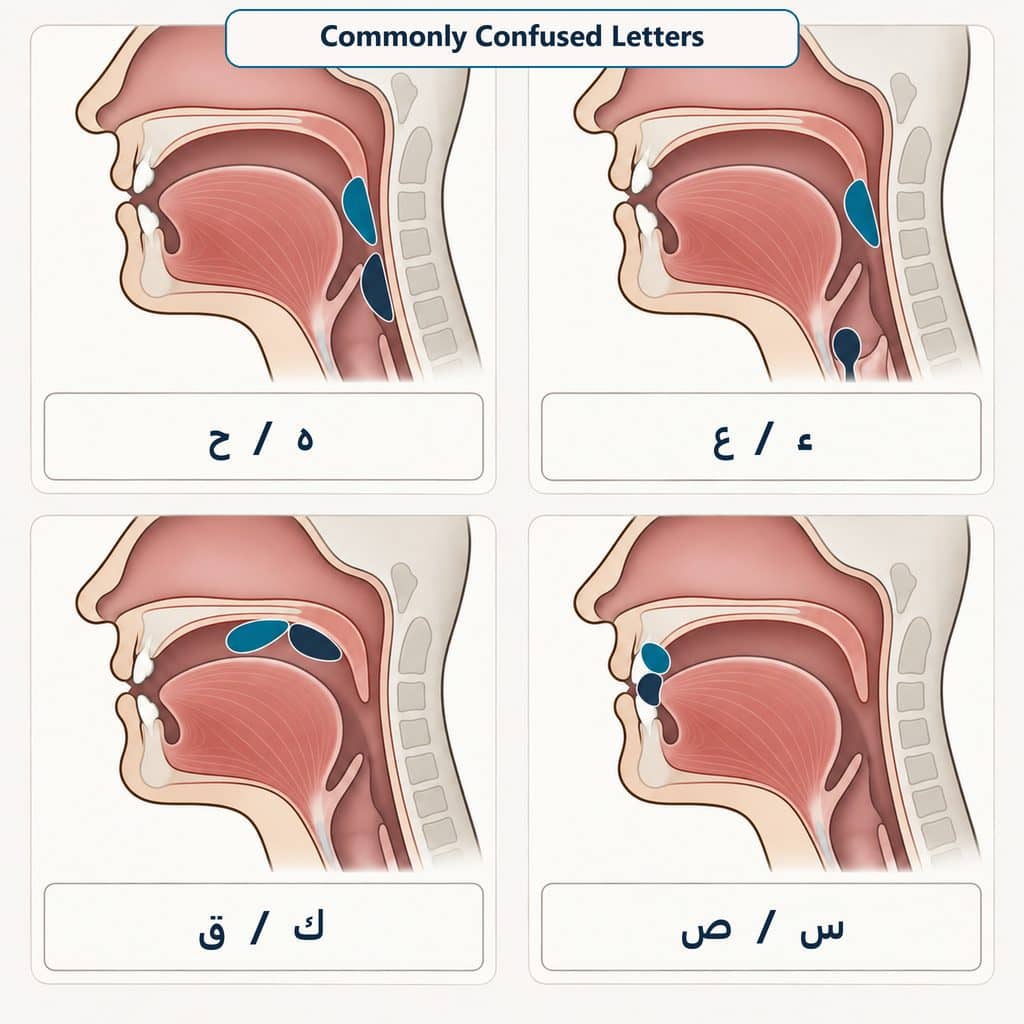
The ق and ك contrast shows why location matters. One sound forms farther back than the other. The ح and ه contrast also shows why “h” is an inadequate teaching label. Transliteration can remind a learner of a letter, but transliteration cannot train the articulation point.
Start with one pair rather than rehearsing every difficult sound at once. Listen to a trusted model, produce each letter slowly, and ask for correction. Our pronunciation guide offers more context on how to pronounce the Quran in Arabic.
How Can You Find a Letter’s Makhraj?
A letter’s makhraj becomes easier to locate when the letter is made sakin after a moving hamzah. The place where the sound ends reveals the articulation point.
The Al-Jazariyyah commentary recommends making the target letter sakin or doubled, then placing a vowelled hamzah before the letter. Sukūn means the letter has no following short vowel. A doubled letter can make the stopping point even clearer.
For ب, say أَبْ slowly. The sound finishes where both lips meet. For ق, say أَقْ and notice the far-back tongue contact. For ف, say أَفْ and feel the inner lower lip approach the upper incisors.
Use a comfortable voice. Excess pressure can distort the sound and hide the natural point. A mirror helps with lips and front-tongue letters. A recording helps you compare repeated attempts. Neither tool can show every throat or tongue movement.
Beginners who are still learning letter shapes may benefit from a structured primer. A guide to learn Noorani Qaida online explains how letter recognition, joining, and foundational pronunciation fit together.
How Should You Practice Makharij Al Huroof?
Effective makharij practice moves from one controlled sound toward connected Quran recitation. Short, focused sessions make careful listening easier than rushed repetition across many letters.
Use the following five-step sequence for one target letter or one contrasting pair.
- Isolate the point. Make the target letter sakin after a vowelled hamzah. Notice where contact or constriction occurs.
- Listen and repeat. Use a trusted teacher or recording as the model. Repeat slowly without adding an unintended vowel.
- Compare a nearby letter. Alternate a pair such as ق and ك. Focus on one physical or sound difference.
- Apply the sound. Move from a syllable to a short word, then to a brief Quranic phrase containing the letter.
- Receive correction. Ask a qualified teacher to identify the exact error. Practice the corrected movement before increasing speed.
The sequence matters because connected recitation creates more demands than an isolated sound. A learner may pronounce ق clearly alone, then lose the far-back contact inside a word. Returning to a slower unit helps rebuild control.


Hekma Academy describes its teaching approach through adaptive progression, active engagement, and guided reflection. In a live one-to-one lesson, a tutor can hear the learner, model the sound, and adjust the next exercise. Readers can meet Hekma Academy’s tutors and review the academy’s published profiles before choosing a teacher.
Frequently Asked Questions
How many makharij are there in Tajweed?
The widely taught classification associated with Al-Khalil ibn Ahmad and selected by Ibn al-Jazari has 17 specific articulation points. Those points sit within five major regions. Other respected scholars counted 16 or 14 by grouping or excluding certain points. The physical distinctions between letters remain important across the counting systems.
What are the five main articulation areas?
The five areas are al-jawf, the open mouth and throat cavity; al-halq, the throat; al-lisan, the tongue; ash-shafatan, the two lips; and al-khayshum, the nasal passage. Those broad areas provide an easy framework for remembering the detailed points.
Why do some scholars count 14, 16, or 17 makharij?
The scholars grouped the articulation points differently. The 16-point view does not count al-jawf as an independent point. The 14-point view also combines the points of ل, ن, and ر, among other grouping choices. The 17-point system gives each of those distinctions a separate place in the teaching map.
What is the difference between makharij and Tajweed?
Makharij are one foundation within Tajweed. Makharij describe where letter sounds emerge. Tajweed also covers letter qualities, lengthening, nasalization, merging, concealment, stopping, starting, and other recitation rules. Learning the chart alone therefore does not complete Tajweed study.
Can you learn makharij without a teacher?
A chart, mirror, and reliable recording can build awareness. Self-study cannot always reveal subtle substitutions or excess pressure. Live correction is especially valuable for throat sounds, ض, ر, emphatic letters, and connected recitation. A patient teacher can identify the specific movement that needs adjustment.
Makharij become useful when the map turns into an audible distinction. Begin with one sound, practice at a measured pace, and welcome correction without embarrassment. If you would like personal feedback, start your free trial with Hekma Academy and experience live teaching before choosing a study plan.