

Tajweed rules help you pronounce Quranic letters accurately, control nasal sounds and vowel length, and know where to pause without disturbing the meaning. This beginner-friendly guide explains ten essential Tajweed rule families with clear Quran examples, transliteration, and practical cues for English-speaking learners. The goal is not to memorize every advanced branch at once. The goal is to recognize the main patterns, understand what each pattern changes, and practice each sound with heard correction.
Tajweed means giving each Quranic letter its proper articulation and characteristics. The science also explains what happens when letters meet during connected recitation. Quran 73:4 instructs the reciter to recite the Quran with measured recitation. Tajweed turns that careful approach into practical sound, timing, and stopping principles.
The science contains more detail than any single beginner article can hold. Some teachers count broad families, while others count every subtype. The ten entries below are therefore a beginner map, not a claim that Tajweed contains exactly ten rules.
| Rule family | Main trigger | What changes | Beginner example |
|---|---|---|---|
| Makharij and Sifaat | Every Arabic letter | Articulation and sound quality | قُلْ in 112:1 |
| Noon Sakinah and Tanween | Silent noon or an n ending | Clarity, merging, conversion, or concealment | أَنْعَمْتَ in 1:7 |
| Meem Sakinah | Silent meem | Lip clarity, merging, or concealment | تَرْمِيهِمْ بِحِجَارَةٍ in 105:4 |
| Ghunnah | Doubled noon or meem | Two-count nasal resonance | إِنَّا in 108:1 |
| Qalqalah | One of five letters with sukoon | Controlled release of the consonant | يَقْطَعُونَ in 2:27 |
| Madd | A long-vowel letter under set conditions | Measured vowel length | قَالُوا in 2:11 |
| Tafkheem and Tarqeeq | Letter identity and context | Heavy or light sound quality | صِرَاطَ in 1:6 |
| Sun and Moon Lam | The definite article ال | Lam merges or remains clear | الشَّمْسِ and الْقَمَرِ |
| Ra and Lam in Allah’s name | Nearby vowels and conditions | Contextual heaviness or lightness | رَبِّ and بِاللَّهِ |
| Waqf and Ibtida | A stop or restart | Ending, breath, and phrase meaning | Stopping on الْعَالَمِينَ |
The table helps you locate a rule. The sections below explain what to notice and how to begin practicing it.
1. Learn Makharij and Sifaat First
Makharij are the articulation points where Arabic letters are formed. Sifaat are the qualities that distinguish letters after the mouth reaches the correct position. Makharij answer “where?” Sifaat answer “how?”
The main articulation regions include the open mouth and throat cavity, the throat, the tongue, the lips, and the nasal passage. Within those broad regions, teachers identify more precise points. A learner does not need to memorize the entire map before practicing. A learner does need to understand that a small change in tongue or throat position produces a different Arabic letter.
Where each sound begins
Consider qaf ق and kaf ك. Both use the back of the tongue, but qaf is produced farther back. Kaf is produced slightly farther forward. The difference is physical, not merely a stronger version of the same English k sound.
English-speaking learners also meet sound contrasts absent from everyday English. A peer-reviewed acoustic study of Arabic emphatic consonants produced by English speakers found that learners maintain meaningful contrasts, while experience influences parts of their production. The practical lesson is simple. Careful listening helps, but targeted placement and feedback also matter.
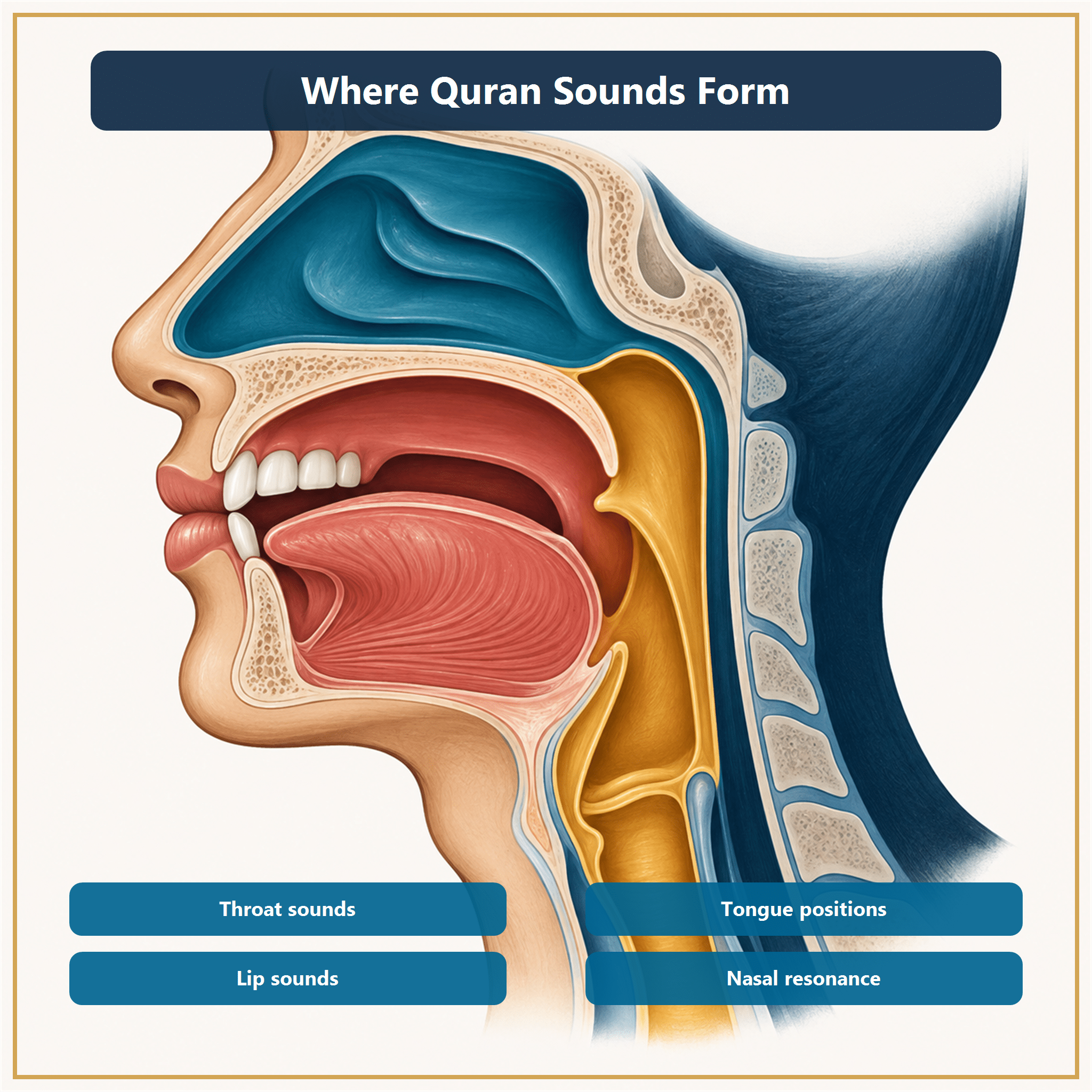
Quran example for Qaf and Kaf
Surah Al-Ikhlas begins with قُلْ هُوَ اللَّهُ أَحَدٌ (Qul huwa Allahu ahad). The qaf in قُلْ comes from the back of the tongue. Replacing qaf with kaf changes the Arabic sound and the word.
Practice the qaf slowly, then place the sound inside قُلْ. A mirror helps with visible lip and tongue movements, but a mirror cannot show every internal contact. Use Hekma Academy’s complete guide to Makharij al Huroof for the broader map, then ask a qualified teacher to hear the result.
2. Apply the Four Noon Sakinah and Tanween Rules
Noon Sakinah is a noon carrying sukoon, written نْ. Tanween is a doubled vowel ending that produces an n sound. The letter after noon or tanween determines one of four outcomes.
The four branches are easiest to learn as a decision:
- Izhar keeps the noon sound clear before the six throat letters
ء ه ع ح غ خ. - Idgham merges noon or tanween into one of the letters in
يرملون. - Iqlab changes the noon sound toward a hidden meem before
ب. - Ikhfa conceals the noon with Ghunnah before the remaining fifteen letters.
The four names matter less than the decision process. Find noon or tanween, look at the next letter, and then choose the correct sound behavior.
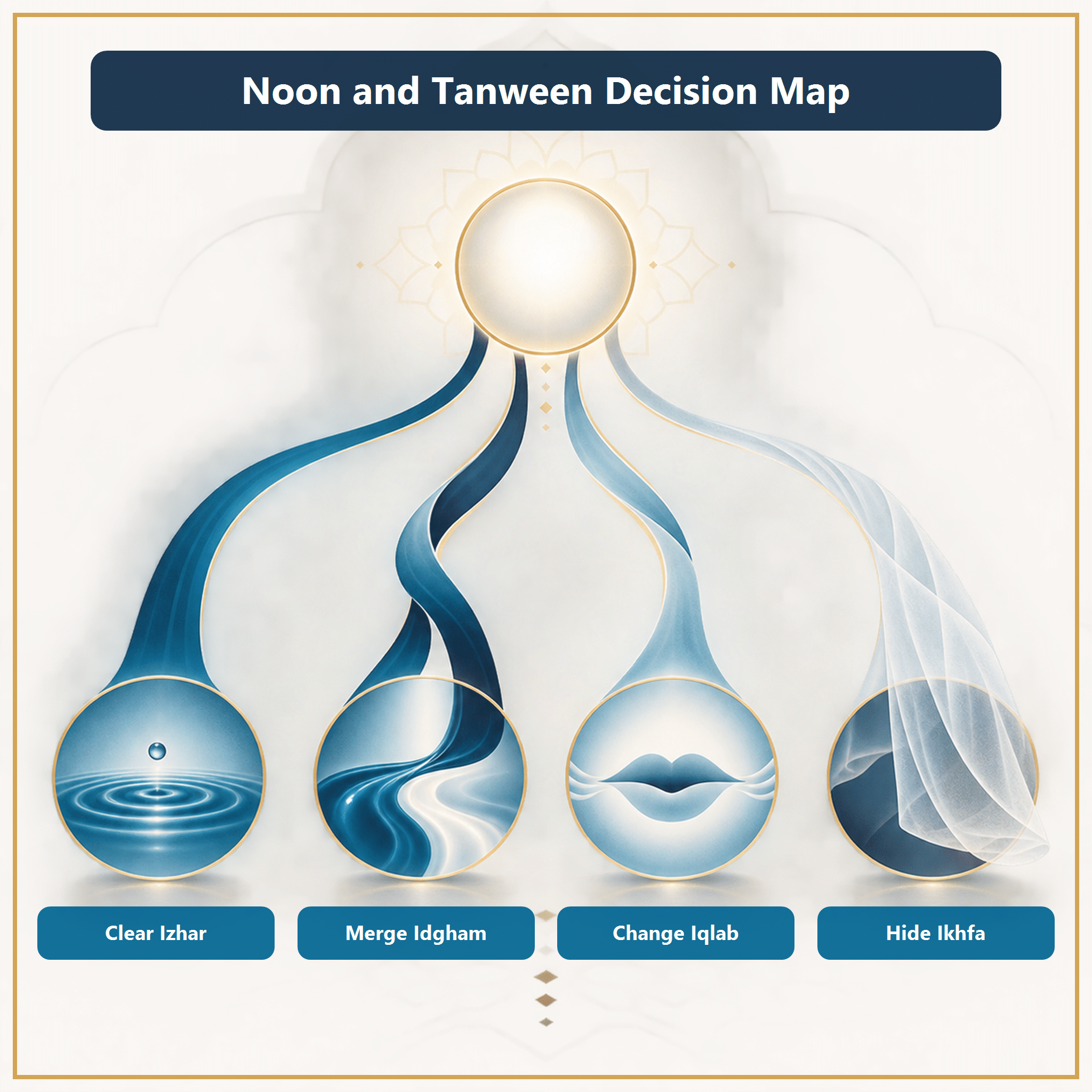
Izhar keeps the noon clear
In أَنْعَمْتَ (an'amta) from Al-Fatihah 1:7, the silent noon comes before ع. The letter ع is a throat letter, so the noon remains distinct. Do not merge the noon into the following sound.
Idgham merges the sound
In مِنْ يَعْمَلْ (min ya'mal) from An-Nisa 4:123, noon comes before ya. The noon merges with Ghunnah. In مِنْ رَبِّهِمْ (min rabbihim) from Al-Baqarah 2:5, noon comes before ra. The noon merges without Ghunnah.
That difference prevents a common mistake. Idgham does not always carry nasal resonance. Ya, noon, meem, and waw use Idgham with Ghunnah. Lam and ra use Idgham without Ghunnah.
Iqlab changes noon toward meem
In مِنْ بَعْدِ (min ba'di) from Al-Baqarah 2:27, noon comes before ba. The noon changes toward a concealed meem sound with Ghunnah. The lips prepare for ba without producing a fully separate meem syllable.
For more focused practice, use the beginner’s guide to Iqlab after learning the four-part map.
Ikhfa conceals the noon
In مِنْ شَرِّ (min sharri) from Al-Falaq 113:2, noon comes before sheen. The noon is neither fully clear nor completely merged. The tongue stays away from the usual noon contact point while nasal resonance continues for two counts.
Beginners sometimes call this sound Ikhfa Shafawi. That label belongs to silent meem before ba. Noon Sakinah and Tanween use Ikhfa Haqiqi.
3. Distinguish the Three Meem Sakinah Rules
Meem Sakinah is a meem carrying sukoon, written مْ. The rule depends on whether the next letter is meem, ba, or any other Arabic letter.
The three cases form a compact lip-based system:
- Before another meem, the two meems merge through Idgham Shafawi.
- Before ba, the silent meem is concealed through Ikhfa Shafawi.
- Before every other letter, the meem remains clear through Izhar Shafawi.
Each case changes how the lips close and release. The sound should remain controlled rather than exaggerated.
Merge before meem
In لَهُمْ مَا (lahum ma) from Az-Zumar 39:34, a silent meem meets another meem. The two sounds merge into a doubled meem with Ghunnah. Keep the nasal resonance even for two counts.
Conceal before ba
In تَرْمِيهِمْ بِحِجَارَةٍ (tarmihim bihijarah) from Al-Fil 105:4, the silent meem comes before ba. The lips prepare gently for ba while the concealed meem carries nasal resonance. Avoid pressing the lips together too early or creating a separate vowel.
Keep meem clear elsewhere
In عَلَيْهِمْ وَلَا (alayhim wa la) from Al-Fatihah 1:7, silent meem comes before waw. Close the lips fully for meem, then release into waw. Waw and fa require attention because their lip movements can tempt a learner to hide the meem.
4. Hold Ghunnah on Doubled Noon and Meem
Ghunnah is nasal resonance associated with noon and meem. A doubled noon نّ or doubled meem مّ carries a clear two-count Ghunnah. The sound resonates through the nasal passage while the letter keeps its proper articulation.
How Ghunnah should feel
A clean Ghunnah feels steady and proportionate. The two counts should follow the same pulse used elsewhere in the recitation. Avoid squeezing the nose, raising the volume, or turning the sound into an extra vowel.
Some earlier rules also use Ghunnah. Idgham with Ghunnah, Iqlab, Ikhfa Haqiqi, Idgham Shafawi, and Ikhfa Shafawi all include nasal resonance. The exact mouth position still depends on the surrounding letters.
Quran example for doubled noon
Surah Al-Kawthar 108:1 begins إِنَّا أَعْطَيْنَاكَ الْكَوْثَرَ (Inna a'taynaka al-kawthar). The doubled noon in إِنَّا receives a two-count Ghunnah. Hold the nasal sound evenly, then move into the following long vowel without adding a break.
5. Make Qalqalah Clear Without Adding a Vowel
Qalqalah is the controlled release of one of five letters when the letter carries sukoon. The letters are ق ط ب ج د, remembered through the phrase قُطْبُ جَدٍّ (qutbu jadd).
The English word “bounce” is often used as a teaching shortcut. The sound is not a free-standing echo. The articulators close for the consonant, pressure builds briefly, and the sound releases without a complete short vowel.
The five Qalqalah letters
Qalqalah appears when qaf, ta, ba, jeem, or dal is sakin. Sukoon can be written inside a word or created when a reciter stops at the end of a word. The release usually sounds clearer at a stop, especially when the final letter carries shaddah.
Quran examples in the middle and at a stop
In يَقْطَعُونَ (yaqta'una) from Al-Baqarah 2:27, the qaf carries sukoon inside the word. Release the qaf distinctly before moving to ta.
At the end of Al-Ikhlas 112:1, a reciter who stops on أَحَدٌ reads the final dal as sakin. The stopping form is أَحَدْ (ahad). The dal receives Qalqalah, but the release must not become ahada, ahadi, or ahadu.
Record both examples and listen for an accidental vowel. A teacher can identify whether the release is too weak, too forceful, or shaped like a new syllable.
6. Count Madd Without Guessing
Madd means lengthening a vowel sound. The three Madd letters are alif after fathah, silent waw after dammah, and silent ya after kasrah. The surrounding letters determine how long the sound continues.
Begin with the natural two-count Madd. Longer branches become easier once the two-count pulse is stable.
| Madd type | Trigger | Common Hafs count | Quran example |
|---|---|---|---|
| Madd Tabi’i | No hamzah or sukoon follows the Madd letter | 2 | قَالُوا in 2:11 |
| Madd Muttasil | Hamzah follows in the same word | 4 or 5 | جَاءَ in 110:1 |
| Madd Lazim | Permanent sukoon or shaddah follows | 6 | الضَّالِّينَ in 1:7 |
| Madd Arid lis-Sukun | A stop creates temporary sukoon | 2, 4, or 6 | الْعَالَمِينَ in 1:2 |
The table gives a common Hafs ‘an ‘Asim beginner framework. Detailed timing follows the learner’s authenticated recitation path and teacher.
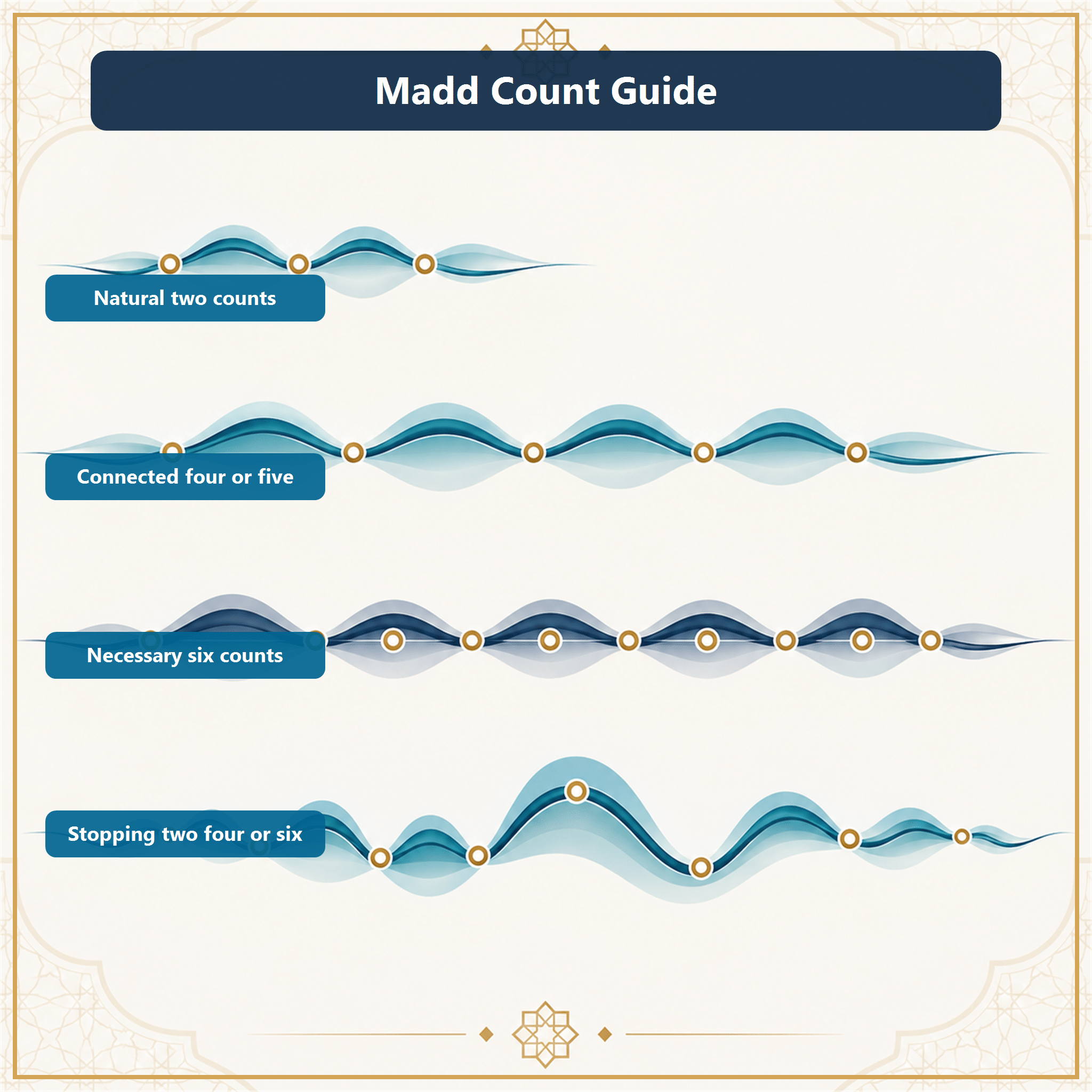
Begin with natural Madd
In قَالُوا (qalu) from Al-Baqarah 2:11, the alif and final waw provide natural lengthening. Each sound lasts two counts. A count should remain an even beat, not a hurried number spoken mentally.
Recognize connected and necessary Madd
In جَاءَ (ja'a) from An-Nasr 110:1, a Madd letter meets hamzah within the same word. The connected Madd lasts four or five counts in the common Hafs treatment.
In الضَّالِّينَ (ad-dallin) from Al-Fatihah 1:7, the Madd letter comes before a doubled lam. Madd Lazim lasts six counts. Keep the vowel stable throughout the extension.
Lengthen consistently when stopping
When stopping on الْعَالَمِينَ (al-'alamin) in Al-Fatihah 1:2, the final noon becomes sakin. The preceding long ya permits two, four, or six counts. Choose one accepted length and use the length consistently within the recitation.
Hekma Academy’s detailed guide to types of Madd explores more branches. Beginners should build a reliable pulse before adding a larger taxonomy.
7. Separate Heavy and Light Sounds
Tafkheem gives a letter a full, heavy quality. Tarqeeq gives a letter a light quality. Heaviness does not mean shouting or lowering the voice. The tongue position and the shape of the vocal tract change the resonance.
The seven consistently heavy letters
The seven Isti’la letters are خ ص ض غ ط ق ظ. A common mnemonic gathers the letters in خُصَّ ضَغْطٍ قِظْ. These letters retain heaviness, although the degree varies with their vowels and context.
Most other letters are normally light. Ra and the lam in Allah’s name require separate contextual rules, which appear in item 9.
A useful Saad and Seen contrast
In صِرَاطَ (sirata) from Al-Fatihah 1:6, sad has a heavy quality. The tongue body rises, and the sound influences the neighboring vowel. In سَبِّحِ (sabbih) from Al-A’la 87:1, seen remains light.
Practice the two letters in short syllables before using full verses. Keep the volume constant. If the only difference is loudness, the tongue and resonance probably need correction.
8. Recognize Sun and Moon Lam
The Arabic definite article is written ال. The lam is heard before moon letters and assimilated before sun letters. The written form stays recognizable, but the connected pronunciation changes.
Sun letters absorb the lam
Surah Ash-Shams 91:1 begins وَالشَّمْسِ (wash-shams). The definite article comes before sheen, a sun letter. The lam is not pronounced separately. The sheen carries shaddah and receives the doubled sound.
Look for the shaddah over the sun letter. The visual sign supports recognition, but the tongue must still produce the following letter correctly.
Moon letters keep the lam clear
The next verse contains وَالْقَمَرِ (wal-qamar) in Ash-Shams 91:2. Qaf is a moon letter, so the lam remains clear before qaf.
A beginner may pronounce every written lam or omit every lam after seeing repeated examples with sun letters. Practice the paired words الشَّمْس and الْقَمَر to hear the contrast directly.
9. Read Ra and the Lam in Allah’s Name by Context
Ra and the lam in Allah’s name are not always heavy. Nearby vowels and specific conditions determine whether the sound receives Tafkheem or Tarqeeq.
When Ra is heavy or light
As a beginner rule, ra is generally heavy with fathah or dammah and light with kasrah. In رَبِّ الْعَالَمِينَ (rabbi al-'alamin) from Al-Fatihah 1:2, ra carries fathah and sounds heavy.
In فِرْعَوْنَ (fir'awna) from Al-Baqarah 2:49, ra is sakin after kasrah and receives a light reading in the common Hafs ‘an ‘Asim treatment. Advanced exceptions need guided study because nearby letters and stopping conditions can change the result.
When the Lam in Allah is heavy or light
The lam in اللَّه is heavy after fathah or dammah. In a phrase such as قَالَ اللَّهُ (qala Allahu), the preceding fathah leads into a heavy lam.
The same lam is light after kasrah. In بِاللَّهِ (billahi), the kasrah before Allah’s name leads into a light lam. Do not make every occurrence heavy simply because the word is sacred. Tajweed follows the transmitted pronunciation rule.
Read the vowel immediately before the target letter, then decide the sound quality. Short paired drills help the ear and tongue learn the contextual change.
10. Stop and Restart Without Breaking the Meaning
Waqf means stopping during recitation. Ibtida means beginning or resuming. Good stopping supports breath, correct word endings, and coherent meaning. A stop should not be chosen only because the reciter has run out of air.
What changes when you stop
When a reciter stops on many words, the final short vowel is no longer pronounced. In connected reading, الْعَالَمِينَ (al-'alamina) in Al-Fatihah 1:2 carries its grammatical ending. At a stop, the final noon becomes sakin and the preceding Madd can be lengthened according to the rule explained earlier.
Mushaf stop signs guide the reader toward required, preferred, permissible, or unsuitable stopping choices. A short article cannot teach every symbol and exception. Learn the common signs with a teacher and connect each sign to the meaning of the phrase.
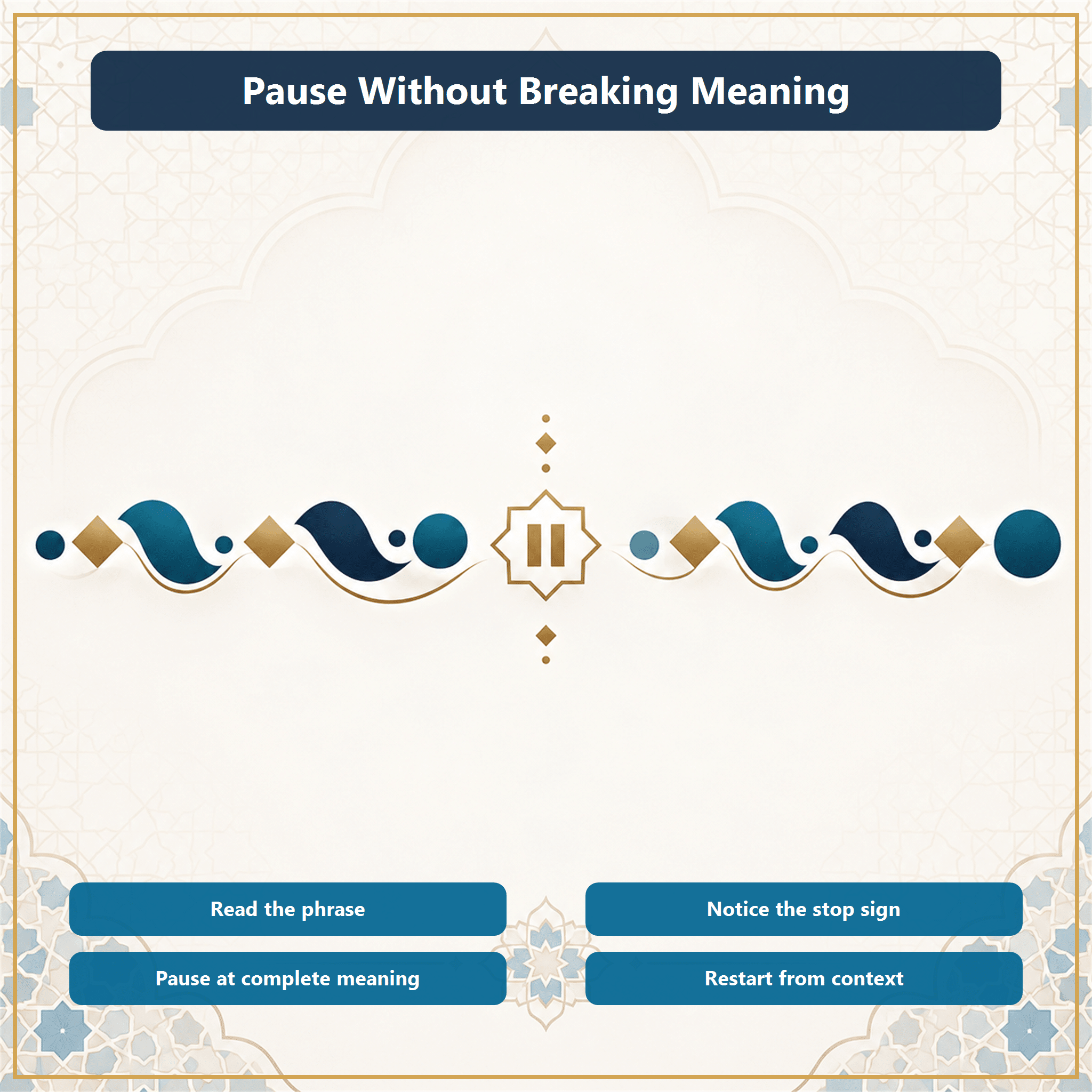
Restart from a meaningful place
A safe restart includes enough context to preserve the intended meaning. Restarting from an isolated word can leave a description, condition, or negation incomplete. Review the phrase before reciting again rather than automatically beginning from the word after the pause.
Breath planning reduces avoidable stops. Hekma Academy’s six steps to read Quran with Tajweed connects rule recognition with a practical recitation routine.
These ten Tajweed rule families move from individual letter production to connected sounds, measured timing, sound quality, and meaningful stopping. Start with one family, recognize the pattern on the page, and then practice a short example aloud. Written knowledge tells you what should happen. Heard feedback shows whether the sound actually happened.
If you want guided correction, explore Hekma Academy’s online Tajweed course. A tutor can listen to your current recitation, identify a suitable starting point, and guide focused practice at your level. You can also start your free trial before choosing a study plan.
Frequently Asked Questions
What are the basic rules of Tajweed?
The basic rule families include Makharij and Sifaat, Noon Sakinah and Tanween, Meem Sakinah, Ghunnah, Qalqalah, Madd, heavy and light sounds, sun and moon lam, contextual ra and lam, and stopping and starting. Teachers often divide those families into smaller subrules.
How many Tajweed rules are there?
Tajweed does not have one universally presented beginner count. Some curricula count broad families, while others count every subtype and exception. The ten families in this guide provide a practical foundation. Advanced study expands each family according to the learner’s recitation path and level.
Can I learn Tajweed without a teacher?
You can learn names, trigger letters, and written examples independently. Accurate application still benefits from a qualified teacher who hears the recitation. A learner may understand a rule correctly but remain unable to hear a misplaced tongue position, an uneven count, or an unintended vowel.
Which Tajweed rule should a beginner learn first?
Begin with Arabic letter articulation through Makharij and Sifaat. Correct connected rules cannot repair a letter formed from the wrong place. After establishing the main sounds, many beginner curricula move into Noon Sakinah and Tanween, Meem Sakinah, Ghunnah, Qalqalah, and natural Madd.
How long does it take to learn Tajweed?
The timeline depends on your starting point, practice consistency, target level, and access to feedback. Recognizing basic rules usually comes before applying them reliably in continuous recitation. Use steady progress and accurate correction as measures rather than expecting a universal completion date.