



Juz Amma memorization becomes easier to plan when you can see the whole journey, not just today’s verses. The Quran’s final juz contains 37 surahs, from An-Naba to An-Nas. Many learners begin at An-Nas and work backward, moving from familiar short chapters toward longer ones. Here are seven Quran memorization schedules at different paces. Each gives you surah checkpoints, a sample practice rhythm, and space to revise what you have already learned. Choose the plan your ordinary week can sustain.
Hifz means memorizing the Quran. Muraja’ah is the planned revision that helps you keep earlier passages. Tajweed covers the rules of correct recitation. A surah is a Quran chapter, and an ayah is a verse. Check the words and sounds with a capable teacher before repeating a new passage many times. Then test your memory without looking. Both new memorization and older review belong in every plan.
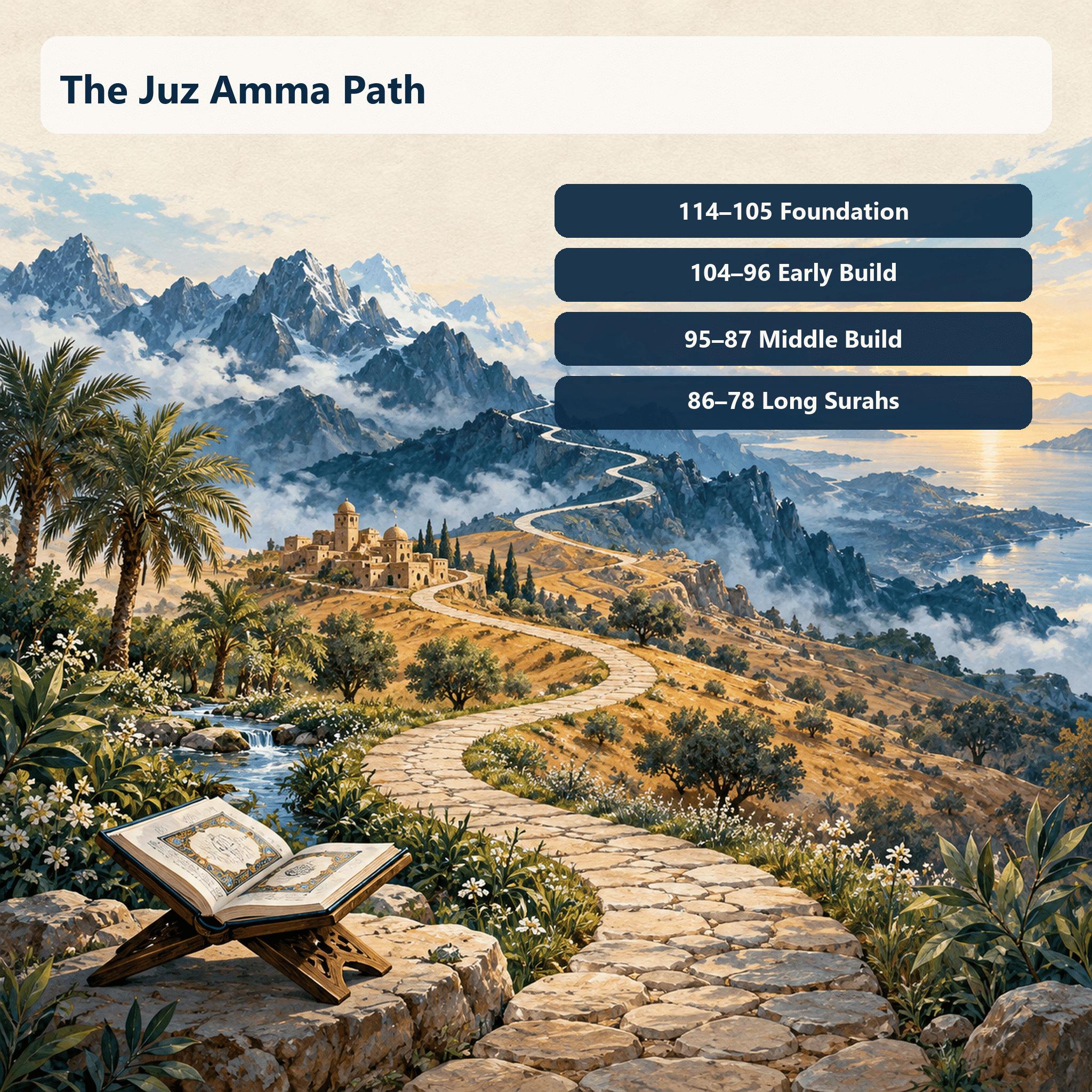
The Quran’s Juz 30 runs from Surah An-Naba (78) to Surah An-Nas (114). The schedules below teach in the opposite direction, starting at An-Nas. This is a practical learning order, not a required religious order. The four bands are planning aids created for this guide. They cover all 37 surahs exactly once: 114–105, 104–96, 95–87, and 86–78.
Use this comparison to choose a starting pace. Minutes describe a possible practice window, not a required daily target or a promise of completion.
| Schedule | Practice pattern | Starting session | First requirement |
|---|---|---|---|
| 40 weeks, gentle | Four short practice days and one review day | 10–15 minutes | Willingness to repeat small phrases with correction |
| 32 weeks, four-day | Three mixed days and one longer review day | 15–20 minutes | Four dependable practice days each week |
| 24 weeks, steady | Four mixed days and one review day | 20–25 minutes | A reliable five-day rhythm |
| 20 weeks, split-session | Two short windows on five days | 10–15 minutes per window | Two openings on most practice days |
| 16 weeks, focused | Six practice days, including a review-centered day | 25–35 minutes | Accurate reading and stable recall |
| 12 weeks, accelerated | Six substantial practice days and one review day | 35–45 minutes | Fluent reading and regular correction |
| 8 weeks, intensive | Six focused days and one review day | 45–60 minutes | Fluency, strong recall, and frequent feedback |
Here is the complete surah path behind each timetable. Each cell gives the number of weeks available for that band, not a number of surahs to rush through every week.
| Schedule | 114–105, An-Nas to Al-Fil | 104–96, Al-Humazah to Al-Alaq | 95–87, At-Tin to Al-A’la | 86–78, At-Tariq to An-Naba |
|---|---|---|---|---|
| 40 weeks | 7 | 7 | 10 | 16 |
| 32 weeks | 6 | 6 | 8 | 12 |
| 24 weeks | 4 | 4 | 6 | 10 |
| 20 weeks | 3 | 3 | 5 | 9 |
| 16 weeks | 2 | 3 | 4 | 7 |
| 12 weeks | 2 | 2 | 3 | 5 |
| 8 weeks | 1 | 1 | 2 | 4 |
The final band receives more time because its chapters are generally longer. Verse counts alone do not measure difficulty, however. A teacher can move a boundary or extend a band when pronunciation or recall needs attention. The aim is to retain what you learn, not to satisfy a calendar.
1. The 40-Week Gentle Juz Amma Schedule
Choose the gentle schedule when correct recitation and a calm habit need more room than a deadline. It suits a learner beginning with listening and short phrases. A parent supports a child’s practice between lessons. An adult rebuilding Arabic reading uses the same timetable without feeling behind. The pace is a starting point, not an age category.
Spend about seven weeks on An-Nas through Al-Fil, seven on Al-Humazah through Al-Alaq, ten on At-Tin through Al-A’la, and sixteen on At-Tariq through An-Naba. You do not have to finish one whole surah per session. Later chapters can be divided at meaningful stopping points that a teacher checks. Keep one Mushaf or recitation model consistent enough to notice corrections.
Across four short practice days, hear or read a small passage accurately before trying to retain it. Recite the new words aloud, then close the Mushaf and say them again. Return later to yesterday’s passage and one older surah. Use a fifth day for review alone. For a young child, a parent can listen, repeat together, and praise a careful attempt. For an adult, a short note about a difficult sound makes the next lesson more useful.
Beginning with familiar chapters helps learners experience a complete surah early. Our guide to short surahs to begin with explains their meanings and prayer context. The 40-week map still continues through all of Juz Amma, including the longer chapters near An-Naba.
If recall becomes uncertain, repeat the current week. Shorten the new portion before removing review. A missed week does not create a debt of verses to repay the following Monday. Return to the last passage you can recite securely, then continue.
2. The 32-Week Four-Day Juz Amma Schedule
The four-day schedule gives a complete Juz Amma plan to someone who cannot practice every day. Its strength is predictability. Four kept appointments serve you better than seven planned appointments that regularly collapse. Children may need shorter sessions and a parent nearby. Adults may spend a little more of each session checking their own recall.
Allocate six weeks each to the first two bands, eight to At-Tin through Al-A’la, and twelve to At-Tariq through An-Naba. Within a band, assign a small portion only after you can read or repeat it accurately. The longer final band needs more than a surah checklist. Mark verse ranges and the transition between them, especially when a long chapter cannot be learned in one sitting.
On the first two practice days, introduce new material after a quick recitation of recent work. Use the third day to connect passages and revisit an older surah. Make the fourth day a review and correction session. A tutor can listen for unclear vowels and letter sounds; a parent who does not know Tajweed can still keep the appointment and encourage the learner. Reserve the remaining days for life rather than pretending every open moment must become a lesson.
Learning research favors recalling material from memory and spreading practice over time. The review of effective learning techniques supports those general principles. It does not prescribe a four-day Quran timetable. The plan uses the principles as practical guidance while leaving religious recitation accuracy to qualified teaching.
When a session is missed, use the next new-material slot for review. Move the new assignment forward. If the weekly review reveals gaps, stay with the current surah until its opening, verse links, and ending are steady.
3. The 24-Week Steady Juz Amma Schedule
A dependable five-day rhythm makes this the middle schedule. It provides enough repetition for a school week or a predictable work week without requiring a long daily block. The plan fits a reader who can already practice a small new portion while preserving older material. If reading is still uncertain, start with a slower plan and use teacher feedback to build that foundation.
Give the first two bands four weeks each. Use six weeks for At-Tin through Al-A’la and ten for At-Tariq through An-Naba. That distribution leaves more room as chapters lengthen. At the start of every week, identify the exact next verse range and the older passages due for review. A surah boundary is a useful milestone, but the quality of recitation decides whether to move on.
Use three days for small new passages and recent review. On a fourth day, connect the week’s verses and rotate an older surah. The fifth day is for a longer recitation check or catch-up, with no new target if the earlier words are weak. A parent can listen to a child’s full recitation and note where help is needed. An adult can record a private practice attempt, then bring uncertain words to a teacher. Neither approach replaces correction from someone who can hear the Arabic accurately.
Our Quran memorization course offers live guidance for learners who want help shaping new Hifz and Muraja’ah around their level. We recommend asking a tutor to set the next portion after hearing your current recitation. A calendar cannot detect a changed vowel or a weak transition between ayat.
If a weekly check is shaky, keep the review day and repeat the assignment. Do not turn the next week into a double workload. The plan can take longer than 24 weeks without becoming a failed plan.
4. The 20-Week Split-Session Juz Amma Schedule
Choose split sessions when two short openings feel more dependable than one uninterrupted block. The first window introduces a small passage and reviews yesterday’s work. The second asks you to recite without looking and revisit older surahs. Separating those jobs makes recall visible instead of letting repeated reading feel like mastery.
The milestone map assigns three weeks each to An-Nas through Al-Fil and Al-Humazah through Al-Alaq. It then gives five weeks to At-Tin through Al-A’la and nine to At-Tariq through An-Naba. This pace assumes that the learner can already read with reasonable accuracy. A child might use a short after-school window and another after a rest. An adult might practice before work and revisit the passage in the evening. Choose times that actually repeat in your home.
For five practice days, start the first window by reciting the previous passage from memory. Read and correct the new portion, then memorize only as much as you can test. In the second window, recall the new portion, link it to the preceding verses, and recite an older surah. Keep a one-line note of a word or transition that needs correction. Use a weekly review-only period to decide whether the next portion is ready.
The split-session pattern is one way to arrange limited time. Our broader Quran memorization schedules show other daily and weekly structures if your available windows change. Keep the same Juz Amma surah sequence while adjusting the clock to fit reality.

When a second window disappears, use the first for review rather than adding untested new words. Move the new passage to the next day. A short, completed recall check matters more than a portion learned only by looking at the page.
5. The 16-Week Focused Juz Amma Schedule
The focused schedule needs reliable reading and stable recall. It is a useful next pace when you can recite the current portion, remember yesterday’s portion, and still make time for older surahs. A teen, adult, or child with a well-established routine might follow it. No age alone makes the pace suitable. Listen to what the learner can actually retain.
Use two weeks for An-Nas through Al-Fil, three for Al-Humazah through Al-Alaq, four for At-Tin through Al-A’la, and seven for At-Tariq through An-Naba. Six practice days a week provide room for new work and review. Plan roughly 25–35 minutes per session if that is comfortable. One of the six days should center on recitation from memory rather than adding verses.
Start by reading the new passage correctly. Divide a longer ayah into phrases where the meaning and stopping point permit, then join the phrases. Recite the passage without the Mushaf, check mistakes, and repeat the whole verse sequence. Revisit recent work and an older surah before closing. The order protects both accuracy and retention. More new verses are useful only if the earlier ones remain available when you need them.
Our guide to Quran memorization techniques explains active recall, careful repetition, and review in greater depth. Here the technique serves the Juz Amma timetable. A teacher judges whether a new portion is too large when long ayat or unfamiliar sounds make the week harder than the plan suggests.

If two checks in a row expose weak older passages, pause new material. Use the next sessions to repair the words and verse links. Extend the band rather than dragging weak memorization into the next one.
6. The 12-Week Accelerated Juz Amma Schedule
Twelve weeks is an accelerated example for a learner who already reads Quran accurately and can protect a longer study period most days. It is not a standard completion time. The real requirement is more than available minutes: you need to recall old material while learning new passages and to receive regular pronunciation feedback.
The first two bands receive two weeks each. At-Tin through Al-A’la receives three, and the nine surahs from At-Tariq to An-Naba receive five. This final block is where many tidy plans become unrealistic. Break longer chapters into exact verse ranges and check each connection before increasing the next assignment. A teacher may move more weeks into the final band or extend the whole timetable.
Six weekly sessions of about 35–45 minutes are one possible structure. Start each session with recent recitation from memory. Read and correct a new passage, memorize a small portion, and return later to recite it without looking. Rotate older surahs through the week. Make the seventh day review-only, including a longer recitation of what you learned recently. If a child follows this pace, keep attention and enjoyment under close observation; an adult should watch for the same fatigue and slipping recall.
Give special attention to similar openings and endings. A learner may know each verse in isolation but hesitate at the link to the next one. Note those links for the next teacher check. The goal is not only to reach Surah An-Naba. The goal is to recite earlier surahs correctly after the new work grows.
When review takes longer than expected, extend the current band. Keep the weekly recitation check and remove new work first. The revised finish date simply reflects honest learning.
7. The 8-Week Intensive Juz Amma Schedule
An eight-week plan answers the question of how to memorize Juz Amma fast, but it demands a strong starting point. Use it only when reading is fluent, prior surahs are secure, daily time is available, and a capable teacher can correct recitation frequently. The calendar is an ambitious example, never a promised result or a benchmark for a child or adult to meet.
Give one week to An-Nas through Al-Fil, one to Al-Humazah through Al-Alaq, two to At-Tin through Al-A’la, and four to At-Tariq through An-Naba. The first bands may feel quick because several chapters are brief or familiar. That early speed should not set the new-verse target for the longer final chapters. Divide those chapters into portions that still leave time to revise everything already learned.
Across six focused days, reserve perhaps 45–60 minutes or two shorter blocks. Begin by checking accurate recitation. Learn the new portion, then test it later without looking. Review recent passages every session and cycle through older surahs. Use the seventh day for a full review check. As the juz fills out, older material will claim more time. Reduce the new portion rather than squeezing the review block.
The fast route also needs a clear stop rule. If you repeatedly miss words, confuse similar verses, or cannot begin an older surah without prompting, pause new Hifz. Correct the reading and restore recall, then resume at a smaller portion. A longer, retained journey is more valuable than an eight-week finish followed by rapid forgetting.
Frequently Asked Questions
Which surah should I memorize first in Juz Amma?
Many learners begin with An-Nas, the Quran’s final surah, then work backward. Its short length and familiarity offer a manageable first milestone. A teacher may choose a different starting point if you already know An-Nas or need another surah for prayer. Check your recitation before repeating the words into memory.
How long does it take a child or adult to memorize Juz Amma?
There is no reliable duration based on age alone. Reading accuracy, available practice time, previous memorization, teacher access, and review load all matter. The schedules above range from 8 to 40 weeks as planning examples. Choose a pace by how well the learner remembers earlier surahs while new material is added, then adjust the finish date.
How can I memorize Juz Amma fast without forgetting it?
Start with correct recitation, test yourself without looking, and reserve time for both recent and older surahs. An intensive timetable works only while recall stays secure. If old surahs weaken, reduce new work and spend more sessions reviewing. Speed is useful only when the memorization remains available after the target week.
What should I do if I miss a week of my plan?
Begin with a recitation check of the last secure passage and the older surahs due for review. Resume new work only after those passages are stable. Move the next milestone forward instead of doubling the assignment. The schedule exists to support Hifz, so a missed week should change the calendar rather than erase your progress.
Do I need a teacher to memorize Juz Amma?
You can practice between lessons on your own, but a capable teacher is valuable for hearing pronunciation, Tajweed, and verse-link errors that a timetable cannot catch. A parent who is not confident in Arabic can still protect the child’s routine, listen, and encourage. Regular feedback helps the learner memorize accurate words from the beginning.
Choose the schedule that survives an ordinary week, then let your recall guide the next assignment. We recommend keeping new Hifz, recent revision, and older-surah review together throughout the journey. If you want a tutor to hear your recitation and help tailor the plan, start a trial with Hekma Academy.