

Hadith vs Sunnah is often explained as the difference between a report and a way of life. That summary helps, but it is not the whole picture. Scholars sometimes use both terms interchangeably and sometimes distinguish them according to context. This guide explains five practical differences, shows where the concepts overlap, and offers a safer way to understand Prophetic guidance.
The following table gives a starting point. Each row describes a common emphasis, not an absolute boundary between the two terms.
| Comparison point | Hadith | Sunnah |
|---|---|---|
| Meaning | A transmitted report | The Prophetic way or guidance |
| Main focus | What was narrated | What the Prophet ﷺ taught or exemplified |
| Preservation | Identifiable chains and texts | Reports, teaching, and established practice |
| Scholarly usage | Often a report studied for reliability | A source, method, path, or legal category |
| Scholarly task | Authentication | Interpretation and application |
The five sections below explain why these distinctions are useful and where they need qualification.
1. What Hadith and Sunnah Mean
Hadith commonly means a transmitted report attributed to Prophet Muhammad ﷺ. Sunnah commonly means his way, example, or normative guidance. The first term often highlights narration. The second often highlights the guidance known through that narration.
What Hadith commonly means
The Arabic word hadith can mean speech, communication, account, or report. In Islamic scholarship, a hadith usually reports something the Prophet ﷺ said, did, approved, or was described as doing.
A report is a particular piece of transmitted evidence. It may recount a statement, describe an act of worship, record a silent approval, or preserve a personal description. Readers often meet that evidence in a Hadith collection or its English translation.
Hadith is not the Quran. Muslims regard the Quran as the revealed word of Allah, while Prophetic Hadith reports convey information attributed to the Messenger ﷺ. The two sources are related, yet their wording, transmission, and place in Islamic study are not identical. A fuller guide to how Hadith and the Quran differ explains that relationship.
What Sunnah commonly means
The Arabic word sunnah carries the sense of a way, path, pattern, or practice. When Muslims speak about the Sunnah of Prophet Muhammad ﷺ, they usually mean his guiding example and teachings.
The Quran presents the Messenger of Allah as an excellent example for believers in Surah Al-Ahzab 33:21. Muslims therefore study his words, actions, judgments, approvals, worship, and character as guidance.
Sunnah does not only mean small recommended habits. In Islamic legal theory, the word can refer broadly to Prophetic authority as a source of religious guidance. In Fiqh, the same word can have the narrower meaning of a recommended act. The subject being discussed determines the definition.
Where the definitions overlap
The two concepts overlap because Hadith is a principal way of knowing Sunnah. A reliable report can preserve a Prophetic teaching or practice. Scholars may then discuss the same material as Hadith when examining transmission and as Sunnah when discussing guidance.
Some specialists also define both terms broadly enough to include reports of the Prophet’s words, actions, approvals, and qualities. In that setting, Hadith and Sunnah may function as synonyms.
A helpful scholarly shorthand describes Hadith as the narrative carrier and Sunnah as the Prophetic example conveyed through it. Mohammad Hashim Kamali presents this relationship while also noting that later technical usage often treated the terms as synonymous. His discussion in Principles of Islamic Jurisprudence shows why both similarity and distinction appear in reliable books.
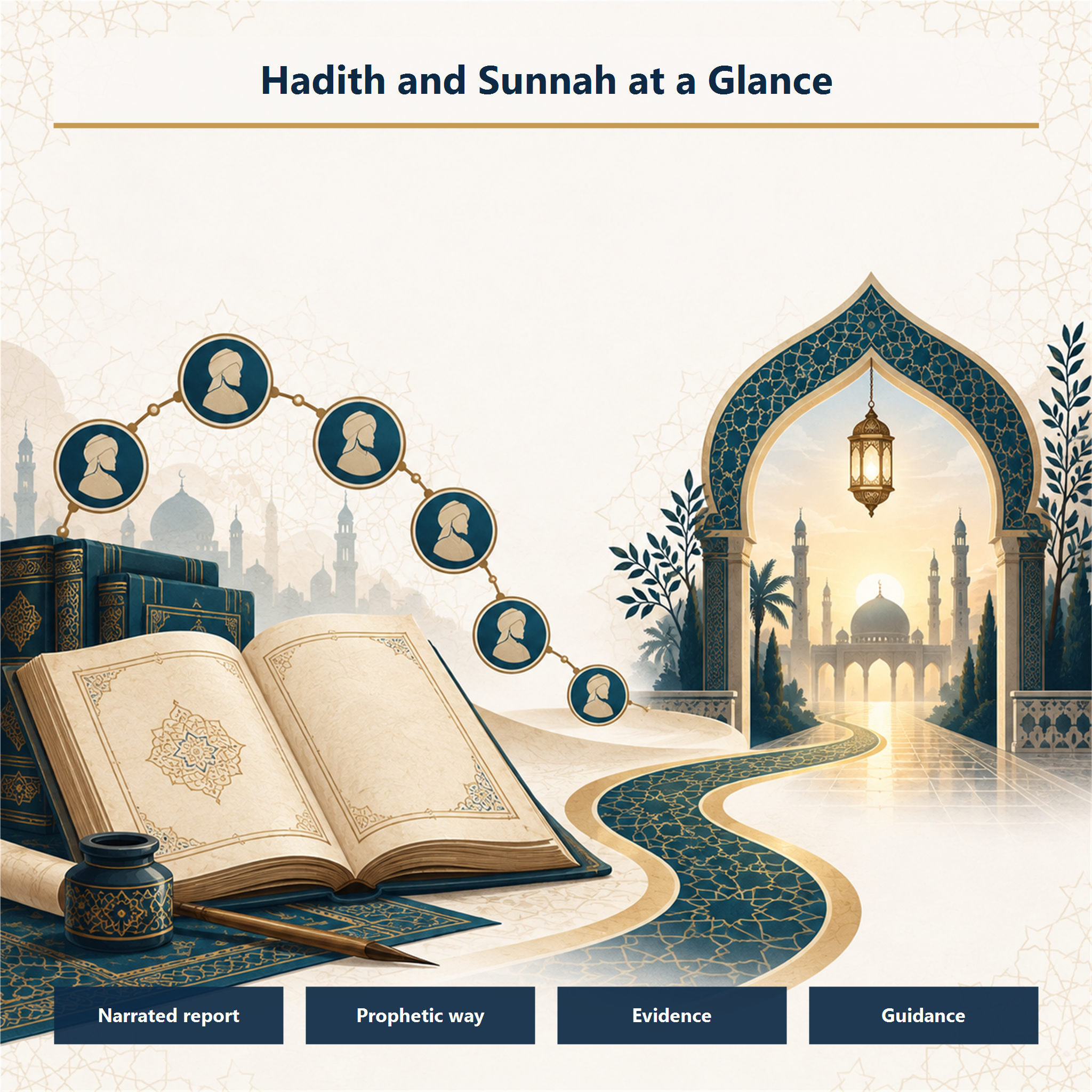
The simplest definition is therefore useful but limited. Hadith often names the report. Sunnah often names the Prophetic way known through reports. Neither statement should be turned into a rigid rule for every scholarly context.
2. Narrated Reports and Prophetic Practice
A hadith is normally encountered as a distinct narration. Sunnah points more broadly to the Prophetic teaching, pattern, or practice understood from reliable evidence. This difference separates a piece of evidence from the guidance scholars derive from it.
What a hadith contains
Most Hadith reports have two recognizable parts. The isnad is the chain of people who transmitted the report. The matn is the reported wording or content.
The chain tells scholars who received the account and passed it onward. The text tells scholars what the report attributes to the Prophet ﷺ or, in other categories, to a Companion or later authority.
A printed translation often places the text in the foreground. Hadith specialists look beyond that short presentation. They examine transmission routes, narrator reliability, wording, corroboration, and possible defects.
Hadith reports also differ by content. A narration may preserve:
- words attributed to the Prophet ﷺ;
- actions observed by a Companion;
- approval of an action performed in his presence;
- descriptions of his conduct, character, or appearance.
These categories explain why Hadith cannot be reduced to “sayings.” A single report may combine a statement, action, and surrounding circumstance.
How reports point toward Sunnah
The Sunnah becomes known chiefly through authenticated reports. A hadith about prayer, for example, may preserve an observed action. Related reports can clarify whether the action was repeated, explained, commanded, or linked to a special circumstance.
Scholars consider the body of evidence rather than treating every narration as an isolated instruction. Several reports may describe different parts of one practice. One report may be general, while another narrows its scope. An account of the Prophet’s regular practice may also help explain a brief statement.
This relationship is why learners benefit from understanding how scholars classify Hadith. Classification helps identify the kind and strength of evidence being considered. It does not by itself complete the work of interpretation.
Why description is not always instruction
A report can accurately describe an event without making every detail a general religious requirement. The Prophet ﷺ acted in several capacities, including as a messenger, judge, community leader, teacher, family member, and person living within a particular culture.
Scholars therefore ask what a report means in context. A narrated action may show an obligation, a recommendation, a permission, a personal preference, or a response to a particular situation. Wording and related evidence help establish the category.
For example, the fact that a report describes an action does not automatically mean every Muslim must copy each incidental feature. Jurists examine whether the Prophet ﷺ intended instruction, whether he repeated the practice, and how the Companions understood it.
Careful study avoids dismissing an unfamiliar report or treating a brief translation as a complete legal ruling.
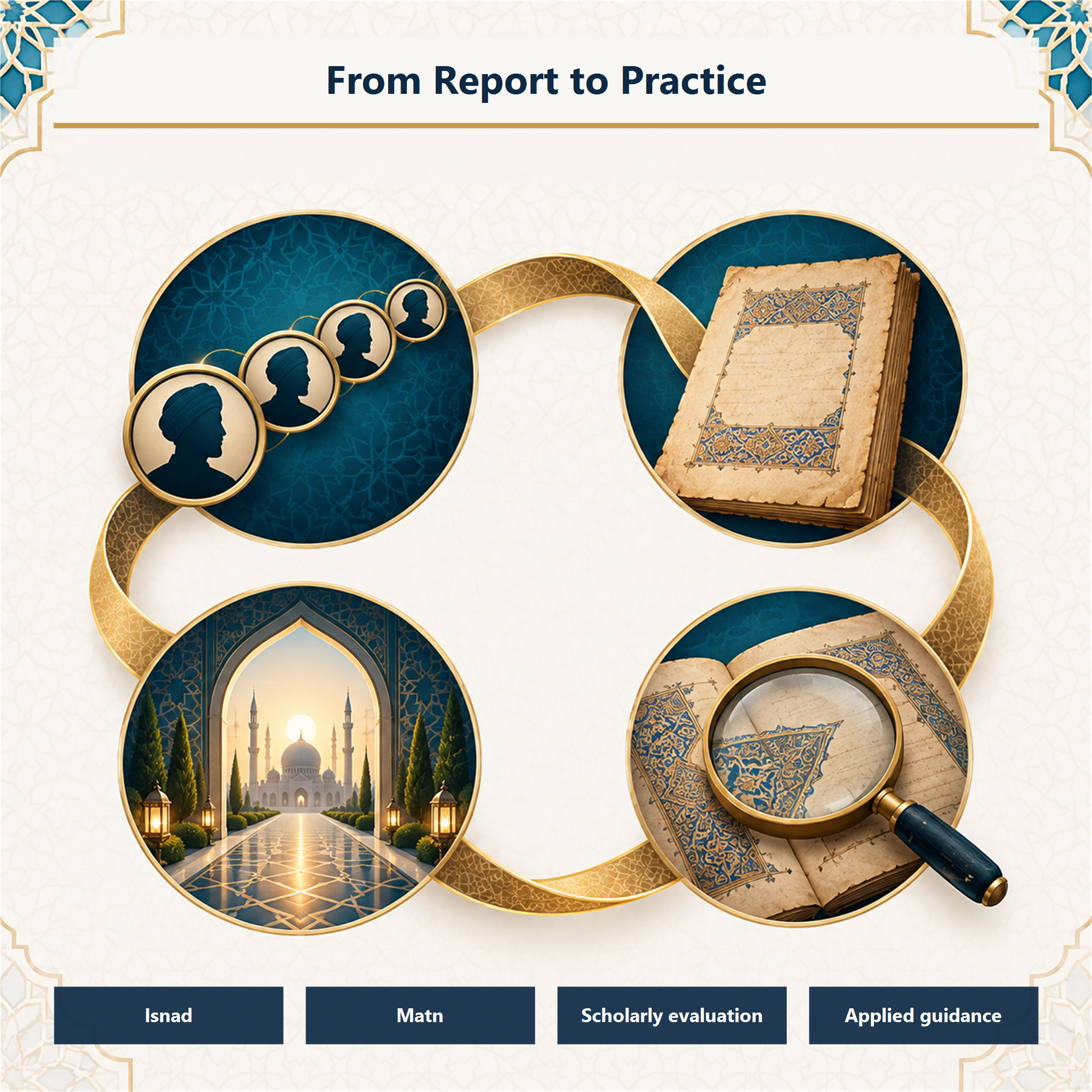
The report and the practice remain closely connected. Still, a unit of narration is not identical to every conclusion drawn from it. Hadith supplies evidence. Understanding Sunnah requires attention to the wider evidence and its meaning.
3. Preservation and Transmission
Hadith literature preserves identifiable reports through oral teaching, written records, chains, and organized collections. Sunnah was also learned through teaching and repeated practice. The phrase “Hadith is written, Sunnah is lived” captures only part of this history.
How Hadith reports were transmitted
The earliest Muslim community relied heavily on memorization and direct teaching. Writing also existed during the early period. Some Companions and students kept personal records, while teachers transmitted material in study circles and through direct authorization.
Later scholars gathered, compared, and arranged large bodies of reports. Collections could be organized by legal topic, narrator, or standards of authenticity. Written books strengthened preservation, but books did not replace teachers, chains, or critical comparison.
The isnad gave each report a traceable history for examination. Scholars compiled biographical information about transmitters. They compared when and where people lived, whether narrators could have met, and how different students reported the same material.
This development should not be described as a simple move from an entirely oral age to a much later written age. Oral and written methods overlapped. Early notebooks and smaller compilations existed before the major canonical collections took their familiar form.
How established practice supports understanding
Prophetic practice was also taught through imitation and community life. Prayer is the clearest example. Muslims learned its basic form through repeated teaching across generations, while Hadith reports preserved detailed words, actions, and explanations.
Communal practice does not make authenticated reports unnecessary. Reports remain central evidence for Prophetic guidance. Established practice can, however, help scholars understand how teachings were received and enacted.
Families can use the same integrated approach. Lessons that teach Quran, Hadith, Seerah, and worship together help children connect reports with belief, character, and practice. The narration then sits within a meaningful framework.
Why written versus lived is only shorthand
Calling Hadith “written” and Sunnah “lived” is easy to remember. The formula becomes misleading when treated as a complete definition.
Hadith was transmitted orally as well as in writing. Sunnah is recorded and discussed in written works as well as embodied through practice. A hadith can report a lived action, while a work of Fiqh can describe Sunnah in text.
The useful distinction concerns emphasis. Hadith scholarship often focuses on a report’s transmission and wording. Discussion of Sunnah often focuses on Prophetic guidance, authority, or application.
Muslims do not have one unrelated stream of books called Hadith and another independent stream of practice called Sunnah. Reports, teaching, interpretation, and community practice developed within a connected scholarly tradition.
4. Meanings Across Islamic Scholarship
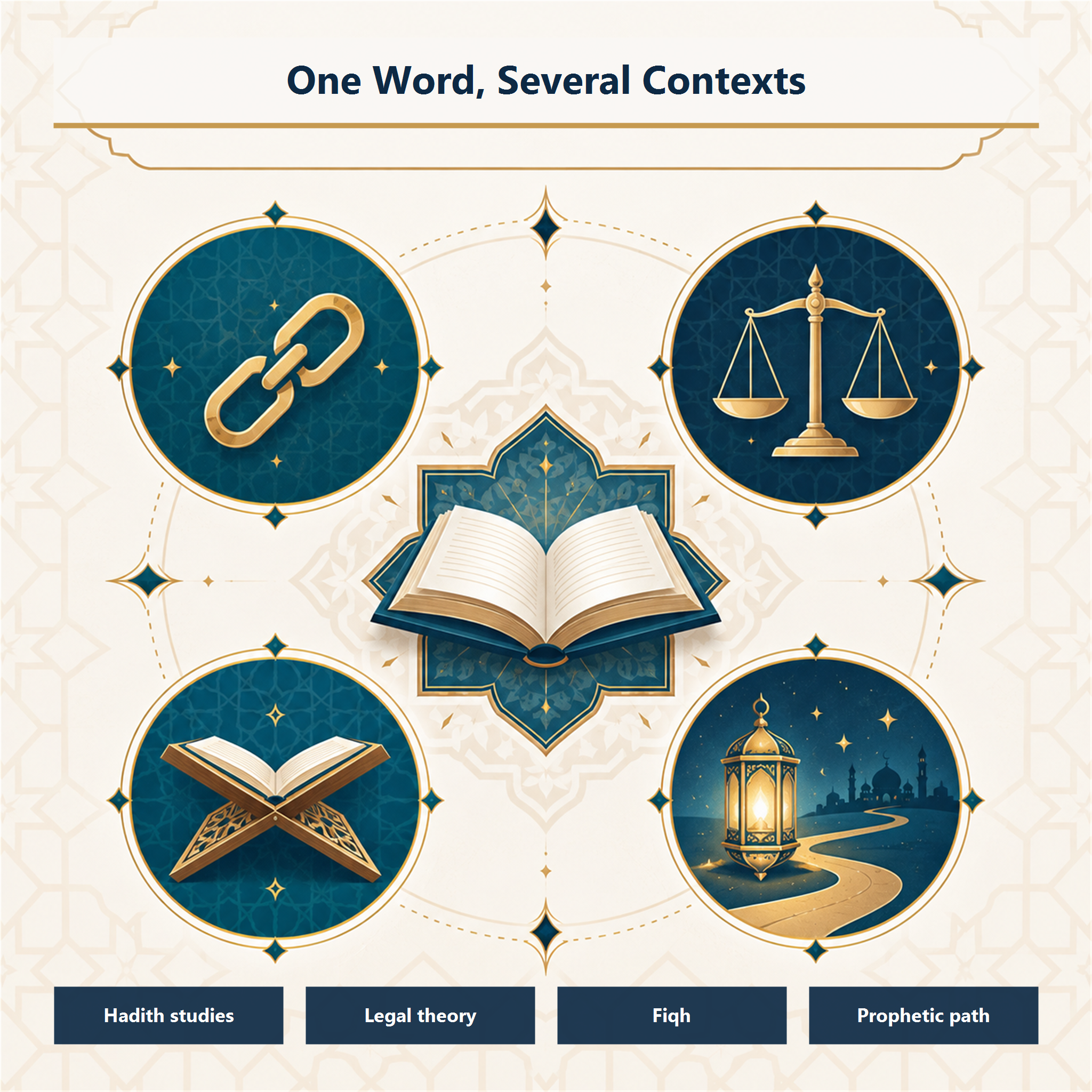
Scholarly fields use Hadith and Sunnah according to the questions they ask. Hadith studies emphasizes reports and reliability. Legal theory considers Prophetic authority. Fiqh classifies actions. Broader religious teaching can use Sunnah for the Prophetic path.
Hadith scholarship
Hadith specialists study transmitted reports. Their work includes collecting narrations, comparing routes, evaluating narrators, examining texts, and identifying subtle defects.
Within this field, Sunnah may be defined very broadly. The term can include what is reported about the Prophet’s words, actions, approvals, personal qualities, and life. Such a definition closely overlaps with Hadith.
The specialist’s main question is evidentiary: Can this report be reliably attributed to its stated source?
Islamic legal theory
Islamic legal theory, or usul al-fiqh, asks how revealed evidence supports legal judgments. In this field, Sunnah is an authoritative source alongside the Quran.
Legal theorists discuss how Sunnah explains general Quranic commands, specifies broad wording, establishes details, and provides guidance on matters not stated in the same detail in the Quran. They also study commands, prohibitions, general language, exceptions, and conflicting evidence.
Here, Sunnah is not merely a label for optional deeds. Prophetic evidence can help establish many legal values, including obligation, prohibition, recommendation, dislike, and permission.
Fiqh and the recommended Sunnah
Fiqh means Islamic jurisprudence. Jurists classify human actions and explain practical rulings. In this setting, “Sunnah” often describes an act that is recommended rather than obligatory.
A recommended Sunnah is rewarded when performed, but leaving it does not carry the same legal consequence as abandoning an obligation. Jurists may use related terms with different nuances across schools of law.
This narrower definition often appears in everyday questions. Someone may ask whether a prayer action is obligatory or Sunnah. The question concerns legal classification, not the entire authority of the Prophetic tradition.
The difference becomes clear in two sentences:
- “The Sunnah is a source of Islamic law” uses the broad legal-theory meaning.
- “This act is Sunnah” often uses the narrower Fiqh meaning of recommended.
Both sentences can be correct. Each belongs to a different discussion.
Sunnah as the Prophetic path
Creed, ethics, and general religious teaching can use Sunnah for adherence to the Prophet’s path. In some works, the term appears as the opposite of religious innovation. This usage can cover belief, worship, conduct, and communal principles.
The word therefore carries a family of related meanings. Confusion often disappears once the reader identifies the field. A Hadith scholar, legal theorist, jurist, and general teacher may emphasize different aspects without contradicting one another.
Beginners do not need to master every discipline at once. They do need a structured foundation and teachers who explain terminology in context. Hekma Academy’s New Muslim Course brings core beliefs and practices into one guided learning path.
When a definition seems inconsistent, ask three simple questions. What subject is being discussed? What problem is the scholar trying to solve? Is Sunnah being used for Prophetic evidence, recommended conduct, or the broader religious path? Those questions usually reveal the intended meaning.
5. Authentication and Application
Authentication asks whether a report is reliably attributed to its source. Application asks what the accepted evidence means and how it guides belief or practice. A sahih label is important, but it is not the final interpretive step.
How a report is evaluated
Hadith criticism examines both transmission and content. Scholars study whether the chain is connected, whether narrators are trustworthy and precise, and whether stronger evidence reveals a contradiction or hidden defect.
Common grades include sahih for sound, hasan for good, and da’if for weak. These labels summarize scholarly judgments, but the full analysis can be more detailed. Scholars may disagree because they assess a transmitter, route, wording, or supporting evidence differently.
Textual analysis is also broader than asking whether a report appears to conflict with the Quran. Specialists compare versions, language, historical circumstances, established principles, and other evidence. A hidden defect may emerge only after many transmission routes are placed side by side.
Authentication answers a crucial question: How strong is the attribution? The answer helps determine how the report can be used. It does not automatically state the report’s legal category or scope.
Why authenticity is not the final step
An authentic report may convey an obligation, recommendation, permission, personal habit, or circumstance-specific judgment. Scholars examine the wording and related evidence before selecting among those possibilities.
They may ask whether a command was general or directed to one person. They consider whether another report supplies an exception. They also ask whether the Prophet ﷺ acted in a legislative capacity or followed an ordinary custom.
Different authentic reports can appear to point in different directions. Jurists may reconcile them by identifying separate situations, chronological order, or levels of preference. They can also disagree about which legal principle best explains the combined evidence.
Weak reports require care too. It is inaccurate to say that only sahih reports have ever been considered in Islamic law. Scholars have discussed conditions for using different grades and have varied in their methods. A beginner should not convert a grade into a ruling without understanding that framework.
A beginner-safe reading method
A responsible reading process moves from verification to interpretation. These four steps provide a practical sequence:
- Verify the source. Find the named collection, full wording, and report reference when available. An unattributed quotation should not be treated as confirmed Prophetic speech.
- Check the grading. Look for a qualified scholarly assessment. Note whether recognized specialists differ and whether the translation reports that difference.
- Read the context. Review the surrounding chapter, related Quranic passages, other narrations, and the historical setting.
- Seek informed application. Consult reliable commentary or a qualified teacher before drawing personal rulings, especially in worship, family matters, or lawful and unlawful conduct.

The process does not require every Muslim to become a Hadith critic or jurist. It teaches intellectual patience.
Translation deserves attention as well. One English word may not capture the grammatical, legal, or cultural range of an Arabic term. Commentary can explain a phrase, connect it to related evidence, and show why jurists reached different conclusions.
Social media makes these habits especially valuable. A polished image can omit the source, grading, or surrounding circumstances. Verification reflects the care Muslim scholars developed to protect Prophetic teaching.
The clearest summary is simple. Hadith commonly refers to the transmitted evidence, while Sunnah commonly refers to the Prophetic way and guidance known through that evidence. The terms sometimes overlap because scholars use them for different purposes.
When definitions seem inconsistent, identify the writer’s field before assuming a contradiction. When a report raises a practical question, move from source and grading to context and qualified explanation.
Beginners who want these ideas explained within a wider Islamic foundation can experience live Islamic guidance through a free trial. A teacher can help connect unfamiliar terms with worship, belief, and daily life at a manageable pace.
Frequently Asked Questions
Are Hadith and Sunnah the same thing?
They can be synonymous in some scholarly contexts. A useful general distinction treats Hadith as transmitted reports and Sunnah as the Prophet’s established guidance or example. The intended meaning depends on the subject and the scholar’s purpose.
What is the simplest difference between Hadith and Sunnah?
Hadith is commonly the narrated evidence about Prophet Muhammad ﷺ. Sunnah is commonly the Prophetic way understood through reliable evidence. “Report and guidance” is a helpful beginner summary, but the boundary is not absolute.
Is every authentic hadith part of the Sunnah?
An authentic Prophetic report is evidence about the Sunnah, but authenticity alone does not define its application. The report may describe an obligation, recommendation, permission, personal habit, or special circumstance. Scholars interpret its scope through related evidence.
Does Sunnah always mean recommended?
No. Fiqh often uses Sunnah for a recommended act. Islamic legal theory uses Sunnah more broadly for authoritative Prophetic guidance. Creed and general religious writing may use the term for the Prophetic path.
How should a beginner study Hadith and Sunnah?
Start with a structured introduction taught by a reliable teacher. Learn basic terms, verify sources, read complete passages, and use recognized commentary. Avoid building beliefs or rulings from isolated translations or unattributed social posts.